Daily brief · November 18, 2026

The agentic stack becomes measurable end to end.

Ten verified developments across frontier models, coding agents, review security, event-driven workflows, PostgreSQL, Arm compute and AI governance.

18 minute read10 developmentsPrimary sources first
01
AI & Models8 min read

OpenAI releases GPT-6.2 Astra and Sol across ChatGPT Work, Codex and the API

OpenAI released GPT-6.2 Astra for complex professional and technical work and GPT-6.2 Sol as a lower-cost general model. Both accept text and images in the API and add stronger coding, computer-use and cybersecurity capabilities. OpenAI prices Astra at $8 per million input tokens and $40 per million output tokens—20% below GPT-6 Astra—and says both models cross its Critical cyber threshold; its benchmark and efficiency comparisons are company-reported.

Why it mattersThe release changes both model quality and the unit economics of long-running coding and tool-use workloads, but capability gains arrive with higher dual-use risk. Teams should rerun task, safety, latency and total-cost evaluations on the exact harness, keep prompt prefixes stable where caching matters, and preserve independent authorization around every external action.
Read the updated agent harness architecture guide

Source: OpenAI release and GPT-6.2 system card ↗ · Published November 17, 2026

#GPT-6.2#foundation models#Codex#model safety
02
AI Coding7 min read

Microsoft launches MAI Code 2 models and previews Cyber 2

Microsoft introduced MAI Code 2 for deep debugging, multi-file implementation and repository reasoning, plus Code 2 Flash for faster routine edits. Both are generally available in GitHub Copilot and Microsoft Foundry. It also introduced Cyber 2 Flash for security work through Microsoft Perception; broader Cyber 2 access remains limited. Microsoft says its models deliver frontier-level results at lower cost, a claim corroborated as an announcement by Reuters but not independently validated on customer workloads.

Why it mattersCoding platforms are adding task-specialized models instead of relying on a single general model. Engineering leaders should compare the two coding tiers against real repositories, review usage-based billing and enterprise model policy, and treat the cyber model as a restricted security tool whose authority must stay outside the model.

Source: Microsoft Ignite announcement and GitHub Changelog, corroborated by Reuters ↗ · Published November 17, 2026

#MAI Code 2#coding models#GitHub Copilot#MAI Cyber 2
03
Security7 min read

GitHub makes Copilot code review adaptive and adds secret detection

GitHub put Adaptive review effort, public cross-repository context and secret detection into public preview for Copilot code review. Adaptive selects Lite, Balanced or Max within administrator-set limits; secret checks combine more than 500 provider patterns with GitHub's purpose-built detection model. Copilot review for Azure Repos is now generally available, and repository insights can show how teams respond to review feedback.

Why it mattersReview depth, repository scope and credential detection are becoming programmable controls in the pull-request path. Teams should cap the maximum effort centrally, opt in deliberately, test false positives and missed secrets, restrict cross-repository context, and measure whether findings change merge outcomes rather than counting review comments.

Source: GitHub Changelog ↗ · Published November 17, 2026

#Copilot code review#secret scanning#AppSec#Azure Repos
04
Software Engineering7 min read

Azure HorizonDB reaches general availability as Fabric HorizonDB enters preview

Microsoft made Azure HorizonDB generally available as a managed PostgreSQL-compatible service for mission-critical applications, with integrated vector indexing and Microsoft Foundry connectivity. Fabric HorizonDB entered public preview as a serverless PostgreSQL experience inside Microsoft Fabric, intended to reduce movement between operational data, analytics and AI. Performance and simplicity claims remain Microsoft's and should be validated against production workloads.

Why it mattersPostgreSQL-compatible operational data, vector retrieval and analytics are converging behind one cloud control plane. Database teams should test extension and protocol compatibility, migration and rollback, recovery objectives, vector-index behavior, regional availability, cost and the operational consequences of tighter Fabric coupling.

Source: Microsoft Azure Blog and HorizonDB product documentation ↗ · Published November 17, 2026

#Azure HorizonDB#PostgreSQL#Microsoft Fabric#vector search
05
Cloud & Infrastructure6 min read

Azure Cobalt 200 Arm virtual machines become generally available

Microsoft made Cobalt 200-based virtual machines generally available in 14 Azure regions, with 23 planned by year-end. The company reports up to 50% higher overall performance than Cobalt 100, with workload-specific gains for web serving, Java, agent tool execution and databases. Those figures are Microsoft benchmarks; several customers separately reported higher throughput or lower latency on their own workloads.

Why it mattersAgent systems spend substantial time outside the model on search, compilation, sandbox execution and databases, so CPU price-performance can move total inference economics. Platform teams should benchmark their own Arm-ready services, container images, native dependencies and tail latency before migrating or using vendor maxima for capacity planning.

Source: Microsoft Azure Blog and VM deployment documentation ↗ · Published November 17, 2026

#Azure Cobalt 200#Arm#cloud compute#agent infrastructure
06
AI Coding6 min read

GitHub opens Copilot Evals for repeatable agent customization tests

GitHub released Copilot Evals in public preview for Copilot Individual, Business and Enterprise plans. Developers can define realistic tasks and checks for a skill, custom agent or MCP tool, approve local runs, inspect failures and compare results before and after a change. The feature uses GitHub's extensible Vally evaluation engine and is available through VS Code, Copilot CLI and the Copilot app.

Why it mattersSkills, prompts and tools can now be regression-tested where developers already configure their coding agents. Teams should store eval definitions with source, use representative repositories, pin model and tool versions, retain run evidence and keep human review for checks that cannot be judged reliably by automation.
See the evaluation and control-plane guidance

Source: GitHub Changelog ↗ · Published November 17, 2026

#Copilot Evals#agent evaluation#MCP#developer tools
07
Software Engineering6 min read

GitHub previews Event Streams for agent coordination without polling

GitHub introduced Event Streams in waitlisted preview on all plans. An agent can subscribe to a pull request over a persistent connection and receive review, commit, merge-conflict, check-suite and closure events without hosting a public webhook endpoint. GitHub positions the feature as a way to reduce polling delay, rate-limit use and wasted tokens for laptop and automation workflows.

Why it mattersEvent-driven coordination changes the default architecture for agents that wait on code review or CI. Implementations still need reconnect and replay logic, deduplication, checkpointed subscriptions, authorization and a bounded fallback when the stream is unavailable; a persistent connection is not a durable queue by itself.
Read the updated event-driven agent guidance

Source: GitHub Changelog ↗ · Published November 17, 2026

#GitHub Event Streams#event-driven agents#pull requests#automation
08
AI & Models6 min read

Microsoft launches an AI Transparency Initiative with more than 40 organizations

Microsoft announced an AI Transparency Initiative with more than 40 organizations to pursue a common approach to evidence, accountability and verification across models and agents. It plans to expand work with NIST's SI Agent Standards Initiative and incorporate resulting evidence into Microsoft AI, Foundry and Copilot. The effort is an announced collaboration, not yet a finished standard or compliance regime.

Why it mattersEnterprise agents can be observed at their inputs and outputs while the reasoning that produced an action remains difficult to verify independently. Engineering and governance teams should follow the standards work, but meanwhile retain external traces, tool authorization, data-access evidence and reproducible evaluations rather than relying on a model's self-report.
Read the independent-evidence architecture guide

Source: Microsoft Source ↗ · Published November 17, 2026

#AI transparency#NIST#agent governance#audit evidence
09
Security7 min read

Microsoft makes its Perception agentic security system generally available

Microsoft made Perception generally available as an agentic security system that coordinates red-team, blue-team and remediation agents through playbooks. It connects signals and actions across Defender, Entra, Intune, Purview, Sentinel, endpoints, networks and cloud controls, while specialized Cyber 2 models remain subject to limited access. Microsoft describes the capabilities and coverage; customers still need to validate outcomes in their own estate.

Why it mattersSecurity automation is moving from recommendations to coordinated containment and remediation. Defenders should begin with narrow playbooks, least-privilege actuator identities, approval thresholds, immutable traces and rollback drills, and should measure false containment and recovery impact before enabling autonomous action broadly.

Source: Microsoft Security Blog ↗ · Published November 17, 2026

#Microsoft Perception#agentic security#Microsoft Defender#security automation
10
AI Coding6 min read

GitHub Copilot app adds browser use and broader enterprise repository access

GitHub's Copilot app now supports Azure DevOps repositories in public preview, GitHub Enterprise Server generally, and browser use in public preview through an extension for Chromium-based browsers. Browser use is off by default and runs in an isolated tab group; Azure DevOps sessions can create branches, change code and open pull requests, but do not support cloud sessions.

Why it mattersA coding agent can now cross from repository work into an authenticated browser session, expanding both usefulness and blast radius. Administrators should keep browser use opt-in, separate identities and profiles, constrain permission levels, test tab isolation and require review before forms, merges or other externally visible actions.

Source: GitHub Changelog ↗ · Published November 17, 2026

#GitHub Copilot app#browser use#Azure DevOps#GitHub Enterprise Server

Shareable visual

Poster of the Day

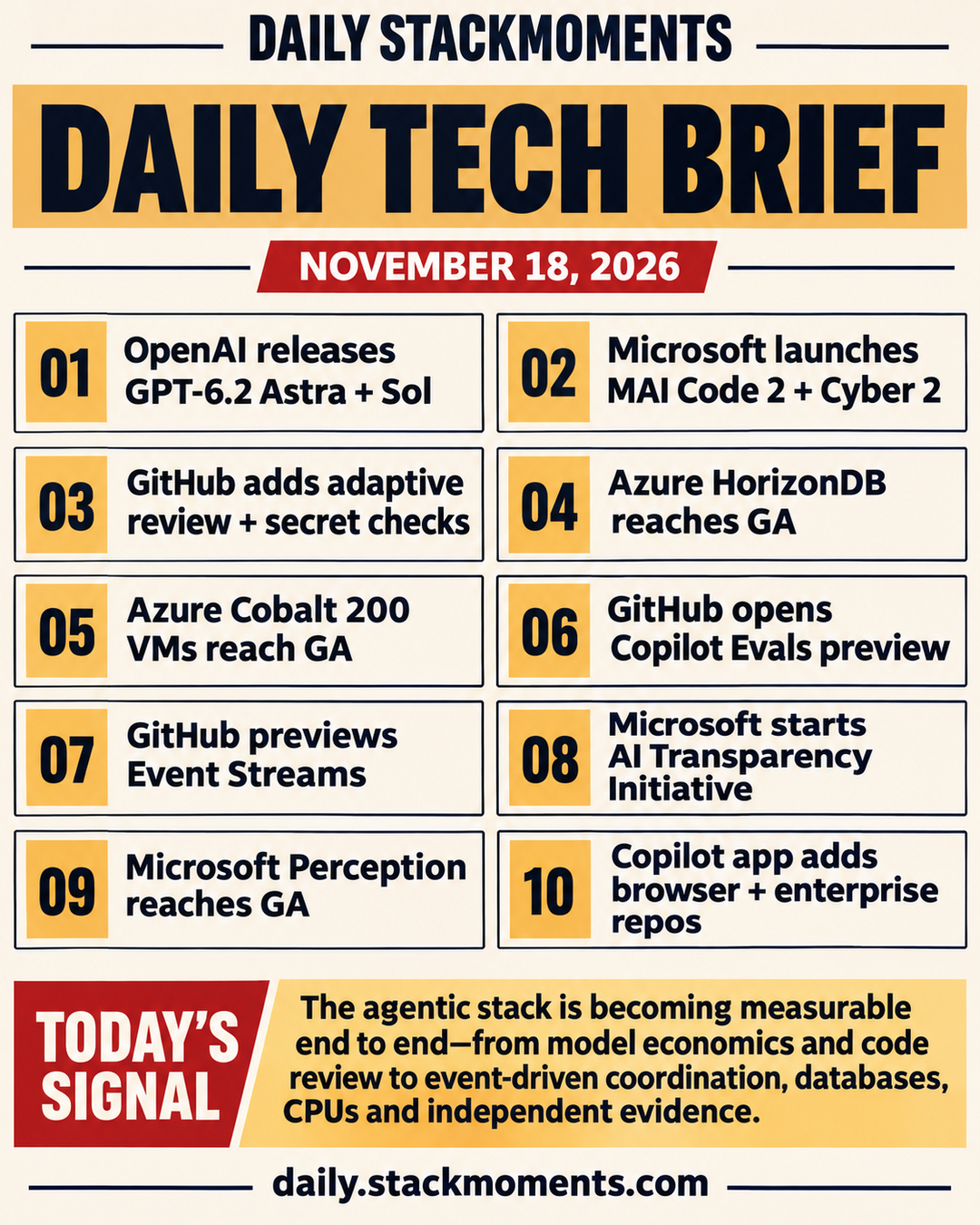
All ten verified developments and today's technology signal, ready to share.

Daily StackMoments 1080 by 1350 poster summarizing ten verified technology developments for November 18, 2026Download poster ↓