Daily brief · November 19, 2026

Engineering boundaries become the day’s defining AI signal.

Eleven verified developments across frontier models, package security, agent sandboxing, chip design, cloud infrastructure, databases and application security.

20 minute read11 developmentsPrimary sources first
01
AI & Models8 min read

Google launches Gemini 4 Neon for agentic coding and long-running work

Google released Gemini 4 Neon with a one-million-token context window, four thinking levels and API pricing of $3 per million input tokens and $15 per million output tokens. The model is rolling out across the Gemini API, AI Studio, Antigravity, Gemini for business and the Gemini app, and is also generally available in GitHub Copilot. Google describes its benchmark, fabrication, cyber and safety results; teams should treat those as vendor-reported until reproduced on their own workloads.

Why it mattersNeon creates a new middle tier between fast utility models and the largest frontier models for coding, research and tool-heavy workflows. Engineering teams should test repository-scale correctness, tool discipline, prompt-injection resistance, latency and total task cost at each thinking level instead of choosing from headline benchmark rank alone.

Source: Google and GitHub Changelog ↗ · Published November 18, 2026

#Gemini 4 Neon#agentic coding#foundation models#GitHub Copilot
02
Security8 min read

Malicious Microsoft Agent Framework releases stole cloud and CI credentials

The GitHub Advisory Database identified Microsoft Agent Framework PyPI releases 1.26.1 and 1.26.2 as malicious. The removed wheels used Python .pth startup hooks to run without an application import and collected environment variables, credential files, CI tokens and cloud identity material. Version 1.26.0 and earlier are not affected; anyone who installed the compromised releases should treat reachable credentials as exposed rather than relying only on uninstalling the package.

Why it mattersThe incident joins package provenance to agent infrastructure: a dependency used to build agents became a path to the credentials those agents and CI systems can reach. Teams should search lockfiles, caches, mirrors and build logs; isolate affected runners; rotate cloud, GitHub, package and CI credentials; and require trusted publishing, attestations and release-pipeline verification for high-privilege packages.

Source: GitHub Advisory Database and Microsoft Agent Framework issue tracker ↗ · Published November 18, 2026

#Microsoft Agent Framework#PyPI#supply chain#credential theft
03
Security8 min read

OpenAI documents the Codex sandbox and its cross-platform permission model

OpenAI published the design of the Codex sandbox, which maps common filesystem and network permission profiles onto native macOS, Linux and Windows enforcement. Its workspace profile keeps Git and Codex configuration read-only, allows broad reads needed by local toolchains, blocks network access by default and uses a proxy for destination rules. OpenAI explicitly notes residual risks, including changes to ignored local dependencies that later execute outside the sandbox.

Why it mattersThe design makes the security contract inspectable and reusable, but also shows why a sandbox cannot be the only control. Agent operators should separate read, write and network authority; protect configuration and hooks; mediate credentials outside the model; inspect ignored build artifacts; and combine sandboxing with monitoring, review and incident response.
Read the updated agent sandboxing architecture guide

Source: OpenAI Engineering ↗ · Published November 18, 2026

#Codex#sandboxing#least privilege#agent security
04
Security7 min read

Palo Alto Networks agrees to acquire Applied Compute for $4.5 billion

Palo Alto Networks signed a definitive all-stock agreement to acquire Applied Compute, a platform for post-training and inference of open-weight models, for $4.5 billion subject to adjustments and regulatory clearance. The buyer says it plans to combine the platform with its security products for public-cloud and sovereign deployments; the transaction is expected to close in its fiscal third quarter of 2027.

Why it mattersThe deal moves a large security vendor deeper into the model-training and inference layer, where weights, data, runtimes and serving identities become security assets. Customers should evaluate the eventual product integration, portability, model and data custody, deployment isolation and roadmap continuity rather than assume the acquisition itself delivers a complete security boundary.

Source: Palo Alto Networks SEC filing, corroborated by Reuters ↗ · Published November 18, 2026

#Palo Alto Networks#Applied Compute#open-weight models#acquisition
05
AI & Models8 min read

OpenAI reports uneven but rising coding-agent autonomy in AI research

OpenAI published internal measurements showing estimated zero-intervention success on two-to-four-hour research tasks rising from 23% in March to 46% in October, while four-to-eight-hour tasks rose from 13% to 35%. It also reports wide task variation—79% for monitoring training runs versus 25% for inference and serving code—and an average 5.7 agent workdays per researcher per day. These are company measurements from one research organization, not a general productivity benchmark.

Why it mattersThe useful signal is not a single productivity multiplier but the operating model: high concurrency, expensive agent use and strong human involvement around weak tasks. Engineering leaders should instrument task-level completion, rework, review load, cost and failure modes before translating AI usage into staffing or delivery forecasts.

Source: OpenAI research report ↗ · Published November 18, 2026

#coding agents#AI research#productivity#engineering economics
06
Cloud & Infrastructure7 min read

OpenAI details model-assisted improvements to custom and RISC-V chip designs

OpenAI described how its models helped engineers improve compute blocks used in its Jalapeño inference silicon, optimize third-party RISC-V designs and explore an end-to-end core from a specification. It is also working with AMD on hardware optimization and with Synopsys to connect frontier models to established electronic-design-automation tools. The reported design gains and evaluation results come from OpenAI and its collaborators.

Why it mattersAI-assisted hardware work is moving from code suggestion into power, performance and area trade-offs inside verified design flows. Chip teams should preserve human sign-off, formal and simulation-based verification, reproducible tool traces and IP boundaries, because a plausible RTL change is not evidence of manufacturable correctness.

Source: OpenAI Research ↗ · Published November 18, 2026

#chip design#RISC-V#EDA#AI infrastructure
07
Cloud & Infrastructure7 min read

Microsoft and Intel expand Azure silicon, packaging and memory collaboration

Microsoft and Intel announced a long-term Azure infrastructure agreement covering multi-year Xeon supply, next-generation Diamond Rapids instances, Intel EMIB advanced packaging for Azure first-party silicon, CXL memory, QuickAssist acceleration and confidential-computing work. The companies also reported workload-specific gains for current Azure M-series memory configurations and SQL backups; those figures are vendor benchmarks and may not generalize.

Why it mattersCloud differentiation is shifting below the virtual machine into packaging, memory topology, accelerators and live-migration protections. Platform teams should benchmark NUMA behavior, CXL latency, backup throughput, confidential-VM constraints and regional availability before adopting vendor performance claims or designing around future capacity.

Source: Intel and Microsoft ↗ · Published November 18, 2026

#Azure#Intel Foundry#CXL#confidential computing
08
Software Engineering6 min read

Amazon Aurora DSQL adds database-internal audit logging

AWS added managed audit logging to Aurora DSQL, capturing DDL, DML, DCL and SELECT statements with statement text, bind parameters, PostgreSQL and IAM identities, timestamps, tables and transaction identifiers. Structured JSON records can be delivered through CloudWatch Vended Logs to Amazon S3. The feature adds DSQL processing, log-delivery and storage charges.

Why it mattersConnection logs show who entered a database; statement-level evidence shows what happened afterward. Regulated teams should define which queries and parameters may be retained, protect the destination bucket, control access to sensitive bind values, set retention and tamper-evidence policy, and test SIEM ingestion before treating the feature as an audit control.

Source: AWS What's New ↗ · Published November 18, 2026

#Aurora DSQL#audit logging#PostgreSQL#compliance
09
Cloud & Infrastructure6 min read

Cloudflare Workers VPC adds private CAs and client-certificate mTLS

Cloudflare added custom certificate-authority trust and client certificates to Workers VPC Services. Workers can now verify private HTTPS or TLS services and authenticate to mTLS-protected origins, including PostgreSQL databases used through Hyperdrive, without disabling certificate verification. Configuration is available through Wrangler 4.164.0 or later, the API and Terraform provider 5.29.0 or later.

Why it mattersServerless code can reach private services without weakening TLS verification or making the origin public. Teams should automate certificate issuance and rotation, keep private keys out of source and logs, use full hostname verification, scope tunnel reachability and test revocation and expiry failures before production rollout.

Source: Cloudflare Developer Platform changelog ↗ · Published November 18, 2026

#Cloudflare Workers#mTLS#private networking#Hyperdrive
10
Security5 min read

GitHub Team organizations now receive automatic security risk assessments

GitHub now runs free code-security and secret-risk assessments automatically for organizations on GitHub Team. Organization administrators and security managers can review exposed credentials and code vulnerabilities, see the current risk picture and prioritize remediation without first starting the assessment manually.

Why it mattersAutomatic discovery reduces the chance that basic exposure evidence is never collected, but it does not assign owners or fix findings. Teams should route results into an accountable backlog, validate severity and repository coverage, rotate exposed credentials promptly and track remediation time rather than treating the generated report as completion.

Source: GitHub Changelog ↗ · Published November 18, 2026

#GitHub Team#code security#secret scanning#AppSec
11
Software Engineering7 min read

Amazon RDS makes MySQL 9.7 LTS generally available

Amazon RDS now supports MySQL 9.7, the community's second long-term-support line after 8.4. The release rolls up features from the 9.0–9.6 innovation series and establishes a stable 9.7 baseline, while AWS continues extended support for MySQL 8.0 and has extended MySQL 5.7 support through June 30, 2029. AWS documents breaking changes and a Blue/Green deployment path from 8.4.

Why it mattersA new managed LTS baseline creates an upgrade target, not an automatic migration. Database teams should inventory removed or changed behavior, drivers, plugins, replication and CDC assumptions, rehearse Blue/Green cutover and rollback, and use the 5.7 extension as planning time rather than a reason to defer modernization indefinitely.

Source: AWS Database Blog ↗ · Published November 18, 2026

#Amazon RDS#MySQL 9.7#LTS#database migration

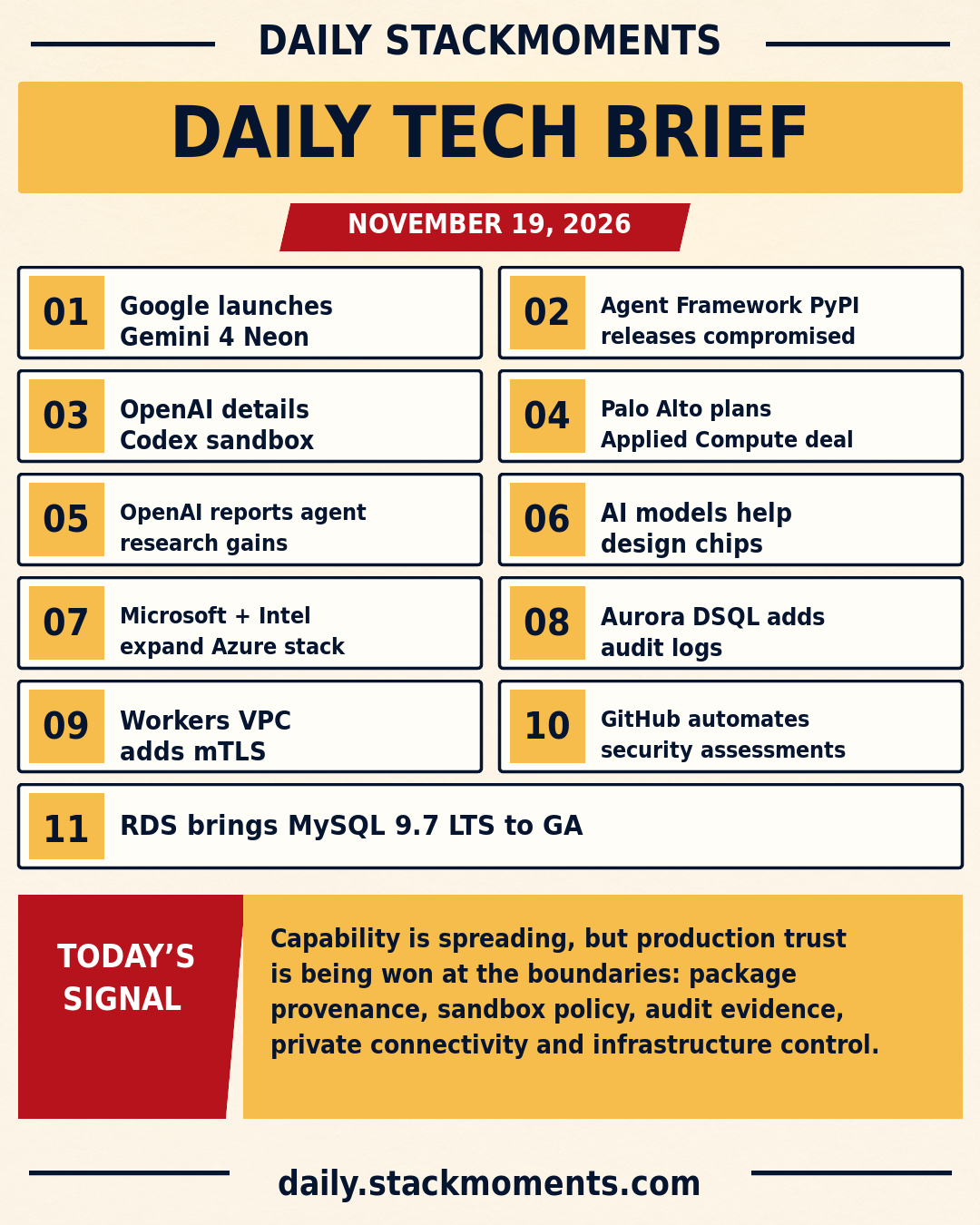
Shareable visual

Poster of the Day

All eleven verified developments and today's technology signal, ready to share.

Daily StackMoments 1080 by 1350 poster summarizing eleven verified technology developments for November 19, 2026Download poster ↓