Daily brief · November 3, 2026

Agent scale moves into the infrastructure beneath software.

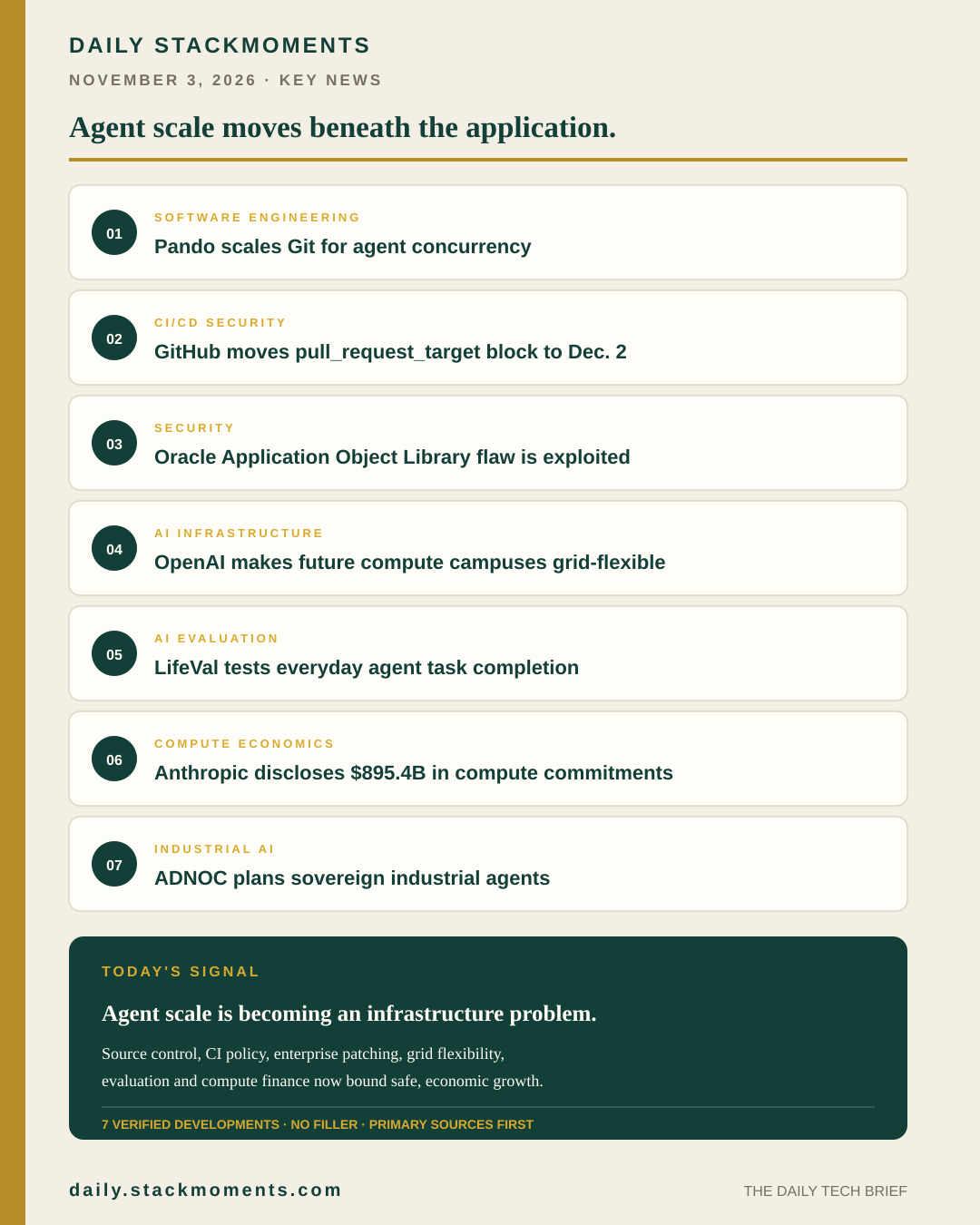
Git concurrency, CI policy, enterprise patching, grid flexibility, agent evaluation, compute finance and sovereign deployment define Tuesday's operating stack.

35 minute read7 developmentsPrimary sources first
01
Software Engineering7 min read

OpenAI rebuilds the Git backend for agent-scale concurrency

OpenAI detailed Pando, the Git-compatible backend now serving its monorepo. The system relaxes repository-wide ref consistency, coordinates each ref independently, reuses pushed packfiles through packfile URIs and compacts them in the background. OpenAI reports nearly 80% lower median push latency, more than 99% cache-served bytes and capacity to deliver about a petabyte of Git data per day; these are company-reported production results.

Why it mattersAI coding changes source-control load before it changes the Git workflow: many agents create branches, pushes, fetches and CI fan-out concurrently. Platform teams approaching that limit should separate per-ref correctness from repository-wide snapshots, cache immutable objects, measure push-to-fetch latency and preserve standard-client compatibility before replacing familiar developer tooling.
Read the agent-scale Git architecture guide

Source: OpenAI Engineering ↗ · Published November 2, 2026

#Pando#Git#coding agents#distributed systems
02
Security4 min read

GitHub delays its pull_request_target default block and sets brownouts

GitHub moved permanent default blocking of pull_request_target in public repositories from November 2 to December 2. It will enforce two test brownouts on November 9 and 16 from 16:00–18:00 UTC. Affected workflows fail unless an applicable Actions event policy explicitly allows them; private and internal repositories are not covered. This materially updates the September announcement already tracked in this archive.

Why it mattersThe extra month is migration time, not a reason to preserve a risky default. Repository owners should inspect policy Insights before the first brownout, remove execution of fork-controlled code from privileged jobs, and allow only named workflows that have a reviewed trust boundary and genuinely require base-repository secrets.

Source: GitHub Changelog ↗ · Published November 2, 2026

#GitHub Actions#pull_request_target#CI/CD security#workflow policy
03
Security4 min read

Attackers target a critical Oracle Application Object Library flaw

Singapore's Cyber Security Agency warned that exploitation attempts are targeting CVE-2026-101767, a 9.8-rated flaw in Oracle Application Object Library. A second issue, CVE-2026-101700, is rated 8.1. Both affect versions 12.2.3 through 12.2.15 and can let an unauthenticated remote attacker with HTTP access take over the product; Oracle updates are available.

Why it mattersInternet-reachable ERP components combine high privilege with valuable business data. Operators should patch immediately, restrict HTTP exposure, preserve web and authentication evidence, hunt for abnormal administrative activity and rotate credentials if investigation cannot establish that the vulnerable service was not reached.

Source: Cyber Security Agency of Singapore and Oracle ↗ · Published November 2, 2026

#CVE-2026-101767#Oracle E-Business Suite#active exploitation#incident response
04
Cloud & Infrastructure5 min read

OpenAI makes flexible power demand part of future compute campuses

OpenAI launched the Grid Protectors Program, saying future US compute campuses will be designed for negotiated demand reductions when local grids are strained. Its planned Effingham County, Georgia campus is the pilot, with an agreement covering up to 1,000 MW of flexible demand response. The broader program is a commitment framework; site-specific terms still require utility and regulatory agreements.

Why it mattersPower availability is becoming a schedulable infrastructure constraint. AI platform leaders should model curtailment in capacity plans, identify interruptible and deferrable workloads, test graceful ramp-down and recovery, and require contractual evidence for grid and ratepayer claims rather than treating flexibility as a substitute for new generation and transmission.

Source: OpenAI ↗ · Published November 2, 2026

#AI data centers#demand response#grid reliability#capacity planning
05
AI & Models5 min read

LifeVal shifts agent evaluation toward everyday task completion

OpenAI introduced LifeVal, an evaluation built from time-use datasets and a demographically representative survey of 3,995 respondents. Its tasks cover caregiving, health, education, household administration, finance, shopping and government services, emphasizing completed workflows rather than advice alone. Example scores and model-performance claims are OpenAI's own and do not constitute independent validation.

Why it mattersAgent evaluation should measure useful outcomes, side effects and unresolved decisions—not only knowledge or browser mechanics. Teams can borrow the method by deriving tasks from user demand, preserving demographic coverage, scoring end-to-end completion and separately testing safety, accuracy and approval behavior in consequential domains.

Source: OpenAI Research ↗ · Published November 2, 2026

#LifeVal#agent evaluation#task completion#benchmarking
06
Cloud & Infrastructure5 min read

Anthropic discloses $895.4 billion in compute commitments

Anthropic's amended IPO filing disclosed $895.4 billion of AI-infrastructure spending commitments, with about $69.8 billion due in the 12 months after September 30 and nearly half due before the end of 2030. The company warned that third-party financing supporting some provider capacity could delay, reprice or reduce delivery. Reuters also reported that third-quarter revenue rose 47% quarter over quarter while $5 billion in additional compute costs weakened efficiency.

Why it mattersFrontier-model economics now depend on the financing and delivery risk of the infrastructure supply chain, not just token demand. Technology leaders negotiating reserved capacity should stress-test take-or-pay obligations, provider financing, delivery milestones, utilization downside and exit rights alongside benchmark and unit-cost forecasts.

Source: Anthropic amended S-1 via Reuters ↗ · Published November 2, 2026

#Anthropic#compute economics#capacity commitments#AI infrastructure
07
AI & Models5 min read

ADNOC plans sovereign industrial agents with OpenAI and G42

ADNOC, OpenAI and G42 announced a multi-year deployment of OpenAI Frontier on UAE-based sovereign infrastructure. Initial work will connect reservoir, facility, capital and commercial data for field planning, then coordinate forecasting and valuation across the energy value chain. ADNOC says human experts will retain oversight of consequential decisions; performance claims and the future operating model remain vendor-reported.

Why it mattersIndustrial agents need an architecture that joins domain systems without collapsing their control boundaries. Engineering leaders should preserve source-level permissions, provenance and human sign-off across every connected decision, keep proprietary data within the promised deployment boundary, and validate failure modes before allowing cross-system optimization to influence operations.

Source: ADNOC and Reuters ↗ · Published November 2, 2026

#industrial AI#sovereign infrastructure#OpenAI Frontier#human oversight

Shareable visual

Poster of the Day

All seven verified developments and today's technology signal, ready to share.

Daily StackMoments 1080 by 1350 poster summarizing seven key technology developments for November 3, 2026Download poster ↓