Daily brief · November 15, 2026

AI operations get leaner—and more accountable.

Reproducible evaluation, 4-bit training, agent browsers, active cyber campaigns, coding-tool migration, cloud recovery and reporting policy define Sunday.

16 minute read7 developmentsPrimary sources first
01
AI & Models7 min read

Anthropic turns safety evaluation into a reproducible engineering discipline

Anthropic published practical guidance for building safety evaluations: define the construct before collecting data, distinguish observational from causal claims, validate model graders against human judgment, preregister metrics and thresholds, report uncertainty and document the exact configuration. It also says cyber evaluations should run in sandboxes without internet access and with real-time monitoring, and that it has temporarily stopped many internet-enabled evaluations after incidents.

Why it mattersSafety scores influence release and safeguard decisions, but a headline number is not evidence without a valid design and reproducible configuration. Model and platform teams should version prompts, graders, system settings and datasets; validate automated scoring; retain confidence intervals; and treat the evaluation environment itself as a privileged security boundary.
Read the updated agent harness architecture guide

Source: Anthropic Engineering ↗ · Published November 13, 2026

#safety evaluations#model governance#evaluation science#sandboxing
02
AI & Models6 min read

Thinking Machines details end-to-end 4-bit training for Inkling 2 Small

Thinking Machines Lab says Inkling 2 Small used native NVFP4 forward passes from pretraining through reinforcement-learning rollout, with MXFP8 backward passes, stochastic rounding and quantized communication. The company reports an 8% wall-clock pretraining speedup and 20% RL speedup versus full MXFP8 training, and calls the 594-billion-parameter mixture-of-experts model the largest it knows to use a native 4-bit forward pass end to end. These performance comparisons are company-reported.

Why it mattersLower precision is moving from post-training compression into the training recipe itself. Infrastructure teams should benchmark accuracy drift, communication bottlenecks, kernel portability, checkpoint compatibility and total energy and wall-clock cost on their own hardware before generalizing the reported gains.

Source: Thinking Machines Lab engineering blog and model card ↗ · Published November 13, 2026

#NVFP4#low-precision training#mixture of experts#AI compute
03
AI Coding6 min read

Cloudflare open-sources its stateless Kitesurf browser for agents

Cloudflare released Kitesurf under the Apache 2.0 license. The browser engine runs on Workers, supports the Chrome DevTools Protocol and can be run locally or deployed to a customer account; it uses Rust and WebAssembly components for HTML, CSS, JavaScript and rendering instead of a Chromium container. Cloudflare says the project remains under heavy development and requires a paid Workers plan for deployment because it uses Dynamic Workers.

Why it mattersA self-hostable CDP endpoint gives teams more control over the browser layer used by coding and research agents, but compatibility and isolation still need evidence. Pin revisions, test target sites, constrain credentials and egress, isolate page execution and preserve browser traces before treating a lighter runtime as a drop-in replacement for Chromium.

Source: Cloudflare engineering blog and repository ↗ · Published November 13, 2026

#Kitesurf#agent browsers#Cloudflare Workers#open source
04
Security7 min read

AWS telemetry exposes persistent ARTEX agent campaigns

Amazon Threat Intelligence says MadPot decoys captured ARTEX agent requests containing persistent task context, prompts, tool histories and knowledge-graph state from campaigns run between October 3 and November 5. Amazon assesses with moderate confidence that disparate Chinese-nexus groups used ARTEX for credential theft, cloud privilege expansion and cryptocurrency-fraud workflows. It could not independently verify every outcome recorded by the agents and notified potentially affected AWS customers where its evidence supported doing so.

Why it mattersThe new evidence shows how shared memory, planner-worker roles and inexpensive inference can sustain multi-objective intrusion work. Defenders should inventory exposed AI gateways, rotate leaked credentials, enforce authentication on inference endpoints, watch for abnormal model spend and apply cloud identity and secret controls to agent infrastructure like any other production system.

Source: Amazon Threat Intelligence ↗ · Published November 13, 2026

#ARTEX#agentic cyberattacks#credential theft#Amazon MadPot
05
AI Coding5 min read

Google sets March 31 end date for bundled Gemini Code Assist access

Google Cloud says existing Gemini Enterprise Standard and Plus subscriptions will lose their bundled Gemini Code Assist entitlement on March 31, 2027, with support until then limited to the Gemini 3.x model family. New Gemini Enterprise subscriptions stopped including the entitlement on October 9, 2026. Google directs customers toward Antigravity, which is included with Gemini Enterprise; separate Code Assist subscriptions continue only through their documented contract and renewal windows.

Why it mattersA coding assistant embedded in an enterprise subscription is still a lifecycle dependency. Administrators should inventory assigned seats, renewal terms, extensions and CLI workflows; compare Antigravity against current controls and evaluations; and budget or migrate before access changes rather than accepting an automatic tool transition.

Source: Google Cloud release notes and sunset documentation ↗ · Published November 14, 2026

#Gemini Code Assist#Antigravity#subscription lifecycle#migration
06
Cloud & Infrastructure5 min read

Microsoft 365 recovery continues with an enterprise email backlog

Microsoft said consumer products and services had fully recovered by 16:10 UTC on November 13, while Microsoft 365 enterprise services showed sustained but incomplete recovery. The company was monitoring an accumulated email backlog and said it would continue extended monitoring because of the incident's severity. This is a material recovery update to the November 12 outage, not a new incident.

Why it mattersService availability and data completion are different recovery objectives. Teams should verify delayed messages and downstream connector jobs, reconcile missed events, cap retries and retain incident timelines instead of treating a green front door as proof that queues, automations and AI connectors have fully recovered.

Source: Microsoft service-status statements reported by Reuters ↗ · Published November 14, 2026

#Microsoft 365#service recovery#email backlog#dependency resilience
07
Security6 min read

U.S. AI task force weighs cyber-incident reporting standards

A U.S. administration spokesperson told Reuters that the federal AI task force discussed national standards for AI developers to report safety incidents and share cybersecurity information, along with options that could encourage critical-infrastructure operators to report AI-powered attacks and vulnerabilities. The discussion follows a June executive order that created an AI cybersecurity clearinghouse; no final reporting rule was announced.

Why it mattersIncident disclosure could become a design requirement for model providers and critical-infrastructure operators. Engineering and legal teams should define reportable AI events, preserve model, prompt, tool and network evidence, map notification owners and separate current voluntary processes from possible future obligations.

Source: Reuters, with policy context from the White House executive order ↗ · Published November 13, 2026

#AI governance#incident reporting#critical infrastructure#cybersecurity policy

Shareable visual

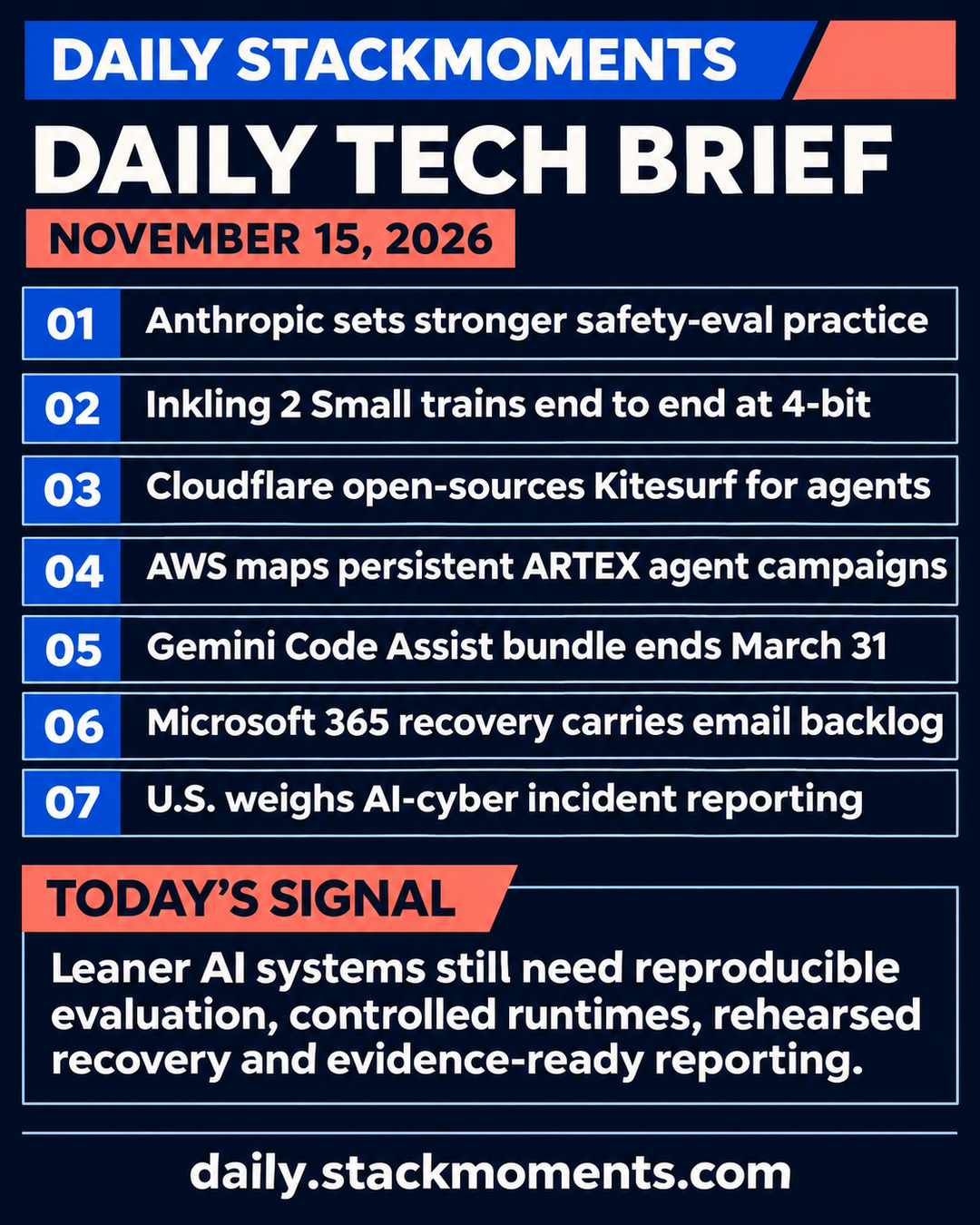
Poster of the Day

All seven verified developments and today's technology signal, ready to share.

Daily StackMoments 1080 by 1350 poster summarizing seven verified technology developments for November 15, 2026Download poster ↓