Daily brief · November 4, 2026

Agent infrastructure gets explicit boundaries.

Governed context, delegated identity, sandbox isolation, regional inference and security tooling define Wednesday's production agent stack.

44 minute read9 developmentsPrimary sources first
01
AI & Models6 min read

Snowflake puts ontology and policy gates beneath enterprise agents

Snowflake announced a Business Ontology in Horizon Context for approved business definitions and a Cortex AI Gateway for governing model, tool and action access. It also introduced CoCo and CoWork agents and background bots. Availability varies by capability, and performance and reliability claims remain Snowflake's own.

Why it mattersEnterprise agents need more than retrieval: they need a versioned semantic layer, policy enforcement at every model and tool call, and an audit trail for actions. Platform teams should treat the ontology and gateway as control-plane components, validate preview boundaries, and keep human approval for consequential operations.

Source: Snowflake ↗ · Published November 3, 2026

#enterprise agents#business ontology#AI gateway#governance
02
AI & Models5 min read

OpenAI extends agent workflows into CAD, simulation and hardware design

OpenAI described early workflows spanning CAD, PCB design, finite-element analysis and cross-discipline reviews. It reported an internal model score of 0.875 on BenchCAD 2.0 versus 0.594 for GPT-6 Astra, and announced a Mazda research collaboration on aerodynamics and crash-safety design. These results are company-reported and the work remains an early collaboration rather than a general product release.

Why it mattersEngineering agents are moving from text and code into tools where a plausible error can become a physical defect. Teams evaluating these workflows need constraint checks, reproducible simulations, design provenance and expert sign-off at every release gate—not only a successful benchmark or generated drawing.

Source: OpenAI Research ↗ · Published November 3, 2026

#CAD#hardware engineering#simulation#human review
03
AI Coding5 min read

GitHub Copilot reaches JetBrains Air through an open agent protocol

GitHub made Copilot available in JetBrains Air through Agent Client Protocol. Developers can run local sessions or cloud tasks in fresh virtual machines and Docker containers, review parallel work in context and charge tasks to a Copilot subscription. Air governance can disable Copilot, but its analytics do not include Copilot usage and administrators cannot set Copilot spending limits inside Air.

Why it mattersACP reduces editor lock-in, but cross-vendor execution creates a new control seam. Engineering leaders should map which provider enforces identity, network egress, secrets, budgets and audit logs before enabling cloud tasks, and should not assume the host IDE's analytics cover the delegated agent.

Source: GitHub Changelog ↗ · Published November 3, 2026

#GitHub Copilot#JetBrains Air#ACP#cloud agents
04
Software Engineering4 min read

Dependabot starts updating agent skills and instructions

GitHub added generally available version-update support for Agent Package Manager dependencies. Dependabot can open pull requests for Git dependencies declared in apm.yml and regenerate apm.lock.yaml. The integration covers version updates, not security updates, and GitHub Enterprise Server support is planned for 3.24.

Why it mattersSkills, prompts and instruction bundles are executable supply-chain inputs even when they are not binaries. Teams should pin them, review diffs, test agent behavior before merge and add provenance checks; Dependabot automation does not yet identify a malicious or vulnerable agent package.

Source: GitHub Changelog ↗ · Published November 3, 2026

#Dependabot#Agent Package Manager#agent skills#supply chain
05
Security5 min read

CodeQL 2.27.3 adds Python 3.15 and AI-source modeling

GitHub released CodeQL 2.27.3 with Python 3.15 syntax and built-in modeling, JSON data extensions, C23 bit-precise integers and accuracy improvements across languages. An opt-in ai threat model lets teams define LLM-generated data as sources, while a GitHub Actions control-flow-graph change may require custom-query migration.

Why it mattersGenerated content should be modeled as untrusted data when it can reach parsers, queries, templates or commands. Security teams can now encode those paths directly, but must define the sources themselves and regression-test custom Actions queries against the new CFG before upgrading self-managed analysis.

Source: GitHub Changelog ↗ · Published November 3, 2026

#CodeQL#Python 3.15#AI threat model#static analysis
06
Cloud & Infrastructure5 min read

AWS adds India-resident inference for Kimi K3

Amazon Bedrock introduced an India geographic inference profile for Moonshot AI's Kimi K3. Requests using in.moonshotai.kimi-k3 are processed only in AWS Mumbai and Hyderabad Regions, with Chat Completions, Responses, Converse and InvokeModel interfaces available. AWS recommends short-lived credentials and notes that IAM and service-control policies must permit both destination Regions.

Why it mattersData residency is becoming an API-level deployment choice rather than a separate model stack. Architects should pin the geographic profile, restrict allowed model ARNs and Regions, log the resolved destination, and test failover without silently falling back to a global inference route.

Source: AWS Machine Learning Blog ↗ · Published November 3, 2026

#Amazon Bedrock#Kimi K3#India#data residency
07
Cloud & Infrastructure5 min read

AMD's data-center revenue nearly doubles as Helios enters production

AMD reported record quarterly revenue of $13.4 billion, with data-center revenue up 97% year over year to $8.5 billion. It said Helios rack-scale systems are in production, ROCm 10 is released and Anthropic, Meta, Microsoft, OpenAI and Oracle are running early MI450-based systems. AMD also disclosed agreements to acquire World Labs and Taalas; operational claims are company-reported.

Why it mattersThe accelerator market is shifting from chips toward integrated racks, software and model research. Infrastructure buyers should benchmark the complete Helios and ROCm stack, price networking and power alongside GPUs, and keep portability tests in procurement plans rather than treating headline accelerator supply as usable capacity.

Source: AMD investor relations and Reuters ↗ · Published November 3, 2026

#AMD Helios#ROCm 10#MI450#AI infrastructure
08
Security5 min read

Docker Desktop WSL2 flaw crosses the container-to-host boundary

CVE-2026-112917 affects Docker Desktop for Windows on x86-64 systems using the WSL2 backend. An unprivileged Linux container can use 32-bit socketcall to bypass the default seccomp restriction on AF_VSOCK, exposing host-facing services and Windows files available to the logged-in user. The published fix requires Docker Desktop 4.98.0 or later and WSL 3.0.3 or later; LinuxKit backends are unaffected.

Why it mattersDeveloper containers are not a safe boundary when the host bridge can be reached through a syscall path the policy missed. Windows teams should update both layers, verify WSL versions in fleet inventory, restrict untrusted images and rotate credentials if exposed host files may have been readable.

Source: NVD and Docker release notes ↗ · Published November 3, 2026

#CVE-2026-112917#Docker Desktop#WSL2#container isolation
09
Security4 min read

CISA flags critical authorization and SQL injection flaws in grid software

CISA published two vulnerabilities in Subnet Solutions PowerSYSTEM Center, used in critical-manufacturing and energy environments. CVE-2026-63017 lets a low-privileged authenticated user reach administrator-only resources, while CVE-2026-63774 is an SQL injection issue. Affected releases span the 2020, 2024 and 2026 product lines; CISA says neither flaw is remotely exploitable and it has no reports of public exploitation.

Why it mattersThe absence of internet exploitation does not reduce risk inside an operational network where trusted accounts and vendor access already exist. Operators should apply vendor updates, segment management interfaces, review low-privilege account activity and monitor database errors or unusual administrative reads.

Source: CISA ICS Advisory ICSA-26-307-01 ↗ · Published November 3, 2026

#CVE-2026-63017#CVE-2026-63774#ICS security#energy

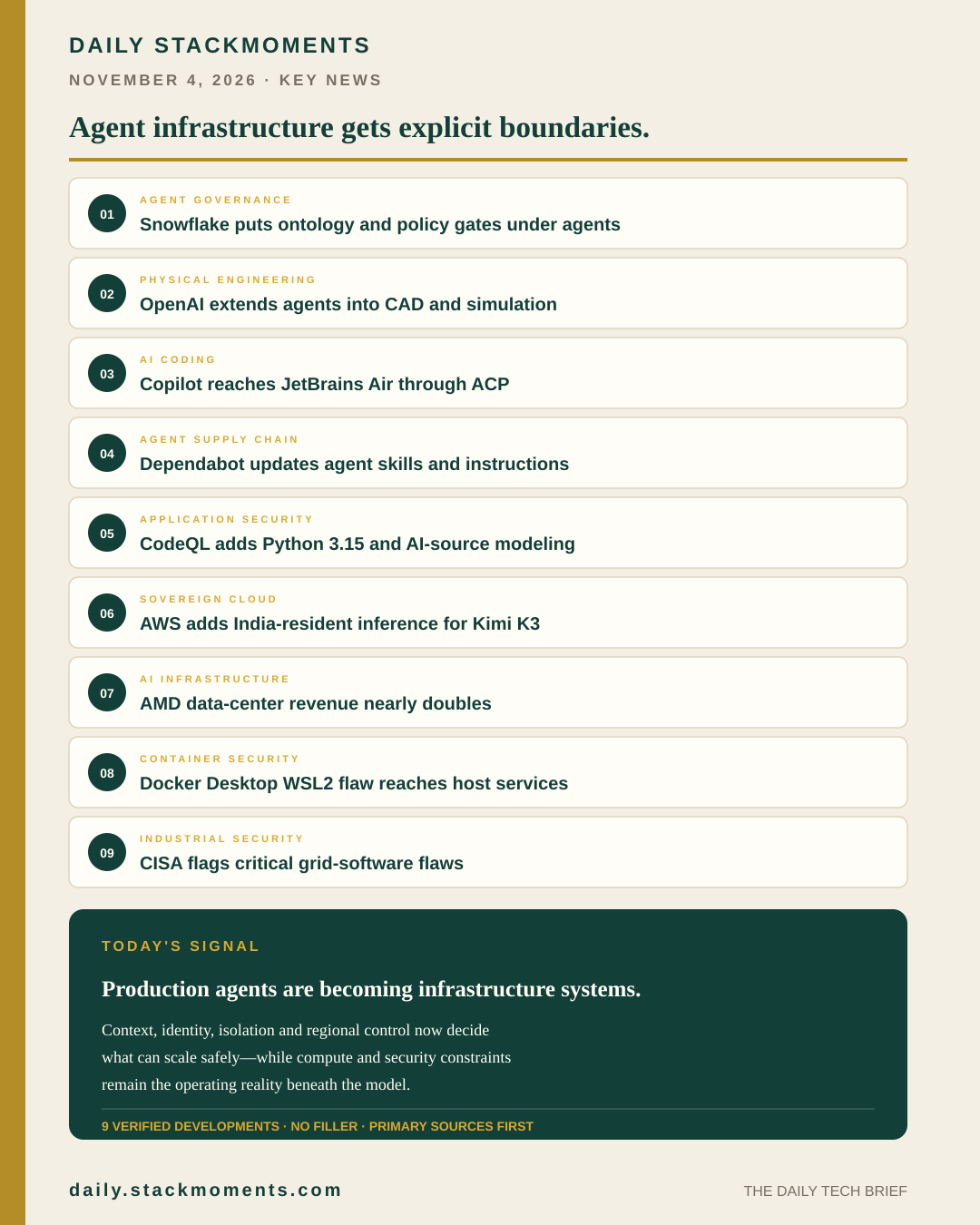
Shareable visual

Poster of the Day

All nine verified developments and today's technology signal, ready to share.

Daily StackMoments 1080 by 1350 poster summarizing nine key technology developments for November 4, 2026Download poster ↓