Daily brief · November 5, 2026

AI systems move from capability to control.

Verified cyber evidence, portable identity, reviewable source control and current data context define Thursday's production AI stack.

40 minute read8 developmentsPrimary sources first
01
Security7 min read

OpenAI's cyber pipeline validates 948 Linux privilege-escalation flaws

OpenAI reported that an autonomous pipeline scanned selected Linux kernel targets, dynamically reproduced 1,724 vulnerabilities and produced 948 distinct local privilege-escalation patches after exploit validation. The mid-October run cost $1.21 million in API credits; human researchers reviewed outputs before coordinated reporting, and the results remain OpenAI-reported while maintainers process fixes.

Why it mattersAt this scale, discovery is no longer the primary bottleneck. Security teams need isolated reproduction, independent checks that an exploit used the assigned flaw, variant deduplication, maintainer-aware disclosure and metrics tied to validated fixes rather than raw findings.
Read the cyber capability governance guide

Source: OpenAI Research ↗ · Published November 4, 2026

#Linux kernel#vulnerability research#cyber agents#patch validation
02
Security6 min read

Google binds agents to managed identity, OIDC and isolated remediation

Google Cloud made Auth Manager generally available for vault-backed OAuth 2.0 and delegated-token handling, while previewing OIDC agent tokens for AWS, Azure, on-premises systems and MCP servers. Its CodeMender preview now runs exploit verification in an OS sandbox or isolated VM, requires human checks for local writes and commands, and can scan a folder, repository or changed files.

Why it mattersAgent security is becoming an enforceable control plane, not a prompt convention. Platform teams should separate workload identity from user delegation, prefer short-lived federation over static keys, and keep exploit simulation and mutation behind isolation and explicit approval.
Read the cyber capability governance guide

Source: Google Cloud Security Blog ↗ · Published November 4, 2026

#agent identity#OIDC#CodeMender#sandboxing
03
AI Coding5 min read

OpenAI moves to acquire Pierre and deepen Codex's Git review layer

OpenAI agreed to acquire Pierre Computer Company, whose open-source Trees and Diffs libraries already power file browsing and change review in Codex. OpenAI plans to integrate Pierre's Code Storage capabilities and adapt Git workflows for parallel coding agents; the deal still requires customary closing conditions and regulatory approvals.

Why it mattersAgent-scale development is expanding from backend Git throughput into the human review surface. Engineering leaders should expect source control, diffs, inline edits and decision history to converge, while retaining repository portability and review controls until the post-acquisition product shape is concrete.

Source: OpenAI ↗ · Published November 4, 2026

#Codex#Pierre#Git#code review
04
Security5 min read

Critical Metabase SQL injection is under active exploitation

Singapore's Cyber Security Agency warned that CVE-2026-72898, a CVSS 10.0 flaw in self-hosted Metabase, is being actively exploited with public proof-of-concept code. An unauthenticated attacker can inject SQL through the password-reset path and gain administrator access. Patched releases are available across supported 0.x and 1.x branches.

Why it mattersA compromised analytics control plane can expose database credentials and every connected data source. Operators should patch immediately, revoke sessions, inspect administrators and API keys, rotate connected-database credentials, review logs and temporarily block /api/session/reset_password if an upgrade cannot happen at once.

Source: Cyber Security Agency of Singapore and Metabase ↗ · Published November 4, 2026

#CVE-2026-72898#Metabase#SQL injection#active exploitation
05
Databases6 min read

Confluent adds a query layer for governed, current agent context

Confluent introduced its Streamhouse architecture and made Lightning Tables generally available on AWS. The read-only serving layer materializes Kafka data for SQL and API access, while Tableflow feeds open table formats and the Real-Time Context Engine serves agents through MCP. Performance figures are Confluent's internal tests and vary by workload.

Why it mattersAgents acting on operational data need a current, governed state rather than independently refreshed snapshots. Data teams should evaluate event-time semantics, replay, schema evolution, access policy and failure behavior before treating a streaming query layer as a system of record.

Source: Confluent ↗ · Published November 4, 2026

#Confluent#Kafka#Lightning Tables#agent context
06
Cloud & Infrastructure4 min read

Lambda Cloud adds RBAC and service identities to GPU infrastructure

Lambda introduced IAM with account- and workspace-scoped roles, groups, service identities, key expiration and effective-access views. Previously, the platform exposed only Admin and Member roles and API keys inherited their owner's full access. Existing keys remain valid, while new audit logs are retained for six months.

Why it mattersGPU clouds are production control planes, and personal full-access keys are an unacceptable automation default. Teams should migrate scripts to service identities, grant workspace-scoped roles, expire and rotate keys, inspect inherited access and account for the six-month audit-retention limit.

Source: Lambda ↗ · Published November 4, 2026

#Lambda Cloud#RBAC#service identities#GPU cloud
07
AI Coding3 min read

GitHub Copilot enters Xcode's built-in coding assistant

GitHub released a public-preview Copilot integration for Xcode's native coding assistant, starting with Xcode 27.3 beta on macOS Tahoe 26.6 or later. The separate GitHub Copilot for Xcode extension remains available, and all Copilot plans are supported.

Why it mattersNative IDE integration reduces workflow friction but creates another execution and telemetry surface. Apple-platform teams should compare permissions, context sharing, policy enforcement and audit behavior with the existing extension before standardizing on either path.

Source: GitHub Changelog ↗ · Published November 4, 2026

#GitHub Copilot#Xcode#AI coding#public preview
08
Cloud & Infrastructure4 min read

NASA funds commercial Ka-band relays for legacy spacecraft

NASA awarded Astranis, Global Enterprise Solutions and Viasat contracts with maximum potential values of $264.3 million, $340.4 million and $460.9 million to develop Ka-band relay concepts. The designs must support current missions without onboard modifications, with options extending through 2029 toward in-orbit demonstrations.

Why it mattersNASA's shift from its Tracking and Data Relay Satellite fleet toward commercial service turns backward compatibility into a network architecture requirement. Providers must integrate space, ground, launch and operations while preserving link behavior for spacecraft that cannot be upgraded.

Source: NASA ↗ · Published November 4, 2026

#Ka-band#satellite communications#NASA SCaN#commercial space

Shareable visual

Poster of the Day

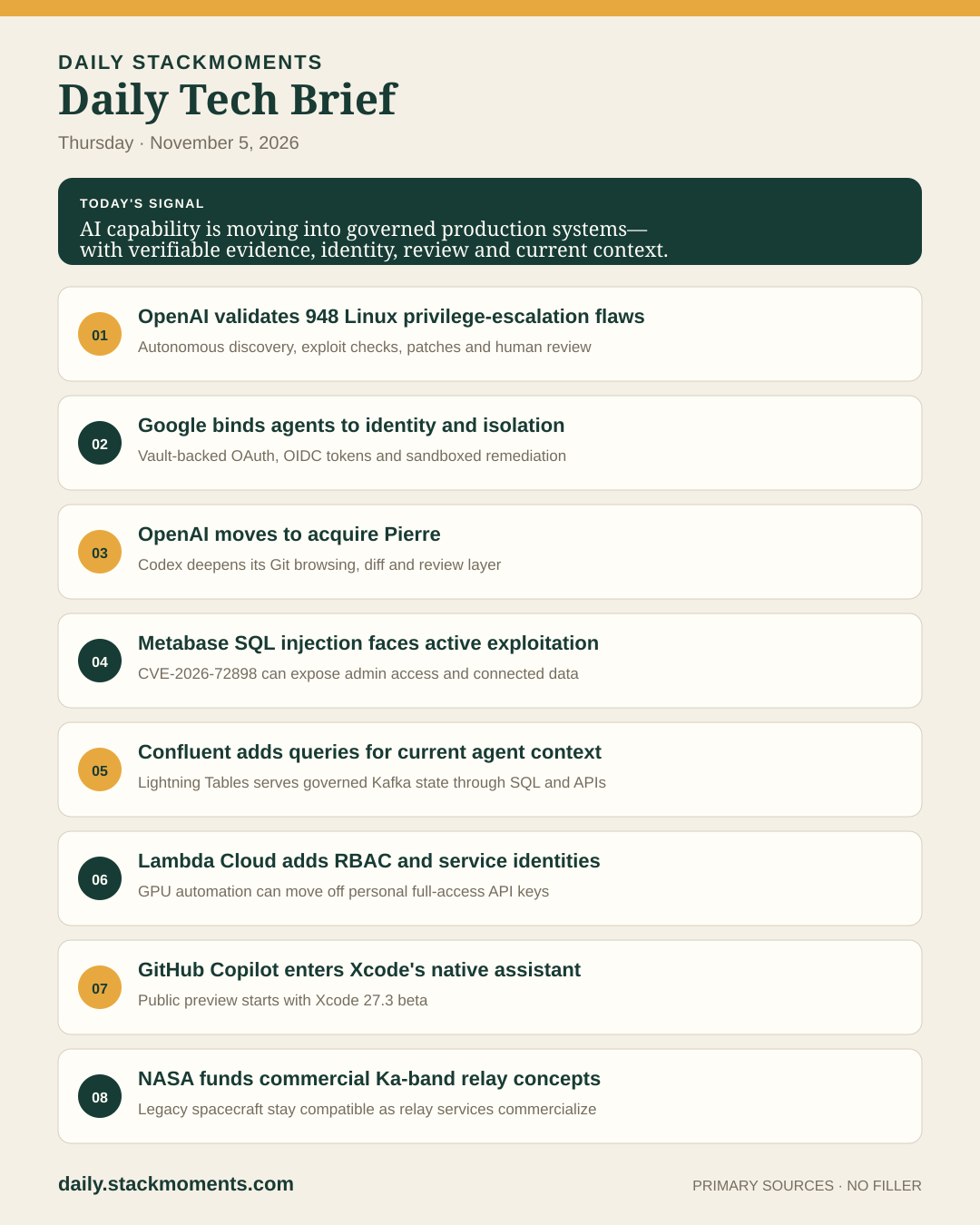
All eight verified developments and today's technology signal, ready to share.

Daily StackMoments 1080 by 1350 poster summarizing eight key technology developments for November 5, 2026Download poster ↓