Daily brief · November 6, 2026

Agents push control planes to both edges.

Privileged cyber capability, local inference and agent-scale source control reshape Friday's engineering boundary.

35 minute read7 developmentsPrimary sources first
01
Security7 min read

OpenAI releases GPT-6 Cyber behind a restricted access tier

OpenAI introduced GPT-6 Cyber, a security-specialized GPT-6 Astra variant for authorized vulnerability discovery, exploit development and web penetration testing. OpenAI classifies it as Critical in cybersecurity under its Preparedness Framework and initially limits access to approved Daybreak Red customers through the API and Codex. Product performance and safety figures are OpenAI-reported.

Why it mattersA more capable cyber model is an operationally privileged system, not a general-purpose assistant. Organizations granted access must enforce SSO, MFA, managed devices, least privilege and IP allowlisting, then bind each run to an authorized target, isolated tools, action review, human oversight and revocable credentials.
Read the updated cyber capability governance guide

Source: OpenAI product announcement and system card ↗ · Published November 5, 2026

#GPT-6 Cyber#Daybreak Red#vulnerability research#agent security
02
Software Engineering6 min read

GitHub redesigns Git storage for thousands of concurrent agents

GitHub detailed Project Rubicon, a storage architecture that separates immutable pack data in Azure Blob Storage from reference state in a replicated Ref-CAS log. Disposable virtual replicas serve reads and writes while separate workers compact and garbage-collect packs. GitHub says internal tests sustained 5,000 concurrent agents and 7,200 pushes per second to one repository.

Why it mattersAgent concurrency changes source control from occasional human bursts into sustained write traffic with amplified CI and fetch demand. Platform teams should isolate branch ownership, control automated push rates, keep merge policy authoritative and design CI, review and storage systems for many parallel writers rather than one fast bot.

Source: GitHub Engineering ↗ · Published November 5, 2026

#Git#Project Rubicon#Ref-CAS#coding agents
03
AI Coding5 min read

Foundry Local brings Qwen3.8-27B coding into GitHub Copilot

Microsoft published a Foundry Local workflow that runs a 4-bit Qwen3.8-27B model through ONNX Runtime and exposes it to the GitHub Copilot app as a local provider. The approximately 18 GB model needs an NVIDIA GPU with at least 24 GB of VRAM for up to 64K context; code and context remain on the developer machine and the workflow can operate offline.

Why it mattersLocal inference offers a useful privacy, availability and cost boundary for routine coding, but it shifts patching, model provenance, GPU capacity and endpoint security to the workstation. Teams should classify which repositories may use local models, pin the model and runtime, and keep cloud fallback explicit for higher-reasoning tasks.

Source: Microsoft Foundry Blog ↗ · Published November 5, 2026

#Foundry Local#Qwen3.8-27B#GitHub Copilot#on-device AI
04
DevOps5 min read

Microsoft makes agent deployment configuration reviewable in azd

Microsoft released version 1.0 of the microsoft.foundry extension bundle for Azure Developer CLI. Agent code and deployment configuration can live together in azure.yaml, developers can inspect requests and responses locally, and the same configuration can flow through CI/CD to Foundry hosted agents. The extension requires azd 1.37 or later.

Why it mattersTreating prompts, tools, models and runtime settings as code makes agent deployment reviewable and repeatable. Teams should add schema checks, environment-specific policy, secret references, evaluation gates and rollback to the pipeline rather than letting a local agent configuration become an unreviewed production control plane.

Source: Microsoft Foundry Blog ↗ · Published November 5, 2026

#Azure Developer CLI#Foundry#hosted agents#CI/CD
05
Security5 min read

US agencies warn that exposed refrigeration controls are being attacked

CISA, the FBI and the US health, agriculture and transportation departments warned that malicious actors are targeting internet-accessible temperature and commercial refrigeration controllers. Successful access can alter temperatures, damage inventory and equipment, and create fire hazards; the joint guidance calls for removing public exposure, segmenting controls, patching and monitoring unexpected changes.

Why it mattersA small remote-control interface can become a physical safety and supply-chain incident. Operators should inventory every controller and modem, remove direct internet access, isolate OT from corporate networks, require strong remote authentication, patch supported firmware and alert on set-point, defrost-cycle and account changes.

Source: CISA joint fact sheet ↗ · Published November 5, 2026

#OT security#cold chain#industrial controls#critical infrastructure
06
Security3 min read

GitHub starts reporting leaked Starlink API secrets to SpaceX

GitHub added SpaceX to its secret-scanning partnership and introduced detection for starlink_public_api_v2_secret credentials. When the pattern appears in a public repository, GitHub forwards the finding to SpaceX so the issuer can revoke or rotate it. Detector updates also reduce false positives for Alibaba, AWS, Google, OpenVSX, Pydantic Services and Tencent secrets.

Why it mattersSatellite and telecom APIs are now part of the same credential supply chain as cloud services. Repositories should still use push protection, short-lived secrets and automated rotation; partner reporting is a recovery path after exposure, not a substitute for preventing the commit.

Source: GitHub Changelog ↗ · Published November 5, 2026

#secret scanning#Starlink#SpaceX#credential security
07
Cloud & Infrastructure4 min read

DARPA funds a second Redwire VLEO propulsion flight test

Redwire said DARPA awarded it $20 million to build and fly a scaled SabreSat spacecraft before the full Otter mission. The precursor will test air-breathing propulsion and collect very-low-Earth-orbit data that cannot be reproduced fully on the ground. The award adds to a $44 million 2025 phase-two contract; schedule and performance claims remain company-reported.

Why it mattersSustained VLEO could support lower-latency communications and higher-resolution observation, but atmospheric drag makes propulsion, autonomy and rapid operations central platform requirements. The phased test program is a useful reminder that simulation and digital engineering still need flight evidence before constellation-scale deployment.

Source: Redwire ↗ · Published November 5, 2026

#VLEO#DARPA Otter#SabreSat#satellite infrastructure

Shareable visual

Poster of the Day

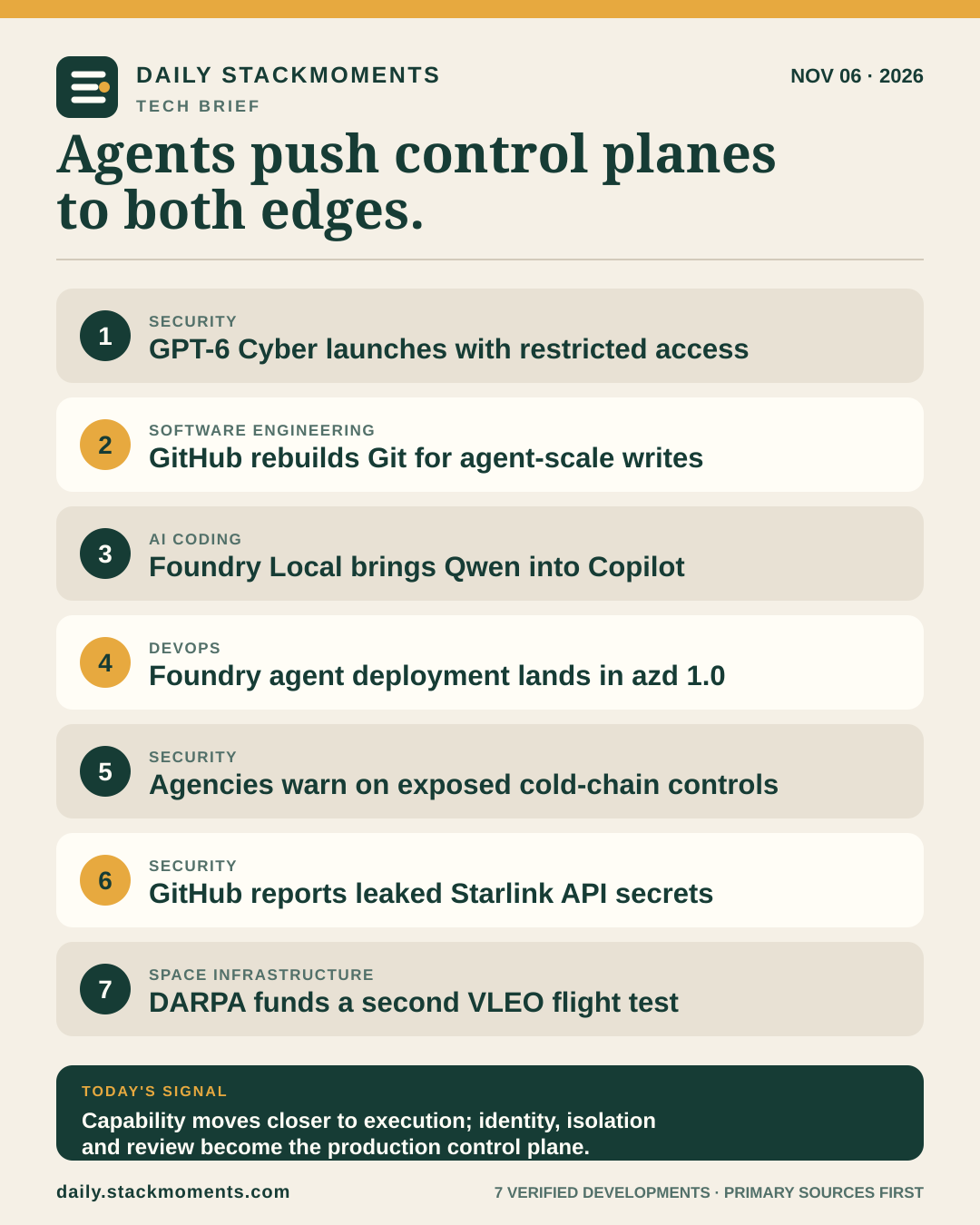
All seven verified developments and today's technology signal, ready to share.

Daily StackMoments 1080 by 1350 poster summarizing seven key technology developments for November 6, 2026Download poster ↓