Daily brief · November 8, 2026

The agent boundary moves into skills, apps and storage.

Skill scanning, agent-built apps, portable data layers and hyperscale infrastructure redraw Sunday's production boundary.

24 minute read5 developmentsPrimary sources first
01
Security5 min read

Google Cloud adds policy-enforced security scanning for agent skills

Google Cloud added automatic security scanning for standalone Agent Registry skill revisions. Administrators can review finding resources, apply least-privilege skill management and use custom Organization Policy constraints to prevent downloads or default-revision promotion when a skill has findings.

Why it mattersAgent skills are executable supply-chain artifacts, not passive prompt files. Platform teams should pin immutable revisions, quarantine new uploads, make findings part of promotion policy and retain runtime identity, egress and tool controls because a clean scan cannot prove safe behavior.
Read the updated agent harness architecture guide

Source: Google Cloud Agent Registry release notes and documentation ↗ · Published November 6, 2026

#Agent Registry#agent skills#supply-chain security#Organization Policy
02
AI Coding5 min read

Cursor cloud agents can now build and publish live applications

Cursor introduced Build Live Apps, a workflow in which a cloud agent can scaffold an application, provision optional Postgres storage and Cursor authentication, and prepare hosting from Cursor Origin or GitHub. Cursor says deterministic and agentic security checks run before an explicit human publication step; administrators can inspect applications and secrets, add rules or unpublish them.

Why it mattersA coding agent that provisions and publishes an application crosses from source generation into operated infrastructure. Teams should review generated identity and data flows, assign service ownership, keep secrets outside prompts, require human release approval and test logging, rollback and deletion before using the path for production work.

Source: Cursor Changelog ↗ · Published November 5, 2026

#Cursor#cloud agents#application hosting#Postgres
03
Cloud & Infrastructure5 min read

Dropbox moves into agent storage with DBX Agent Cloud and a Tigris deal

Dropbox announced a planned acquisition of Tigris, whose globally distributed object store exposes an S3-compatible API, and introduced DBX Agent Cloud. The new platform begins with standalone object storage and is planned to add filesystem and content-processing capabilities; Dropbox says supported AI actions on existing content will honor permissions, require plan approval and retain history for undo.

Why it mattersPersistent data is becoming a first-class agent dependency rather than temporary workspace state. Engineering leaders should evaluate IAM boundaries, data residency, consistency, egress pricing, durability, audit and export paths—and treat the Tigris integration as a pending transaction until the acquisition closes.

Source: Dropbox announcement and SEC filing ↗ · Published November 5, 2026

#Dropbox#Tigris#DBX Agent Cloud#object storage
04
Cloud & Infrastructure4 min read

SpaceX selects Qualcomm for Starlink Mobile's terrestrial 5G build

Qualcomm said SpaceX selected its Dragonwing QRU100 and QDU100 platform, including 64T64R Massive MIMO radios and Layer 1 software, for Starlink Mobile's terrestrial 5G network. The companies say US deployment will begin in 2027 and expand to tens of thousands of sites under a multi-year agreement.

Why it mattersSatellite and terrestrial networks are converging into one programmable service edge. Telecom and platform teams should plan for identity, roaming, observability and failover across both domains, while treating rollout scale and timing as company projections until deployed capacity is independently visible.

Source: Qualcomm announcement, corroborated by Reuters ↗ · Published November 4, 2026

#Starlink Mobile#Qualcomm Dragonwing#5G#Massive MIMO
05
Cloud & Infrastructure5 min read

Google commits $17 billion to its first Wyoming data center

Google announced a $17 billion long-term investment in its first Wyoming data center. Its plan includes an air-cooled design and a proposed 702 MW fuel-cell development with carbon capture and storage. The next day, Crusoe said Google acquired the southeast Wyoming site after Crusoe completed predevelopment, approvals and power strategy work.

Why it mattersAI capacity planning now binds software demand to multi-year power, cooling, construction and community commitments. Leaders should separate announced investment and proposed energy systems from operating capacity, then model deployment timing, grid constraints, emissions accounting and supplier concentration alongside accelerator demand.

Source: Google and Crusoe announcements ↗ · Published November 5–6, 2026

#Google Cloud#Wyoming#data centers#AI energy

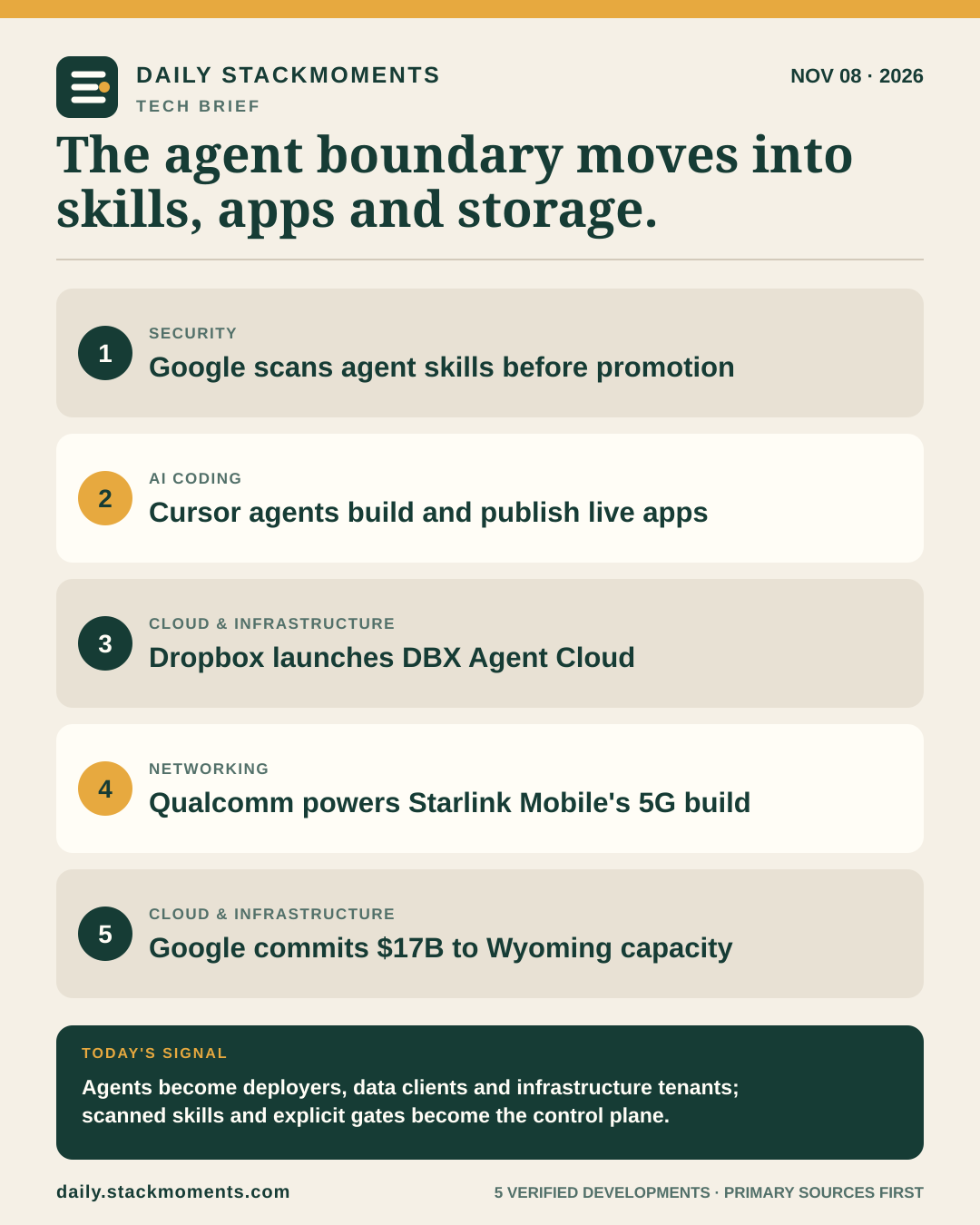
Shareable visual

Poster of the Day

All five verified developments and today's technology signal, ready to share.

Daily StackMoments 1080 by 1350 poster summarizing five key technology developments for November 8, 2026Download poster ↓