Daily brief · November 10, 2026

AI infrastructure specializes from models to machines.

Gated frontier models, confidential accelerators, agent-assisted runtime audits and portable VM APIs redraw the production stack.

8 minute read4 developmentsPrimary sources first
01
AI & Models6 min read

Anthropic releases Claude Fable 5.2 and restricted Mythos 5.2

Anthropic released Claude Fable 5.2 for broad use and Claude Mythos 5.2 for approved cybersecurity and life-sciences organizations. They share an underlying model, while Fable applies stronger cyber and biology safeguards. Anthropic says the models generate output up to 30% faster than their 5.1 predecessors, start at $8 per million input tokens and $40 per million output tokens, and add an optional faster mode at twice that price.

Why it mattersModel selection is becoming a routing decision rather than a single default. Engineering leaders should benchmark the new model on their own migrations and agent workflows, separate vendor-reported evaluation gains from production evidence, and budget fast mode only where latency changes user or operational outcomes. Restricted Mythos access also shows capability gating becoming part of model architecture and procurement.

Source: Anthropic announcement and model documentation, corroborated by Reuters ↗ · Published November 9, 2026

#Claude Fable 5.2#Claude Mythos 5.2#model routing#Claude Code
02
Cloud & Infrastructure6 min read

Google adds confidential-computing and high-context TPU systems

Google introduced TPU 8tx for confidential inference and smaller-scale training, pairing TPU 8t silicon with 5th Gen AMD EPYC hosts to protect models and data while in use. It also introduced TPU 8i Max, a dual-chip package with twice the compute, SRAM and HBM bandwidth of TPU 8i for large-context agent workloads. Performance and density figures are Google claims pending independent production evidence.

Why it mattersAccelerator selection now includes data-in-use protection, context shape, memory bandwidth and rack density—not only raw model throughput. Platform teams should validate attestation, key ownership, isolation boundaries, supported frameworks, regional capacity and workload-level cost before treating confidential AI or maximum-context packaging as an architectural guarantee.

Source: Google Cloud announcement, corroborated by AMD and Reuters ↗ · Published November 9, 2026

#TPU 8tx#TPU 8i Max#confidential computing#AI accelerators
03
Security7 min read

Microsoft's agentic scanner finds soundness bugs in Rust's standard library

Microsoft FORGE Lab reported several soundness bugs in Rust's core and standard libraries, including cases where safe Rust can trigger undefined behavior because unsafe internals trusted panic behavior, caller-provided implementations or process-wide operating-system state. Researchers reproduced the issues and coordinated with Rust maintainers; several fixes landed, while two reported issues remained open at publication.

Why it mattersRust reduces memory-safety risk but does not eliminate review obligations at unsafe boundaries. Teams maintaining unsafe Rust should make invariants explicit, test panic and adversarial trait behavior, model FFI and process-global state, track upstream toolchain fixes and combine agentic discovery with human reproduction and impact analysis. A soundness bug is not automatically an exploitable vulnerability.
Read the unsafe Rust soundness-boundary guide

Source: Microsoft FORGE Lab research and linked Rust maintainer reports ↗ · Published November 9, 2026

#Rust#memory safety#unsafe code#agentic security research
04
Cloud & Infrastructure5 min read

VM API enters the CNCF Sandbox for Kubernetes-native virtual machines

The Cloud Native Computing Foundation accepted VM API into its Sandbox. Contributed by Broadcom, the project defines Kubernetes APIs for provisioning and managing virtual machines across heterogeneous infrastructure providers. Broadcom also said it will co-chair a new Kubernetes Workload Conformance Working Group; both efforts are early-stage community work rather than finished portability standards.

Why it mattersA vendor-neutral API could let platform teams apply declarative workflows and policy across containers and VMs without coupling the control model to one virtualization stack. Before adoption, teams should evaluate provider implementations, lifecycle semantics, storage and network integration, migration behavior and project governance—the Sandbox designation signals experimentation, not production maturity.

Source: Broadcom announcement and CNCF project listings ↗ · Published November 9, 2026

#VM API#CNCF Sandbox#Kubernetes#virtual machines

Shareable visual

Poster of the Day

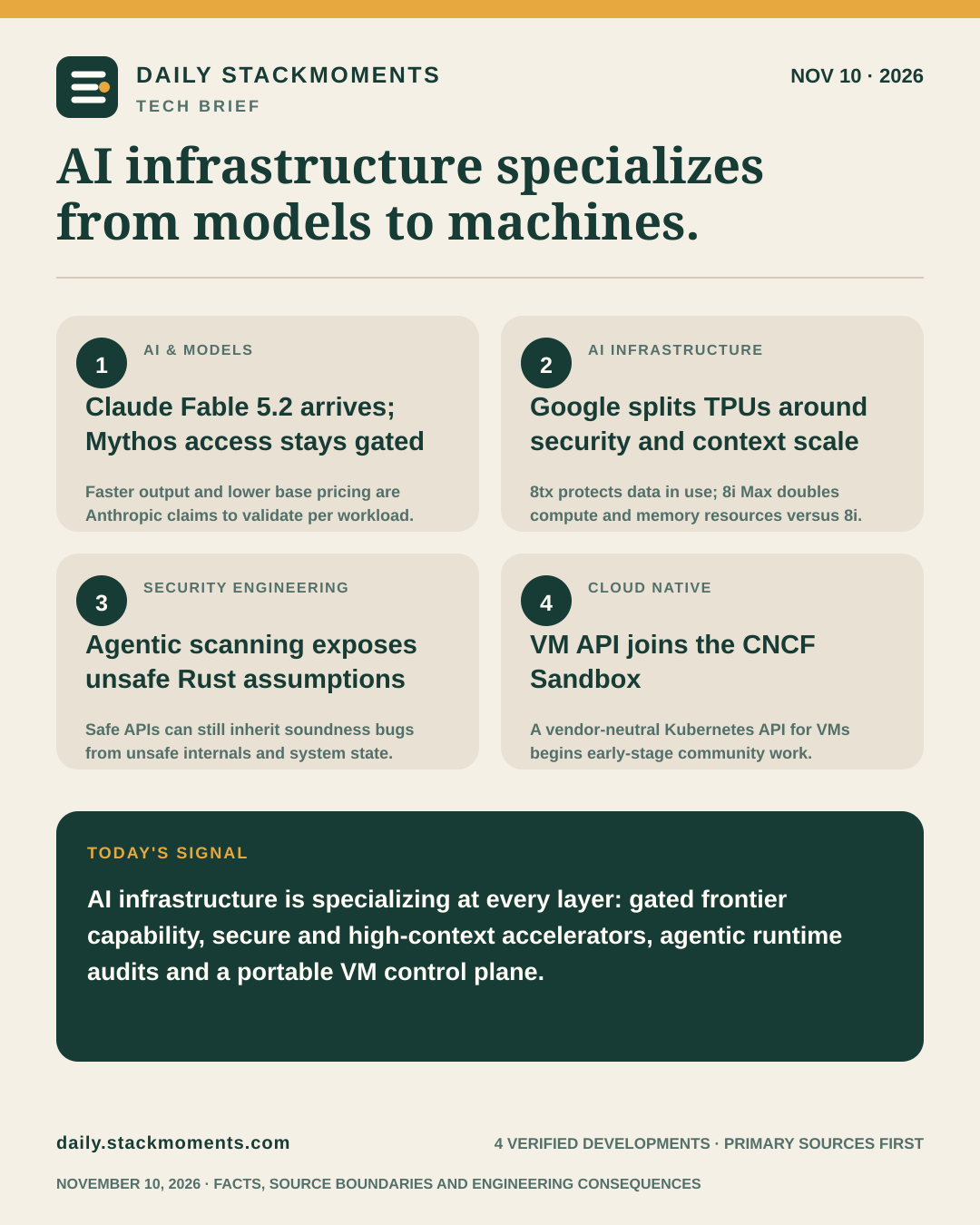
All four verified developments and today's technology signal, ready to share.

Daily StackMoments 1080 by 1350 poster summarizing four verified technology developments for November 10, 2026Download poster ↓