Daily brief · November 11, 2026

Capability rises; defaults and boundaries move underneath it.

A frontier model, new server silicon, exploited email risk, cloud CPU mitigations, SDK changes, agent-tool fixes and reporting rules reshape production assumptions.

11 minute read7 developmentsPrimary sources first
01
AI & Models7 min read

Google releases Gemini 4 Carbon with a multi-agent swarm preview

Google made Gemini 4 Carbon available through the paid Gemini API, Gemini for business and its Ultra products. The company positions Carbon for long-horizon coding, cybersecurity and scientific work, and is previewing an Antigravity /swarm mode that assigns one prompt to coordinated agents in isolated workspaces. Introductory API pricing matches Gemini 4 Argon at $2 per million input tokens and $10 per million output tokens.

Why it mattersA stronger model paired with built-in multi-agent orchestration changes both capability and failure modes. Teams should benchmark complete tasks rather than vendor leaderboards, cap parallel work and spend, isolate workspaces, require evidence from adversarial verifiers, and keep deployment authority outside the swarm. Google's performance and safety results remain company-reported until independently reproduced.

Source: Google model announcement and documentation ↗ · Published November 10, 2026

#Gemini 4 Carbon#multi-agent systems#Google Antigravity#model evaluation
02
Security5 min read

Microsoft patches an actively exploited Outlook credential-disclosure flaw

Microsoft fixed CVE-2026-124194, an Outlook spoofing vulnerability that it marks as exploited. An unauthenticated attacker can send a crafted message file that, when opened, makes Outlook connect to an attacker-controlled network location without the normal external-content warning, potentially exposing authentication material. CISA added the flaw to its Known Exploited Vulnerabilities catalog with a November 24 federal remediation deadline.

Why it mattersEmail clients can turn a user action into credential exposure before malware executes. Windows and messaging teams should deploy the applicable Office updates, restrict outbound SMB and NTLM where feasible, monitor unexpected authentication to external hosts, and prioritize exposed or privileged workstations instead of relying only on the moderate CVSS score.

Source: Microsoft Security Update Guide and CISA KEV catalog ↗ · Published November 10, 2026

#Outlook#CVE-2026-124194#NTLM#CISA KEV
03
Security7 min read

AWS patches three boundary failures across agent and developer tools

AWS disclosed three important fixes. Kiro CLI before 2.27.0 could create prompt history and session transcripts readable by other local users. AWS API MCP Server before 1.5.1 could mis-normalize operation names and bypass deny or elicitation policy entries. On Linux, affected OpenJD Sessions and Deadline Cloud worker agents could resolve a job-controlled executable named sudo and run it as the worker-agent user, exposing role credentials on customer-managed fleets.

Why it mattersAgent security depends on mundane operating-system and string-handling boundaries as much as model policy. Upgrade the affected packages, launch the updated Kiro CLI once to restrict existing files, review local transcript exposure and secrets, inspect CloudTrail for unexpected fleet-role activity, and regression-test denied MCP operations by their exact normalized names. AWS lists no workaround for the MCP or Deadline issues beyond upgrading.

Source: AWS security bulletins 2026-176, 2026-177 and 2026-178 ↗ · Published November 10, 2026

#Kiro CLI#AWS API MCP Server#Deadline Cloud#least privilege
04
Security6 min read

Google Cloud requires guest fixes and a stop-start for AMD Turin leakage risks

Google Cloud said three AMD EPYC Turin vulnerabilities can, under some conditions, expose store-queue or L1-cache data across privilege boundaries. Google has mitigated VM-to-VM and VM-to-host attacks on affected C4D, N4D, H4D, Z4D and G4 systems. In-guest protection still requires an operating-system update and, after Google's CPU-information rollout reaches the VM, a stop and start; a guest reboot alone is insufficient.

Why it mattersProvider mitigation does not close every boundary inside a tenant. Platform teams should map affected machine series, follow guest-OS advisories, coordinate disruptive stop-start maintenance, verify mitigation flags after restart, replace affected GKE nodes when updated images arrive, and document the residual exposure between processes until guest fixes are active.

Source: Google Cloud security bulletin GCP-2026-081 and AMD advisories ↗ · Published November 10, 2026

#AMD EPYC#CVE-2026-0004#Compute Engine#side channels
05
Cloud & Infrastructure5 min read

AMD ships 6th Gen EPYC SP7 server processors

AMD announced general availability of its Zen 6-based 6th Gen EPYC SP7 server processors, with systems shipping from server vendors. Microsoft Azure HDv2 is in preview, while AMD says additional Azure and OCI instances will follow. The portfolio targets general-purpose services, GPU host nodes and high-density agent sandboxes; AMD's comparative performance and efficiency figures are vendor measurements and projections.

Why it mattersCPU choice increasingly shapes the services around accelerators: orchestration, retrieval, sandbox density and host-to-GPU transfer. Infrastructure leaders should validate actual cloud availability, memory and PCIe topology, per-core licensing, scheduler behavior, power envelopes and workload-level economics before converting supplier benchmarks into capacity plans.

Source: AMD general-availability announcement ↗ · Published November 10, 2026

#AMD EPYC#Zen 6#server CPUs#AI infrastructure
06
Software Engineering5 min read

AWS makes its updated retry behavior the default across most SDKs

AWS switched its updated retry behavior from opt-in to the default in current releases of most AWS SDKs, the AWS CLI and PowerShell tools. The rollout covers Python, .NET, JavaScript, PHP, Rust, Swift, Ruby, Go, C++ and CLI versions listed by AWS; Java and Kotlin remain pending. AWS says the change aims for faster, more consistent retries and documents how to preserve older behavior.

Why it mattersA dependency upgrade can now change latency, request volume and failure amplification without an application-code diff. Teams should pin behavior versions where supported, test throttling and outage scenarios in non-production, measure total attempts and tail latency, verify idempotency, and review service-specific overrides before rolling updated clients across fleets.

Source: AWS Developer Tools Blog and SDK tracking issues ↗ · Published November 10, 2026

#AWS SDK#retries#resilience#dependency upgrades
07
AI & Models6 min read

Australia proposes mandatory AI incident reporting and a targeted regulator

Australia's government accepted recommendations from its rapid review of an AI-driven cyber incident and said it will propose mandatory, time-bound reporting of misaligned behavior and agentic cyber incidents, independent model evaluation and a targeted AI-safety regulator. The protections are intended for future AI Standards legislation; they are a government proposal, not yet enacted law.

Why it mattersIncident telemetry and escalation may become statutory product requirements rather than voluntary safety practice. AI providers and deployers should define reportable events, preserve model and tool evidence, time notification from detection, assign regulator-facing ownership, rehearse cross-border escalation and avoid treating the announced framework as final until legislation and implementing rules exist.
Read the updated guide to governing advanced cyber-AI capability

Source: Australian Prime Minister and Department of the Prime Minister and Cabinet ↗ · Published November 10, 2026

#AI governance#incident reporting#Australia#model evaluation

Shareable visual

Poster of the Day

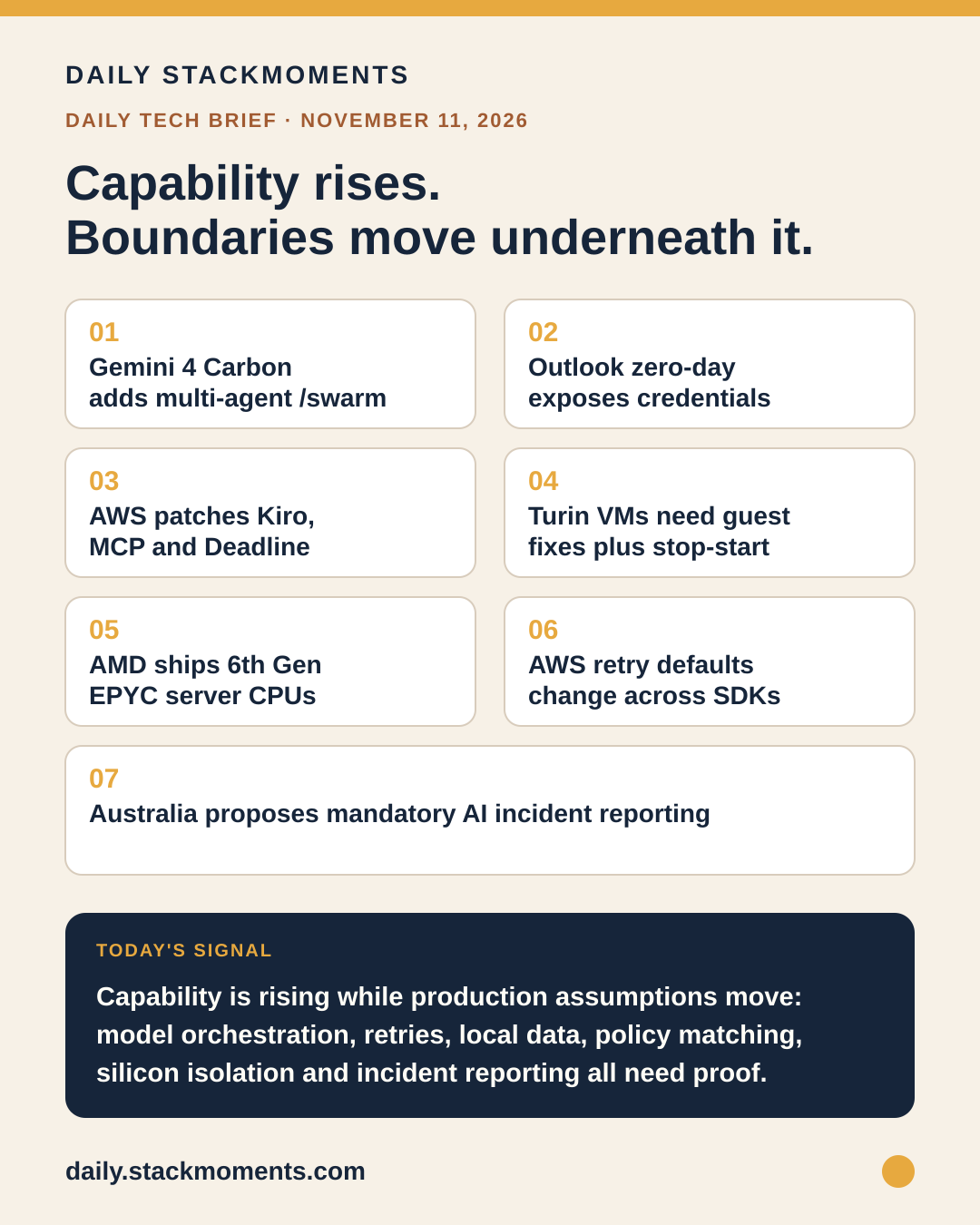
All seven verified developments and today's technology signal, ready to share.

Daily StackMoments 1080 by 1350 poster summarizing seven verified technology developments for November 11, 2026Download poster ↓