Daily brief · November 12, 2026

Infrastructure earns trust by making its boundaries testable.

Local cloud fidelity, cross-cloud agent governance, hybrid quantum execution and regional AI investment move ambitious systems closer to operational evidence.

9 minute read4 developmentsPrimary sources first
01
Software Engineering7 min read

AWS releases an open-source local emulator for cloud application tests

AWS made AWS Emulator generally available as a free, open-source Rust project. Applications, CLI scripts and coding agents can call a local HTTPS endpoint through the same AWS SDK and CLI interfaces used in production. AWS publishes service-level fidelity tests, while documenting that the emulator does not enforce IAM or resource policies and does not model cross-account or cross-Region behavior.

Why it mattersA first-party emulator can shorten feedback loops and let agents exercise cloud APIs without real credentials or deployed resources. Teams should pin emulator versions, review published fidelity scores, fail on unimplemented operations, keep production credentials out of test jobs and retain integration tests in real AWS because local behavioral fidelity is not an authorization or security guarantee.

Source: AWS News Blog and AWS Emulator documentation ↗ · Published November 11, 2026

#AWS Emulator#local testing#coding agents#cloud fidelity
02
Security7 min read

Google extends agent governance across Kubernetes and hardens CodeMender sandboxes

Google Cloud released Agent Gateway for cross-cloud in limited preview for agents on CNCF-conformant Kubernetes outside Google Cloud, including EKS, AKS, OpenShift and bare metal. Local proxies can enforce access and Model Armor policies and export traces. CodeMender 0.21 also moves build validation inside its sandbox, mounts host toolchains read-only, isolates caches and Git configuration, disables repository hooks and adds recovery controls.

Why it mattersAgent policy must travel to the runtime without turning the model into its own security boundary. Platform teams should verify identity propagation, proxy bypass paths, log destinations and failure behavior across clusters. For coding agents, build commands, hooks, caches and host configuration belong inside the threat model; the new controls are a useful baseline, not evidence that arbitrary repositories are safe to execute.
Read the updated agent harness architecture guide

Source: Google Cloud Gemini Enterprise Agent Platform release notes ↗ · Published November 11, 2026

#Agent Gateway#CodeMender#Kubernetes#sandbox isolation
03
Cloud & Infrastructure6 min read

IBM details a 520-qubit Nighthawk processor and hybrid quantum platform

IBM announced that Nighthawk r3 is designed for 10,000 quantum operations across 520 programmable qubits, with a plan to link two processors into a 1,040-qubit system in 2027. IBM also expanded its managed Quantum Platform to combine quantum execution with classical and HPC resources. The processor and 2027 system are roadmap commitments; reported workload speedups come from IBM and participating partners.

Why it mattersNear-term quantum engineering is becoming a hybrid scheduling, sampling and post-processing problem rather than a standalone chip exercise. Technology leaders should evaluate reproducible workload evidence, error rates, classical resource requirements, queue time and total cost before translating qubit or operation targets into application roadmaps.

Source: IBM Quantum announcement and platform documentation ↗ · Published November 11, 2026

#IBM Quantum#Nighthawk r3#hybrid computing#HPC
04
AI & Models5 min read

Databricks plans a $3 billion EMEA expansion for enterprise AI

Databricks announced plans to invest approximately $3 billion across Europe and the Middle East over three years, its largest regional investment outside North America. The company says the program will expand engineering and customer teams, support adoption of Lakebase, Genie and Unity Gateway, grow European R&D hubs and train about 500,000 people by 2030. These are company commitments and future targets, not completed investment or adoption results.

Why it mattersRegional engineering capacity, sovereignty requirements and skills availability increasingly shape where enterprise AI platforms can be deployed. Leaders should separate announced spending from delivered capacity, and validate data residency, control-plane location, model availability, support coverage and exit costs before treating regional investment as architectural sovereignty.

Source: Databricks regional investment announcement ↗ · Published November 11, 2026

#Databricks#EMEA#enterprise AI#data sovereignty

Shareable visual

Poster of the Day

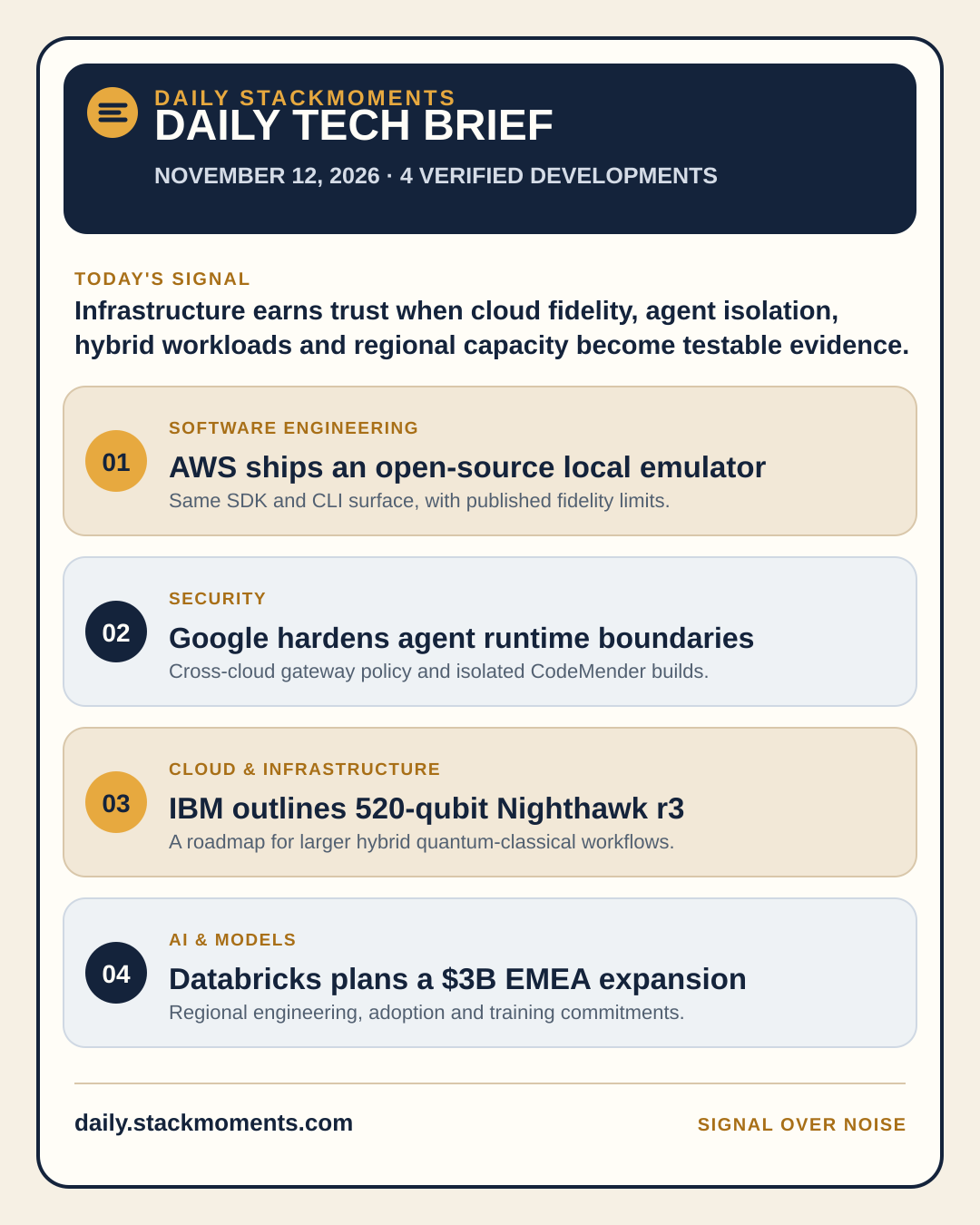
All four verified developments and today's technology signal, ready to share.

Daily StackMoments 1080 by 1350 poster summarizing four verified technology developments for November 12, 2026Download poster ↓