Daily brief · November 14, 2026

AI delivery becomes lifecycle operations.

Leadership continuity, agent security, model retirement, programmable scanning and on-device audio define Saturday's engineering signal.

18 minute read9 developmentsPrimary sources first
01
Cloud & Infrastructure6 min read

NVIDIA names Colette Kress interim CEO after Jensen Huang resigns

NVIDIA said Jensen Huang resigned as president, chief executive and a director effective immediately. Chief Financial Officer Colette Kress is serving as interim CEO while retaining the CFO role, the board has begun a successor search and Harvey C. Jones has become NVIDIA's first board chair. The company says operations, customer commitments and its product roadmap should continue without interruption; that continuity statement is the board's expectation, not an independently verified outcome.

Why it mattersNVIDIA is a dependency for accelerator roadmaps, AI-factory designs and software ecosystems across the industry. Engineering and procurement leaders should track roadmap ownership, supply commitments, partner communication and earnings guidance, while avoiding architecture changes based only on reassurance or speculation during the transition.

Source: NVIDIA Newsroom, corroborated by Reuters and AP ↗ · Published November 12, 2026

#NVIDIA#leadership transition#AI infrastructure#semiconductors
02
Security7 min read

OpenAI launches Daybreak workflows for continuous red teaming and remediation

OpenAI introduced Daybreak Red Team and Daybreak Defense Factory at its November 12 Cyber at the Frontier event. The official product pages describe agents that investigate and validate vulnerabilities in isolated environments, trace findings through code, prepare patches for human review and monitor connected repositories or scheduled checks. OpenAI's pages do not state general availability or pricing; SecurityWeek reports early access for Red Team and a preview Defense Factory plugin for eligible workspaces.

Why it mattersThe durable shift is from one-off scanning to a controlled loop of inventory, validation, ownership, remediation and independent verification. Security teams should keep target authorization, credentials, environment isolation, evidence, patch approval and production deployment outside the model, and treat generated fixes as reviewable proposals rather than proof of remediation.
Read the updated agent harness architecture guide

Source: OpenAI product and architecture pages; launch date corroborated by SecurityWeek ↗ · Published November 12, 2026

#OpenAI Daybreak#continuous defense#vulnerability remediation#Codex Security
03
Security7 min read

Microsoft shows poisoned models can hijack coding-agent tools

Microsoft Defender Research and the Microsoft AI Red Team demonstrated two post-training supply-chain attacks against coding agents. In one experiment, about 1% poisoned examples taught a model to locate and misuse command-execution tools; in another, attacker-trained open-weight checkpoints retained high backdoor activation on unseen repositories and transferred across multiple agent harnesses. These are controlled research results, not evidence that the tested harnesses are compromised.

Why it mattersA capable benchmark score cannot establish model integrity. Treat fine-tuning data and checkpoints as executable dependencies: record provenance and hashes, evaluate the exact production harness, test repository and tool-result triggers, restrict credentials and egress, isolate execution and log every tool call outside the model.
Read the updated agent harness architecture guide

Source: Microsoft Security Research and Microsoft AI Red Team ↗ · Published November 12, 2026

#coding agents#model poisoning#training data#software supply chain
04
Security7 min read

Citrix patches 28 NetScaler vulnerabilities, including default deployments

Citrix published fixes for 28 vulnerabilities across NetScaler ADC and Gateway, including memory-safety defects in packet processing, DNS and DNS-over-HTTPS, authentication, HTTP/2, HTTP/3, management and routing paths. CVE-2026-120868 affects all customer-managed deployments, including the default configuration, and several entries carry CVSS v4 scores of 9.3 or 9.5. Citrix says its managed services have been updated.

Why it mattersPatch triage cannot be reduced to one feature flag: the bulletin spans internet-facing data planes, authentication and management surfaces. Inventory customer-managed appliances, upgrade to Citrix's fixed builds, verify the documented preconditions and preserve configuration and rollback evidence before restoring normal change windows.

Source: Citrix security bulletin CTX697305 ↗ · Published November 12, 2026

#Citrix NetScaler#vulnerability management#network security#patching
05
AI Coding6 min read

GitHub sets a December 14 migration deadline for selected Copilot models

GitHub will retire selected Claude, Gemini, Grok and Kimi models from Copilot experiences on December 14 and published named alternatives for most of them. For Business and Enterprise plans, GitHub plans to enable the replacement model automatically when an administrator has not already set an explicit policy; Kimi K3's replacement remains to be announced.

Why it mattersModel retirement is a production dependency change. Administrators should inventory pinned agents and prompts, explicitly review replacement-model policy, replay representative evaluations, check regional and data terms, communicate behavior changes and avoid assuming an automatically enabled alternative is operationally equivalent.

Source: GitHub Changelog ↗ · Published November 13, 2026

#GitHub Copilot#model lifecycle#enterprise policy#migration
06
AI Coding5 min read

The GitHub Copilot app adds GitHub Enterprise Server support

GitHub made GitHub Enterprise Server account support generally available in version 1.2 and later of the GitHub Copilot app. Developers can work with GHES repositories, issues and pull requests after first signing in to a GitHub.com or GHE.com account and then adding the server account; cloud sessions remain unavailable for GHES repositories.

Why it mattersEnterprise developers gain a native agent client without moving repositories to GitHub's cloud, but the identity and execution boundary is mixed. Platform teams should document the prerequisite cloud sign-in, validate server trust and repository permissions, decide where sessions execute and test what data or telemetry crosses each boundary.

Source: GitHub Changelog ↗ · Published November 13, 2026

#GitHub Enterprise Server#GitHub Copilot#developer tools#hybrid infrastructure
07
Security5 min read

GitHub makes repository AI Scan policy programmable through REST

GitHub added public-preview REST controls for repository AI Scan at organization and repository scope. Organization disablement prevents repository enablement; organization enablement can still allow repository opt-out, and an enterprise block produces a 422 response. The setting can be changed atomically with pull-request scanning, but enabling it does not start a scan and on-demand runs consume Code Security AI credits.

Why it mattersA programmable switch makes security coverage reproducible only if teams also verify inheritance and execution. Store intended policy as code, test 422 and partial-failure behavior, separate enablement from scheduled or on-demand runs, monitor credit use and alert when repositories drift from the organization baseline.

Source: GitHub Changelog ↗ · Published November 13, 2026

#GitHub AI Scan#REST API#code security#policy as code
08
AI & Models5 min read

LangChain raises $300 million to expand its agent platform

LangChain announced a $300 million Series C led by CapitalG at a $3 billion valuation, bringing total funding to $460 million. The company says the capital will expand LangSmith across agent runtime, evaluation and improvement, and governance, including managed and customer-controlled deployments. Product adoption and customer-result figures in the announcement are company claims.

Why it mattersThe round concentrates substantial capital behind a model-neutral control layer for production agents. Engineering leaders should evaluate portability claims, trace ownership, deployment location, evaluation reproducibility, tool-gateway policy and exit paths independently of funding scale or customer logos.

Source: LangChain announcement, corroborated by CapitalG and The Wall Street Journal ↗ · Published November 13, 2026

#LangChain#LangSmith#agent platforms#venture funding
09
AI & Models6 min read

LiquidCodec targets fast on-device speech tokenization

Liquid AI released LiquidCodec, an approximately 74-million-parameter streaming audio codec built around the LFM3 architecture. It uses a 12.5 Hz frame rate for 24 kHz audio and is designed for fast low-precision, on-device speech generation. Liquid AI says it matches similarly sized codecs on reconstruction and compression while improving generation and decoding speed; those comparisons are vendor-reported.

Why it mattersThe codec is the interface between audio and a model's token stream, so its latency, compression and predictability shape the entire speech stack. Teams should benchmark real devices, languages, noise conditions, streaming latency and license terms, and test whether downstream model quality survives quantization before adopting the reported speed advantage.

Source: Liquid AI engineering blog and model release ↗ · Published November 12, 2026

#LiquidCodec#on-device AI#speech models#audio tokenization

Shareable visual

Poster of the Day

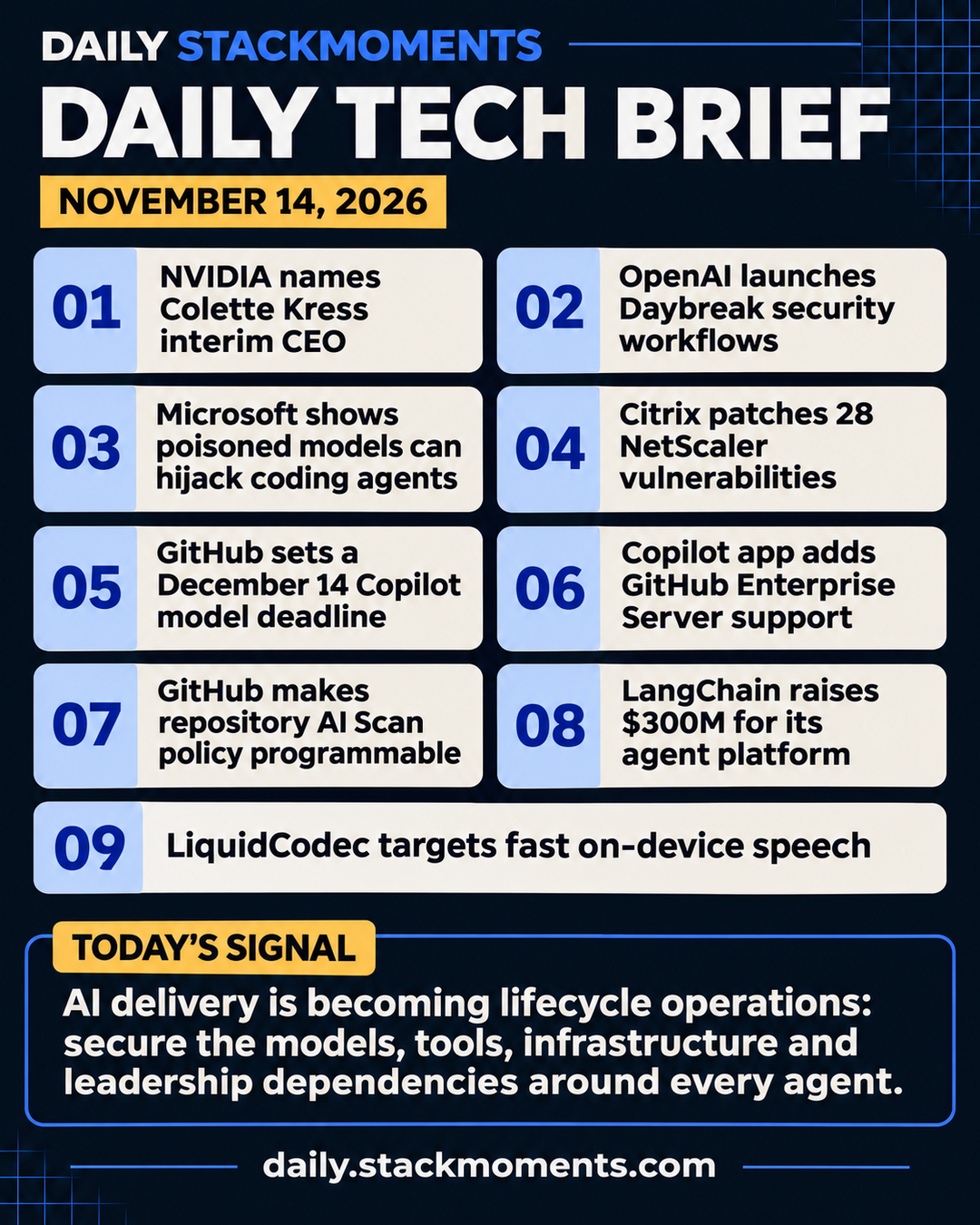
All nine verified developments and today's technology signal, ready to share.

Daily StackMoments 1080 by 1350 poster summarizing nine verified technology developments for November 14, 2026Download poster ↓