Daily brief · October 1, 2026

AI capability accelerates—and the control stack tightens.

Six verified developments connect a new frontier model, regulatory scrutiny, memory and rack-scale capacity, multi-model coding and token-free package operations.

19 minute read6 developmentsPrimary and corroborated sources
01
AI & Models4 min read

Google unveils Gemini 4 Argon

Google announced Argon, the first flagship model in its Gemini 4 generation, for complex workloads. Google says its internal results are competitive with OpenAI Astra and Anthropic Opus on selected coding and cybersecurity benchmarks; the model is initially being shared with selected cybersecurity partners, with no public-release date announced.

Why it mattersArgon adds another frontier option but remains a controlled preview backed largely by vendor benchmarks. Engineering leaders should wait for reproducible evaluations, pricing, latency and safety documentation before making architecture or migration decisions.

Source: Reuters ↗ · Published September 30, 2026

#Gemini 4#Argon#frontier models#model evaluation
02
Security3 min read

FTC opens an inquiry into AI-agent risks

Reuters reported that the US Federal Trade Commission opened an investigation involving Anthropic, OpenAI and the research organization METR. The inquiry focuses on potential consumer and cybersecurity harms from autonomous AI systems and may seek records and executive testimony.

Why it mattersAgent failures are moving from voluntary safety reviews into regulatory discovery. Providers and enterprise adopters should retain evaluation evidence, access logs, incident timelines and remediation decisions that can demonstrate how autonomous actions were constrained and investigated.

Source: Reuters ↗ · Published September 30, 2026

#FTC#AI agents#regulatory inquiry#incident evidence
03
Cloud & Infrastructure3 min read

Micron's long-term customer commitments reach $32 billion

Micron said customer commitments under long-term supply agreements increased from $22 billion in June to $32 billion, with most backed by cash deposits. The company reported orders exceeding capacity as demand for high-bandwidth memory and other AI data-centre components remains strong.

Why it mattersMemory is becoming a first-order capacity constraint for AI systems, not a secondary server component. Infrastructure planners should model accelerator, HBM, storage and networking availability together and expect longer procurement commitments to shape cloud pricing and deployment timelines.

Source: Reuters ↗ · Published September 30, 2026

#Micron#HBM#AI infrastructure#capacity planning
04
Cloud & Infrastructure3 min read

Vultr places HPE's first AMD Helios rack order

HPE announced a $1.2 billion order from Vultr for AMD Helios AI Rack systems at US cloud data centres. It is HPE's first order for the Helios platform, which combines AMD accelerators with purpose-built HPE scale-up networking and software for training and inference workloads.

Why it mattersRack-scale AI systems are becoming integrated procurement units rather than collections of independently selected servers and switches. Cloud architects should evaluate the resulting performance benefits alongside supplier concentration, portability, cooling, network topology and operational tooling.

Source: HPE ↗ · Published September 30, 2026

#HPE#Vultr#AMD Helios#rack-scale AI
05
AI Coding3 min read

HydraFusion expands to VS Code and the Copilot app

GitHub expanded the HydraFusion research preview from Copilot CLI to Visual Studio Code 1.140 or later and the GitHub Copilot app. The orchestration layer can use a single model, a cascade or a critique workflow depending on the coding task and available models.

Why it mattersMulti-model orchestration is moving into mainstream developer interfaces, making the routing layer—not only the chosen model—part of code-generation quality, cost and latency. Teams should evaluate the complete workflow and preserve human review for generated changes.

Source: GitHub Changelog ↗ · Published September 30, 2026

#HydraFusion#VS Code#GitHub Copilot#multi-model orchestration
06
Security3 min read

npm trusted publishing adds token-free dist-tag management

npm trusted-publishing configurations can now receive an opt-in permission to manage dist-tags such as latest, next and beta using short-lived OIDC credentials. The permission defaults to off and is independent of direct package publication, including for staging-only configurations.

Why it mattersMaintainers can remove another reason to retain long-lived npm access tokens while keeping tag promotion separately scoped. Release teams should enable the permission only on the workflows that need it and review rollback and promotion paths before deleting existing credentials.

Source: GitHub Changelog ↗ · Published September 30, 2026

#npm#OIDC#trusted publishing#software supply chain

Shareable visual

Poster of the Day

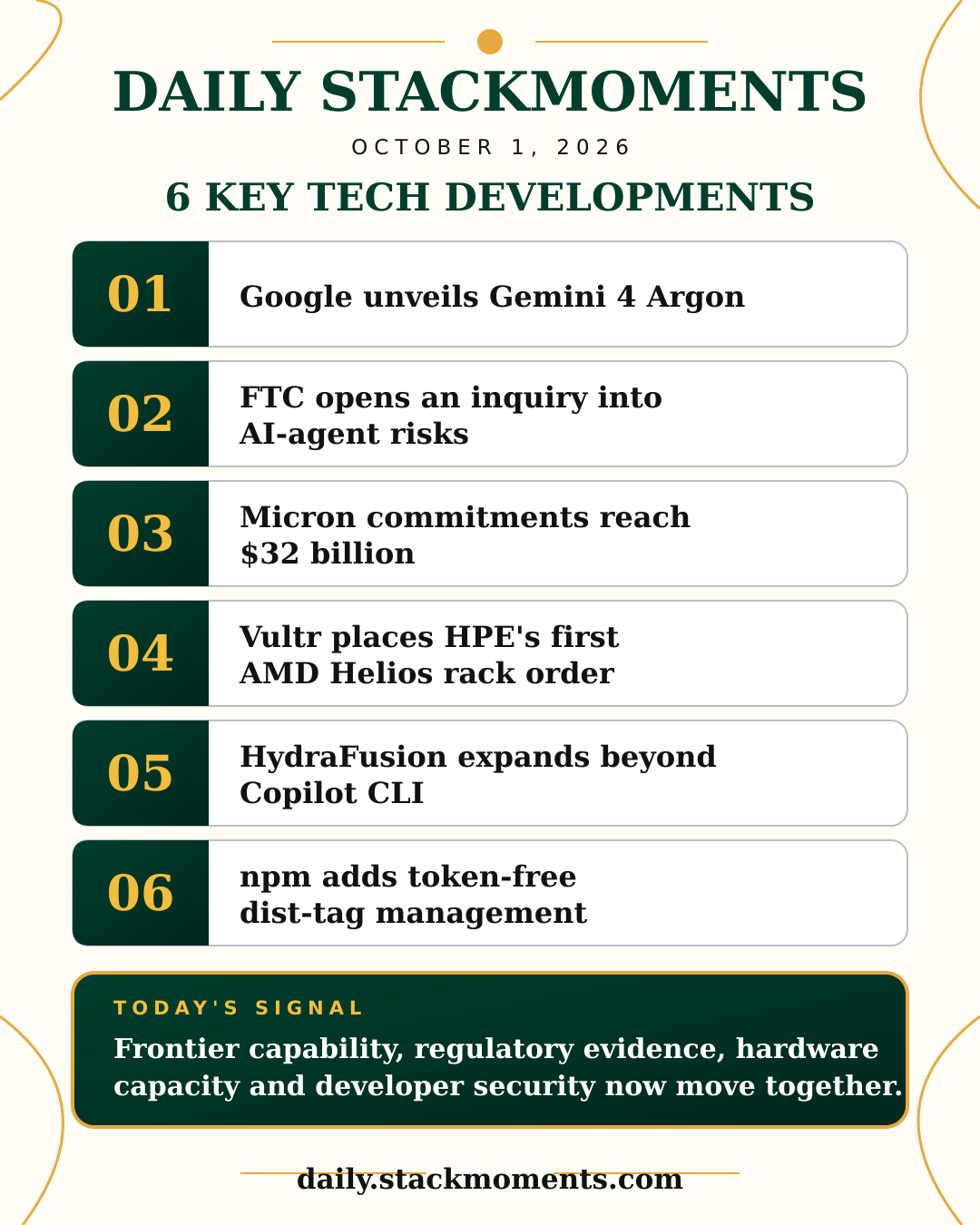
All six key developments from today's verified edition, ready to share.

Daily StackMoments 1080 by 1350 poster summarizing six key technology developments for October 1, 2026Download poster ↓