Daily brief · October 2, 2026

AI scale meets its financing, security and integrity limits.

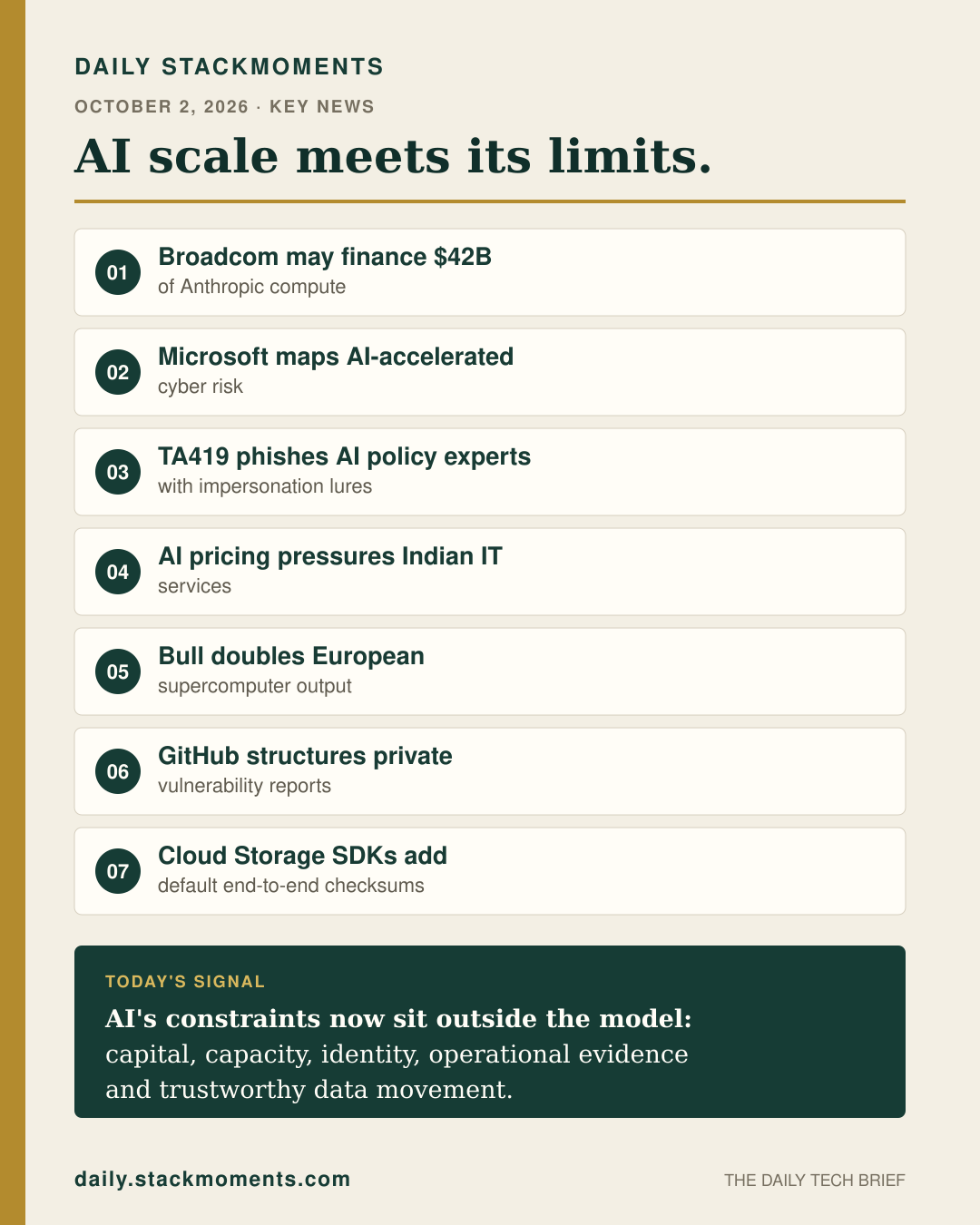
Seven verified developments connect compute financing, cyber risk, services economics, sovereign infrastructure, secure disclosure and data integrity.

23 minute read7 developmentsPrimary and corroborated sources
01
Cloud & Infrastructure4 min read

Broadcom may finance up to $42 billion of Anthropic compute

Anthropic's IPO filing says Broadcom agreed to provide up to $42 billion in convertible financing tied to infrastructure purchases. The facility could fund roughly one-third of Anthropic's five-year, $125.2 billion commitment to lease Google TPU capacity supplied through Broadcom.

Why it mattersAI infrastructure deals are becoming intertwined with their financing. Engineering and finance leaders should model supplier concentration, conversion rights, pricing incentives and counterparty risk alongside compute capacity and unit economics.

Source: Reuters ↗ · Published October 1, 2026

#Anthropic#Broadcom#AI infrastructure#compute financing
02
Security4 min read

Microsoft maps AI-accelerated cyber risk

Microsoft's 2026 Digital Defense Report says threat actors are using AI across reconnaissance, social engineering, malware and exploit development, and post-compromise activity. It finds that AI mostly accelerates familiar attack paths while identity, exposed systems and trusted access remain central targets.

Why it mattersAI changes the speed and scale of attacks more than the defensive fundamentals. Security teams should prioritize identity hardening, exposure reduction and telemetry while treating agent access to enterprise data, applications and APIs as a new privileged surface.

Source: Microsoft Security ↗ · Published October 1, 2026

#Microsoft#cybersecurity#AI threats#identity security
03
Security3 min read

TA419 targets AI policy experts with credential phishing

Proofpoint documented a China-aligned TA419 campaign impersonating former US officials and researchers to target fewer than ten people working on AI policy. Collaboration-themed lures directed targets to credential-stealing sites; Reuters independently reported the campaign.

Why it mattersPolicy communities around strategic technology are high-value access paths, even when campaigns are small. Organizations should protect external collaboration with phishing-resistant authentication, verified contact channels and rapid investigation of identity anomalies.

Source: Proofpoint ↗ · Published October 1, 2026

#TA419#credential phishing#AI policy#threat intelligence
04
Software Engineering3 min read

AI pricing pressure reaches Indian IT services

Reuters reported that five brokerages expect a weak September quarter for India's largest IT services firms as clients remain cautious and AI puts pressure on billable-hours pricing. The top six firms are projected to post sequential revenue growth between 0.7% and 3.5%.

Why it mattersAI is beginning to reshape commercial models, not only delivery workflows. Services leaders need outcome-based pricing, measurable productivity evidence and workforce plans that do not assume revenue will continue to track engineering hours.

Source: Reuters ↗ · Published October 1, 2026

#IT services#AI economics#pricing#workforce
05
Cloud & Infrastructure3 min read

Bull doubles European supercomputer output

French supercomputer maker Bull expanded its Angers factory from six to twelve racks per month and says it can reach 24 next year. The Atos-owned facility supports EuroHPC deployments and is described as Europe's only factory dedicated to these systems.

Why it mattersSovereign AI ambitions depend on physical production capacity as much as policy and software. More regional rack output can shorten deployment timelines, but buyers still need durable semiconductor supply, energy, networking and operational expertise.

Source: Reuters ↗ · Published October 1, 2026

#Bull#EuroHPC#supercomputing#sovereign AI
06
Security3 min read

GitHub structures and rate-limits private vulnerability reports

GitHub introduced customizable private-vulnerability-report forms with required fields, optional CWE selection and AI-assistance disclosure. New per-account, repository and platform limits are intended to reduce spam while preserving a private channel for coordinated disclosure.

Why it mattersBetter intake quality helps maintainers triage reports faster without weakening private disclosure. Security teams should define the evidence they require, disclose AI assistance accurately and keep an alternate contact path for legitimate reports that hit automated limits.

Source: GitHub Changelog ↗ · Published October 1, 2026

#GitHub#vulnerability disclosure#security triage#AI disclosure
07
Cloud & Infrastructure3 min read

Cloud Storage SDKs enable end-to-end checksums by default

Google Cloud said current Cloud Storage SDKs now calculate upload checksums when an application does not provide one, support download verification, and add end-to-end range checksums for gRPC reads. Applications must update to current SDK versions to receive the behavior.

Why it mattersSilent data corruption is rare but costly, especially in large AI and analytics pipelines. Default integrity checks reduce application burden, but teams should update clients, verify performance impact and preserve explicit validation where compliance or recovery requires it.

Source: Google Cloud ↗ · Published October 1, 2026

#Cloud Storage#checksums#data integrity#SDKs

Shareable visual

Poster of the Day

All seven key developments from today's verified edition, ready to share.

Daily StackMoments 1080 by 1350 poster summarizing seven key technology developments for October 2, 2026Download poster ↓