Daily brief · October 3, 2026

AI agents meet explicit permission boundaries.

Seven verified developments connect operating-system consent, agent-toolchain security, programmable review and the economics of AI capacity.

23 minute read7 developmentsPrimary and corroborated sources
01
Security4 min read

Apple plans stronger consent for apps requesting Full Disk Access

Apple said it will add controls requiring very explicit user action before an app receives macOS Full Disk Access. The company warned that the permission can expose files, mail, messages and browsing history, and said the risk grows as AI agents become more capable and autonomous.

Why it mattersA broad operating-system permission can turn an agent into a high-impact data path. Desktop-agent teams should design for scoped capabilities, visible consent, revocation and auditability instead of treating a one-time Full Disk Access grant as durable authorization.
Read the desktop-agent security guide

Source: Apple Developer ↗ · Published October 2, 2026

#macOS#AI agents#permissions#privacy
02
Security4 min read

AWS patches agent-control and SageMaker workspace flaws

AWS published important bulletins for three Loom for AWS flaws, including an authentication bypass and access to internal credential endpoints, and for a SageMaker Space startup-script injection path that could expose another project member's temporary role credentials. It also fixed argument injection in its security-agent MCP server's diff scan.

Why it mattersAgent orchestration, MCP tools and shared ML workspaces all sit close to credentials and execution. Operators should upgrade Loom to 1.7.0 and security-agent-mcp-server to 0.2.0, then restart affected SageMaker Spaces so patched images are applied.

Source: AWS Security Bulletins ↗ · Published October 1–2, 2026

#AWS#SageMaker#MCP#agent security
03
Cloud & Infrastructure3 min read

Amazon reportedly explores moving $8 billion of AI chips off balance sheet

Reuters, citing the Financial Times, reported that Amazon is seeking investors for a special-purpose vehicle that would own about $8 billion of NVIDIA Grace Blackwell chips and lease them back to Amazon. Amazon and NVIDIA did not comment on the reported proposal.

Why it mattersAI capacity is creating new financing structures alongside new hardware architectures. Engineering and finance leaders should evaluate lease duration, residual value, hardware obsolescence, counterparty exposure and portability—not only accelerator availability.

Source: Reuters ↗ · Published October 2, 2026

#Amazon#NVIDIA#AI infrastructure#compute financing
04
Software Engineering3 min read

Anthropic commits $100 million to train enterprise AI deployment engineers

Anthropic launched Claude Frontier Academy, a program combining instruction, simulated deployment and security reviews, and a 12-week residency. The company says it aims to train 10,000 Frontier Deployed Engineers by the end of 2027, beginning with cohorts from consulting, finance and healthcare organizations.

Why it mattersEnterprise AI deployment is becoming a distinct engineering discipline spanning workflow design, evaluation, security and change management. Leaders should judge the program by measurable deployment quality and safe operating practices, not the training target alone.

Source: Anthropic ↗ · Published October 2, 2026

#Anthropic#AI workforce#enterprise deployment#training
05
AI Coding3 min read

GitHub exposes Copilot code review through REST and GraphQL APIs

GitHub made Copilot code review requestable through REST and GraphQL APIs and added configurable review effort. Balanced becomes the default for repositories without an explicit Lite setting, while existing explicit settings remain unchanged.

Why it mattersAI review can now be wired into repository automation rather than triggered only through the interface. Teams should set effort deliberately, measure useful findings and false positives, and retain human ownership of merge decisions.

Source: GitHub Changelog ↗ · Published October 2, 2026

#GitHub Copilot#code review#REST API#GraphQL
06
Security3 min read

GitHub expands private advisory collaboration and automation

GitHub added confidential comments to repository security advisories, a public-preview REST API for non-confidential advisory comments, and new SecurityAdvisory GraphQL fields and filters. Confidential comments are visible only to maintainers with write access and are recorded in the audit log.

Why it mattersDisclosure workflows need both a restricted channel for sensitive coordination and machine-readable records for triage, audit and reporting. Maintainers should define when a comment must remain confidential and avoid placing secrets in API-managed discussion.

Source: GitHub Changelog ↗ · Published October 2, 2026

#GitHub#security advisories#vulnerability disclosure#automation
07
Software Engineering3 min read

GitHub completes its rollout of stateless App installation tokens

GitHub completed the move to stateless installation access tokens with a new ghs_APPID_JWT format. Tokens are roughly 520 characters instead of 40, while permissions, repository scope and the one-hour lifetime are unchanged.

Why it mattersToken consumers must treat credentials as opaque. Integrations should remove fixed-length validation and truncation, expand secret-redaction patterns and verify storage fields before GitHub retires the temporary compatibility header on November 30.

Source: GitHub Changelog ↗ · Published October 2, 2026

#GitHub Apps#access tokens#authentication#integrations

Shareable visual

Poster of the Day

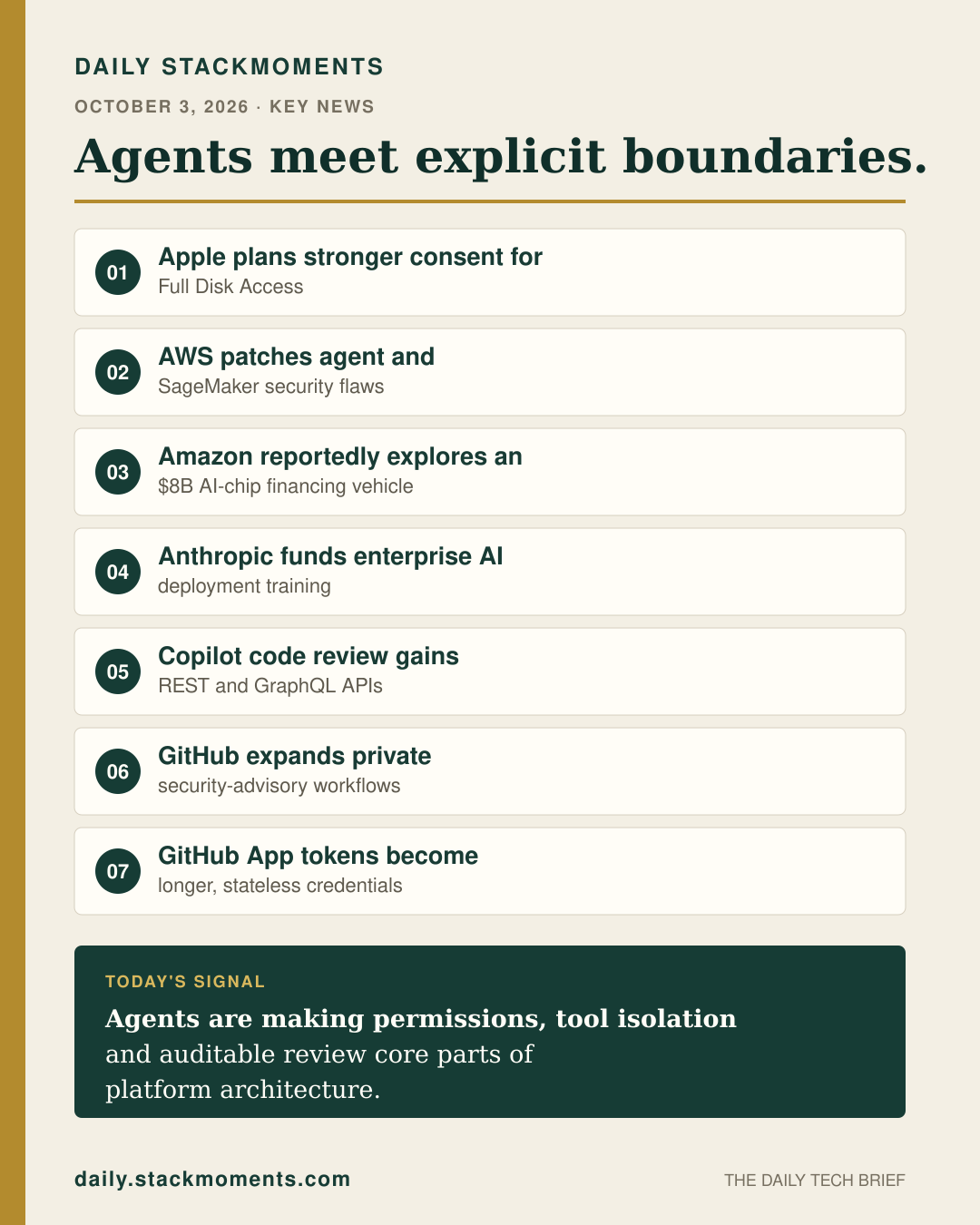
All seven key developments from today's verified edition, ready to share.

Daily StackMoments 1080 by 1350 poster summarizing seven key technology developments for October 3, 2026Download poster ↓