Daily brief · October 8, 2026

Interactive AI meets local execution boundaries.

GPT-6 reshapes the answer surface while Windows and GitHub move model execution, sandboxing and context-aware security closer to the developer.

21 minute read5 developmentsPrimary sources first
01
AI & Models4 min read

ChatGPT rolls out GPT-6 with an interactive answer surface

OpenAI began rolling out GPT-6 with Intelligent UI in ChatGPT. The product can combine text, visuals and interactive elements such as calculators or diagrams, and can start presenting an answer while reasoning or tool use continues. Paid Chat plans receive GPT-6 Sol first; Free and Go begin receiving GPT-6 Luna on October 8, while Work and Codex models are unchanged.

Why it mattersGenerated interfaces are becoming a model output, not a separately designed application screen. Product and security teams should test accessibility, state handling, tool boundaries, partial-answer updates and the provenance of interactive elements—not just the factual quality of final text.

Source: OpenAI ChatGPT release notes ↗ · Published October 7, 2026

#GPT-6#Intelligent UI#ChatGPT#generative interfaces
02
Cloud & Infrastructure5 min read

Windows combines local frontier models with enforceable agent containment

Microsoft made Microsoft Execution Containers generally available on Windows 11 and outlined a hybrid-intelligence stack that routes work between local and cloud models. It says organizations can constrain agent access to files and networks at runtime; MAI Code 1.1 Flash now runs locally with 3-bit quantization and a 256K context window, while GitHub HydraFusion local routing is planned for experimental preview later in October.

Why it mattersInference placement is becoming an architecture choice driven by privacy, latency and token cost, but local execution does not remove the need for governance. Engineering teams should benchmark device requirements and model quality while defining enforceable filesystem, network, identity and logging policies for every local agent.
Read the updated desktop-agent security guide

Source: Microsoft Windows Experience Blog ↗ · Published October 7, 2026

#Windows#local AI#MXC#hybrid inference
03
AI Coding4 min read

GitHub Copilot local sandboxing reaches general availability

GitHub made local sandboxing generally available in Copilot CLI, the Copilot app and VS Code Agent Host sessions. Policies can restrict filesystem, network and credential access, including local MCP servers and language servers; organizations can require settings that developers cannot weaken. The cross-platform implementation uses Microsoft Execution Containers.

Why it mattersAgent autonomy is safer when tool execution is constrained independently of the model. Platform teams can now standardize local sandbox policy across Windows, macOS and Linux, but should validate defaults, credential handling, MCP exposure and exception workflows before making sandboxed agents the enterprise baseline.
Read the updated desktop-agent security guide

Source: GitHub Changelog ↗ · Published October 7, 2026

#GitHub Copilot#sandboxing#MXC#agent security
04
Security4 min read

GitHub adds a context-aware model for unstructured secrets

GitHub introduced a fine-tuned classifier that uses surrounding code to identify likely credentials without recognizable token formats. Existing AI-detected password alerts moved to the new model; push protection is in private preview, Copilot security-review integration is coming, and GitHub Enterprise Server 3.23 is slated to receive alert support in public preview.

Why it mattersPattern matching misses passwords and credentials that lack a fixed format, so context-aware detection can close a real supply-chain gap. Security leaders should still measure false positives and define remediation ownership, while reviewing the separate AI-credit billing and policy controls for opt-in push and review checks.

Source: GitHub Changelog ↗ · Published October 7, 2026

#secret scanning#push protection#GitHub Advanced Security#software supply chain
05
AI & Models4 min read

Biohub partners assemble $1.8 billion for AI-ready biology data

Biohub said the U.S. Department of Energy, NIH, Meta, Google DeepMind and Isomorphic Labs are joining its Virtual Biology Initiative, bringing funding, existing federal data and infrastructure commitments to $1.8 billion. The project aims to generate and standardize large cellular datasets for predictive biology models; commercial contributors receive a temporary head start before funded datasets become public.

Why it mattersFor scientific foundation models, measurement quality and interoperability may matter more than another round of model scaling. Data and ML leaders should watch the project's schemas, provenance, access terms and validation methods before treating the promised virtual-cell models or accelerated drug timelines as established outcomes.

Source: Reuters ↗ · Published October 7, 2026

#AI for science#biological data#open data#foundation models

Shareable visual

Poster of the Day

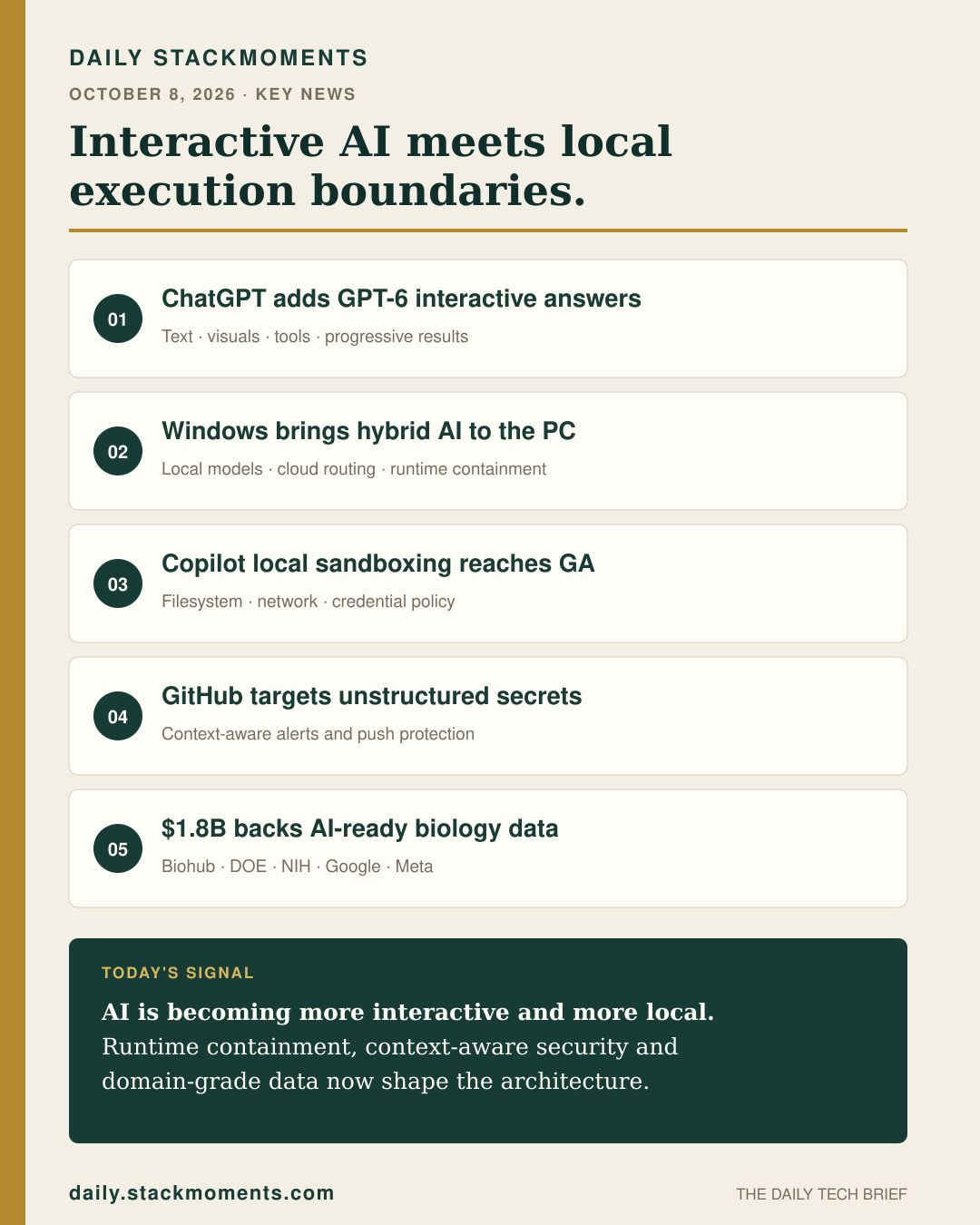
All five verified developments and today's technology signal, ready to share.

Daily StackMoments 1080 by 1350 poster summarizing five key technology developments for October 8, 2026Download poster ↓