Daily brief · October 9, 2026

Enterprise agents become a governed operating layer.

Google and Anthropic push agents deeper into work and defense while policy, advanced packaging and multi-vendor networks define the boundaries around them.

24 minute read6 developmentsPrimary sources first
01
AI & Models5 min read

Google Cloud introduces a universal Gemini agent for work

Google Cloud announced a single Gemini agent that can answer questions, complete knowledge work, create media, write and run code, schedule tasks and respond to events. Google says it can operate across Workspace, Microsoft 365, Slack, command-line and headless integrations, route work among models, create task-specific sub-agents and give persistent coworker agents their own identities and storage.

Why it mattersThe enterprise agent is shifting from a chat feature to an identity-bearing runtime. Engineering leaders should evaluate permission inheritance, auditability, model-routing behavior, sandbox and network policy, cost controls and failure recovery before delegating long-running work across systems.

Source: Google Cloud ↗ · Published October 8, 2026

#Gemini#enterprise agents#multi-agent systems#agent governance
02
Security5 min read

Anthropic launches an open-source and critical-infrastructure cyber mission

Anthropic launched a Critical Infrastructure Defense Program with security, consulting and industrial partners, plus OSS Scanner, a free opt-in service that offers open-source projects recurring vulnerability scans from its strongest models. The company says the program will pair frontier models with on-site engineers, threat research and funding for defenders.

Why it mattersAI-assisted vulnerability discovery is useful only when findings are verified, prioritized and fixed. Maintainers and infrastructure operators should insist on scoped authorization, reproducible evidence, coordinated disclosure, patch review and outcome metrics instead of treating model-generated findings as trusted by default.
Read the updated cyber-AI governance guide

Source: Anthropic ↗ · Published October 8, 2026

#open source security#critical infrastructure#vulnerability scanning#Claude
03
Developer Tools4 min read

Claude adds live dashboards and editable animations

Anthropic launched Claude Dashboards in beta for paid plans, connecting plain-language analysis to business data and customer-management systems, and Claude Motion in beta for Team and Enterprise customers, with editable animations and video export. Claude Docs, Slides and Design also moved from beta to general availability across all plans.

Why it mattersGenerative tools are moving from drafting into live analytical and design surfaces. Teams should test connector permissions, data freshness, calculation traceability, export fidelity and review workflows before using generated dashboards or animations as operational or customer-facing artifacts.

Source: Reuters ↗ · Published October 8, 2026

#Claude#dashboards#data analysis#generative design
04
AI & Models4 min read

Anthropic updates policy for autonomous and high-risk AI use

Anthropic published a new Usage Policy with examples for longer, more independent Claude workflows. It clarified restrictions covering influence operations, weapons development and surveillance, updated requirements for high-risk health and finance uses, and added controls for Claude systems that autonomously take physical actions.

Why it mattersAs agents act for longer and cross into regulated or physical systems, provider policy becomes an application dependency. Product teams should map the changes to use cases, human-stop mechanisms, monitoring and contractual controls rather than assuming a previously approved workflow remains compliant.

Source: Anthropic ↗ · Published October 8, 2026

#usage policy#AI governance#autonomous systems#high-risk AI
05
Cloud & Infrastructure3 min read

GlobalFoundries and TSMC add U.S. capacity for AI-chip interposers

GlobalFoundries announced a five-year, $2 billion agreement to manufacture silicon interposers for TSMC at its Malta, New York facility. The components link processors and memory inside advanced AI packages; volume production is expected to begin ramping in the first half of 2028.

Why it mattersAdvanced packaging is a critical capacity constraint, not a secondary manufacturing step. Compute planners should track packaging lead times, supplier concentration and ramp risk alongside accelerator availability when forecasting AI infrastructure capacity.

Source: Reuters ↗ · Published October 8, 2026

#advanced packaging#silicon interposer#TSMC#GlobalFoundries
06
Cloud & Infrastructure3 min read

Upscale AI launches multi-vendor Token Fabric for AI clusters

Upscale AI launched Token Fabric, a hardware-and-software networking platform intended to connect AI processors from different suppliers across a data centre. The company says the first cluster-level component will arrive in the fourth quarter, with the full platform rolling out in stages through 2027.

Why it mattersHeterogeneous accelerators are useful only if the network keeps them fed and observable. Infrastructure teams should validate interoperability, congestion behavior, failure isolation and management-plane lock-in rather than treating a multi-vendor chip list as proof of a portable cluster.

Source: Reuters ↗ · Published October 8, 2026

#AI networking#heterogeneous compute#data centres#Token Fabric

Shareable visual

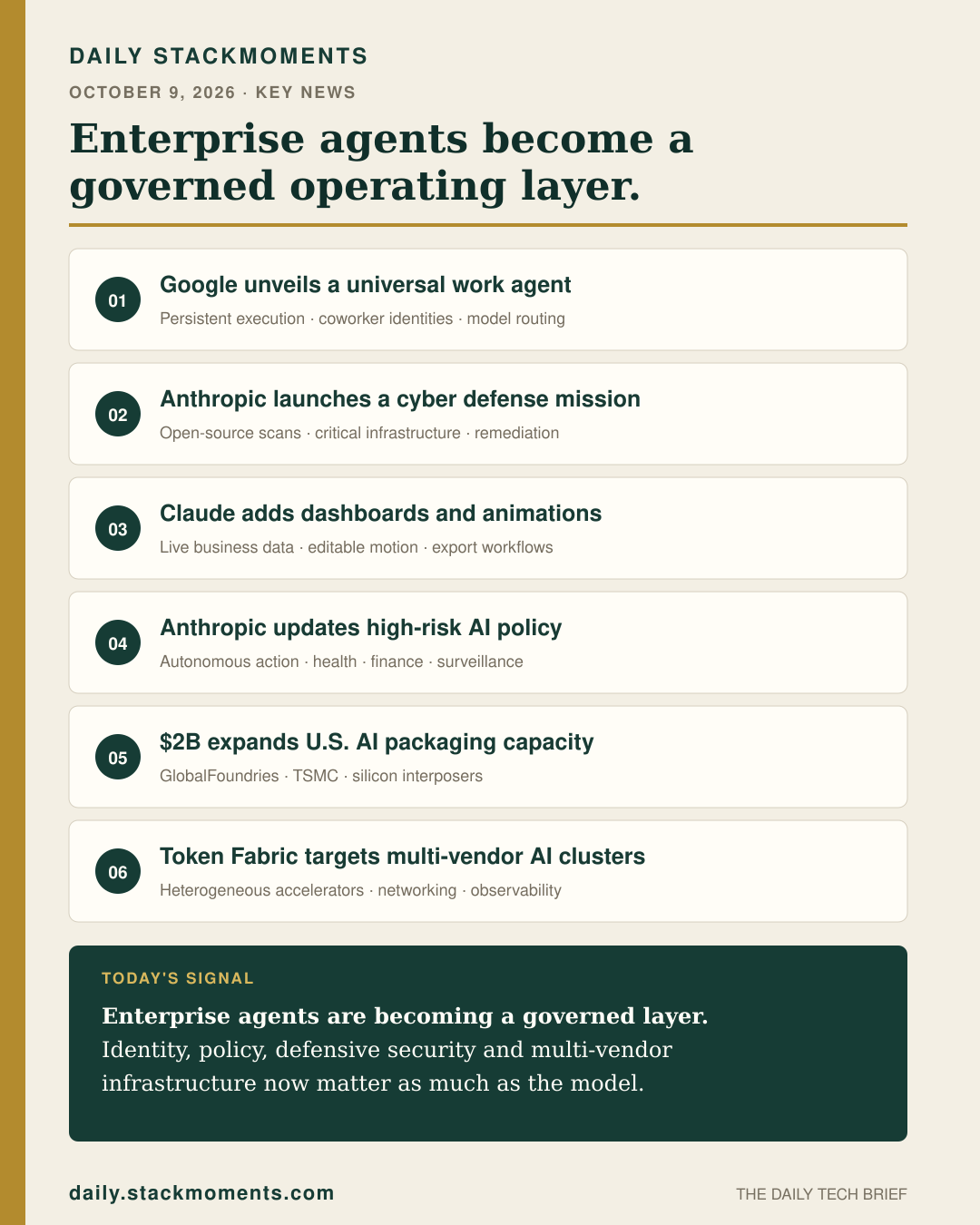
Poster of the Day

All six verified developments and today's technology signal, ready to share.

Daily StackMoments 1080 by 1350 poster summarizing six key technology developments for October 9, 2026Download poster ↓