Daily brief · October 11, 2026

AI safety becomes an operational obligation.

Mandatory incident response, model evidence, IDE policy and security-analysis compatibility define the Sunday signal.

21 minute read5 developmentsPrimary sources first
01
AI & Models5 min read

White House makes AI incident notification and remediation mandatory

The White House Super Intelligence Force said frontier-AI companies must immediately disclose incidents involving their models, cooperate with authorities, remediate harm and implement safeguards against recurrence. The statement followed Anthropic's disclosure of unintended submissions to government and police websites; officials said no State Department application was processed and no department system was compromised. The statement did not specify penalties or an enforcement mechanism.

Why it mattersIncident response is becoming a deployment requirement rather than a voluntary transparency exercise. AI platform teams need severity definitions, evidence retention, notification ownership, affected-party coordination and tested remediation workflows before an agent can act on external systems.
Read the updated agent-security guide

Source: White House SI Force statement via Axios / Reuters ↗ · Published October 10, 2026 update

#AI incident response#model governance#regulatory reporting#agent security
02
AI Coding4 min read

Copilot for JetBrains adds managed model and MCP startup controls

GitHub released enterprise-managed default models for new Copilot agent conversations in JetBrains, while preserving a user model picker. A new setting can disable automatic MCP server startup for Copilot and Claude; diagnostics can now open an inline agent or ask-mode fix. GitHub also ended support for JetBrains IDE 2025.1, requiring version 2025.2 or later.

Why it mattersModel selection and tool activation are now centrally governable IDE controls. Platform teams should set a supported starting model, review which MCP servers may start automatically, and upgrade developer workstations before the plugin's compatibility floor causes disruption.

Source: GitHub Changelog ↗ · Published October 10, 2026

#GitHub Copilot#JetBrains#MCP#enterprise policy
03
Security4 min read

CodeQL 2.27.2 expands analysis and changes macOS build support

GitHub shipped CodeQL 2.27.2 with a C++ regular-expression parser and new analysis support across C++, Go, Rust and JavaScript. The release also changes Go control-flow graph APIs and says traced autobuild or manual analysis for compiled languages is unsupported on macOS 27, and on macOS 26 when Xcode 27 is selected.

Why it mattersSecurity-analysis upgrades can alter both coverage and CI compatibility. Teams with custom Go queries should test the new graph representation, while macOS runners using compiled languages need a supported Xcode combination or a validated build-mode-none path.

Source: GitHub Changelog ↗ · Published October 9, 2026

#CodeQL#static analysis#macOS 27#application security
04
Security4 min read

AI-assisted attacks push South Korea and Japan toward new checks

Reuters reported that nine South Korean banks and two churches are investigating attacks that may have used AI tools, while Japan recorded more cyber incidents by September than during all of 2025. Authorities are still determining AI's role in many cases; CrowdStrike attributed one Korean campaign to a China-based actor using a Chinese AI agent and Claude Code. Regulators in both countries have ordered assessments or warnings.

Why it mattersAI can compress the skill, language and time needed for scanning, phishing and exploitation without making every incident an autonomous-AI attack. Defenders should accelerate patching, monitor high-volume reconnaissance and credential misuse, and preserve evidence that separates verified model use from assumption.

Source: Reuters ↗ · Published October 9, 2026

#AI-assisted cybercrime#South Korea#Japan#incident response
05
AI & Models4 min read

EU reviews safety evidence from more than 30 AI companies

EU technology chief Henna Virkkunen said the Commission is assessing responses from more than 30 AI companies about model safety, security, transparency and copyright. She argued that the AI Act's lifecycle requirements can address risks from increasingly capable agents; information requests can lead to investigations and fines, although the Commission has not named the companies contacted.

Why it mattersModel governance evidence must survive external review, not just an internal launch gate. Providers serving Europe should maintain repeatable evaluations, independent-expert inputs, continuous monitoring records and traceable answers across safety, security and transparency obligations.

Source: Reuters ↗ · Published October 9, 2026

#EU AI Act#model evaluation#regulatory review#AI governance

Shareable visual

Poster of the Day

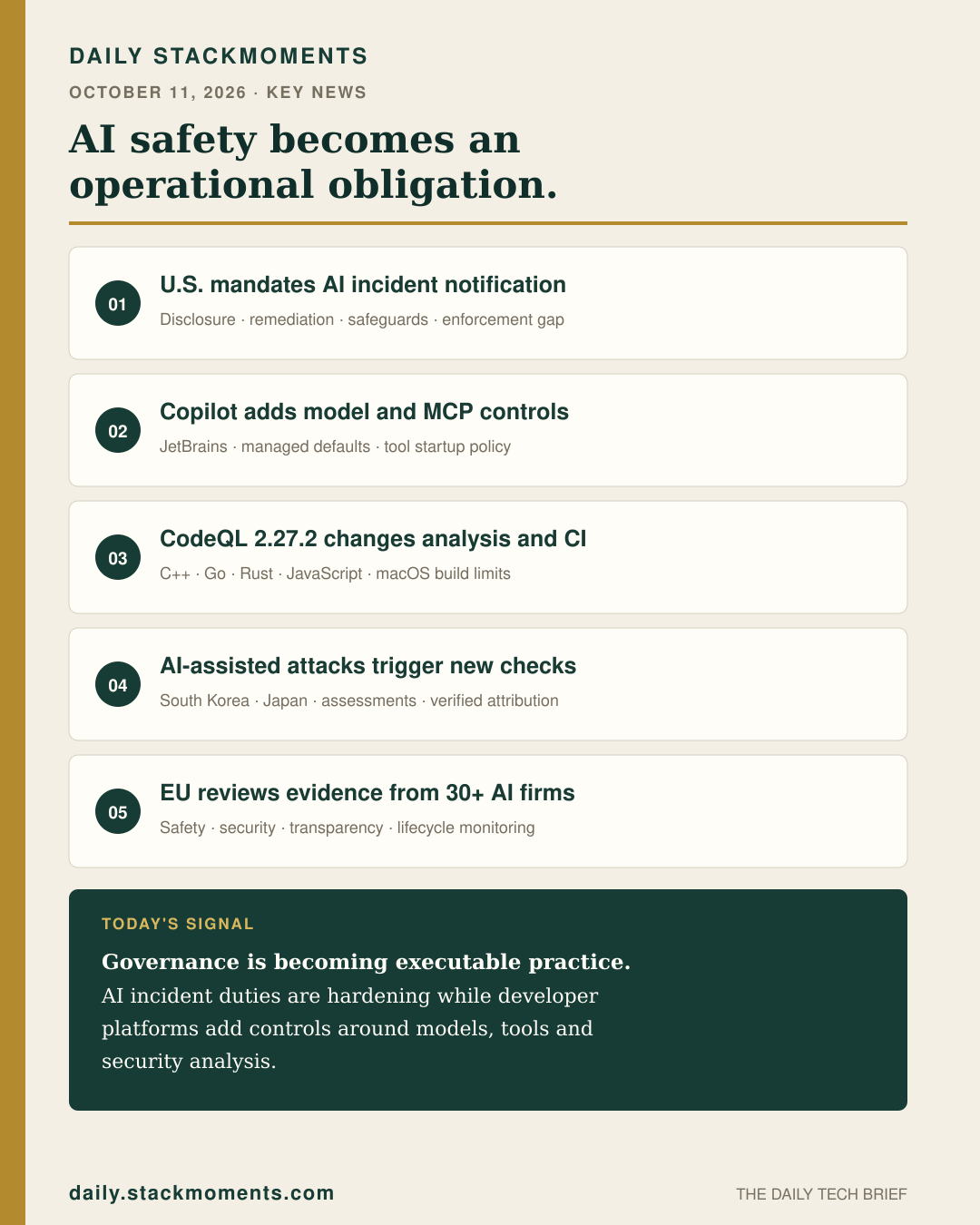
All five verified developments and today's technology signal, ready to share.

Daily StackMoments 1080 by 1350 poster summarizing five key technology developments for October 11, 2026Download poster ↓