Daily brief · October 13, 2026

AI scale meets controls closer to execution.

Agent models and custom silicon arrive alongside model-theft defenses, evaluation regimes and stronger software provenance.

9 minute read7 developmentsPrimary sources first
01
AI & Models5 min read

Meta releases Muse Wonder models for long-running agent work

Meta released Muse Wonder through its Model API and Muse Code, with Muse Wonder Full for Muse Code subscribers. The company says the models add Active Memory across conversations and Active Focus for retrying, recovering and checking before important actions. Meta described them as its most capable models, but said a full safety-evaluation report will follow later.

Why it mattersPersistent memory and extended autonomous work enlarge the state, privacy and failure surface of an agent. Teams evaluating the models should test memory retention and deletion, permission scopes, interruption, recovery and confirmation behavior—and treat benchmark and safety claims as provisional until the full report is available.

Source: Meta Newsroom ↗ · Published October 12, 2026

#Muse Wonder#agentic AI#active memory#model API
02
Cloud & Infrastructure5 min read

Microsoft commits Maia 300 to multi-gigawatt Azure deployments

Microsoft said Maia 300 production deployments will begin in 2027 as it scales the accelerator family to multi-gigawatt capacity. The inference-first system combines 96 accelerators in a 167-kilowatt rack with 27.6 TB of HBM and 1.7 PB/s aggregate memory bandwidth. Microsoft claims 40% more tokens per megawatt than leading GPU-based systems.

Why it mattersAI economics increasingly depend on the whole rack—memory, interconnect, power and software—not a chip in isolation. Infrastructure leaders should compare delivered throughput and model compatibility, plan for power-density and cooling changes, and account for capacity and portability risk before assuming vendor efficiency claims translate to their workloads.

Source: Microsoft ↗ · Published October 12, 2026

#Maia 300#AI accelerators#Azure#inference infrastructure
03
Security4 min read

Anthropic says new controls cut distillation extraction by 90–99%

Anthropic said new safeguards against model-distillation attacks reduced harvested data by about 90% to 99% and reasoning-token extraction by 10 to 100 times. The company says the controls make proxy-network probing harder, have a false-positive rate below 0.1%, and accompanied bans on tens of thousands of linked accounts. The figures are Anthropic's measurements; Z.ai, one company it named, did not immediately comment to Reuters.

Why it mattersModel APIs now need abuse controls that join identity, traffic, proxy and reasoning-access signals. Providers must measure extraction resistance without silently blocking legitimate workloads, while customers should expect tighter account linkage and anomaly detection around high-volume or patterned requests.

Source: Reuters / Anthropic ↗ · Published October 13, 2026

#model distillation#API abuse#model security#Claude
04
AI & Models4 min read

UK expands frontier-model testing and AI cyber preparedness

The UK government said its AI Security Institute is evaluating the latest advanced models and will extend defensive-AI pilots that have identified and fixed more than 1,000 potential government-system vulnerabilities. It is also considering AI incident and near-miss reporting under the Cyber Security and Resilience Bill regime and preparing for serious incidents involving autonomous agents.

Why it mattersExternal evaluation and AI incident readiness are becoming operational dependencies for frontier providers and critical services. Teams should be able to reproduce model evaluations, grant secure pre-deployment access, document remediation and connect agent incidents to established cyber-response ownership.

Source: UK Cabinet Office / AI Security Institute / NCSC ↗ · Published October 12, 2026

#AI evaluation#AI Security Institute#cyber resilience#agent incidents
05
Developer Platforms5 min read

AWS launches Lambda Web Functions for standard HTTP apps

AWS launched Lambda Web Functions for port-listening Node.js applications without event-handler adapters. The service supports up to 128 concurrent requests per environment, active-CPU billing, multi-region deployment, weighted revision traffic and CloudFront private origins. It launches on Arm64 with Node.js 24 in five regions.

Why it mattersWeb Functions reduce the glue needed to run conventional servers on Lambda, but they also introduce a distinct concurrency, memory-billing and regional model. Platform teams should benchmark latency and cost, validate state and connection behavior, and plan around the launch runtime and region limits before migration.

Source: AWS News Blog ↗ · Published October 12, 2026

#AWS Lambda#serverless#web applications#Node.js 24
06
Security4 min read

GitHub adds authenticated pusher identity to every commit

GitHub now durably records the authenticated pusher for each commit, separately from client-supplied author and committer strings, and exposes the identity in its UI and API. A new ruleset condition can require the committer to match a verified email address of the pusher. The feature is in limited public preview for GitHub Enterprise customers.

Why it mattersCommit metadata alone is not a reliable identity control. Authenticated pusher attribution strengthens investigation and policy enforcement after an account compromise, but security teams must update API consumers, audit workflows and rulesets to use the new field.

Source: GitHub Changelog ↗ · Published October 12, 2026

#GitHub#commit provenance#repository rules#software supply chain
07
Security3 min read

Dependabot supports anonymous organization-level registries

GitHub made anonymous authentication generally available for organization-level private registries on github.com, covering internal mirrors that allow credential-free reads. The registry applies to granted repositories, including security-update-only setups; Dependabot still limits outbound access to its allowlist and configured registries. Existing placeholder-token configurations must be recreated.

Why it mattersRemoving dummy credentials simplifies organization-wide dependency updates and reduces unnecessary secret handling. Teams should still treat an anonymously readable internal mirror as a supply-chain boundary, restrict reachability, verify package provenance and recreate old placeholder-token entries deliberately.

Source: GitHub Changelog ↗ · Published October 12, 2026

#Dependabot#private registries#dependency security#package mirrors

Shareable visual

Poster of the Day

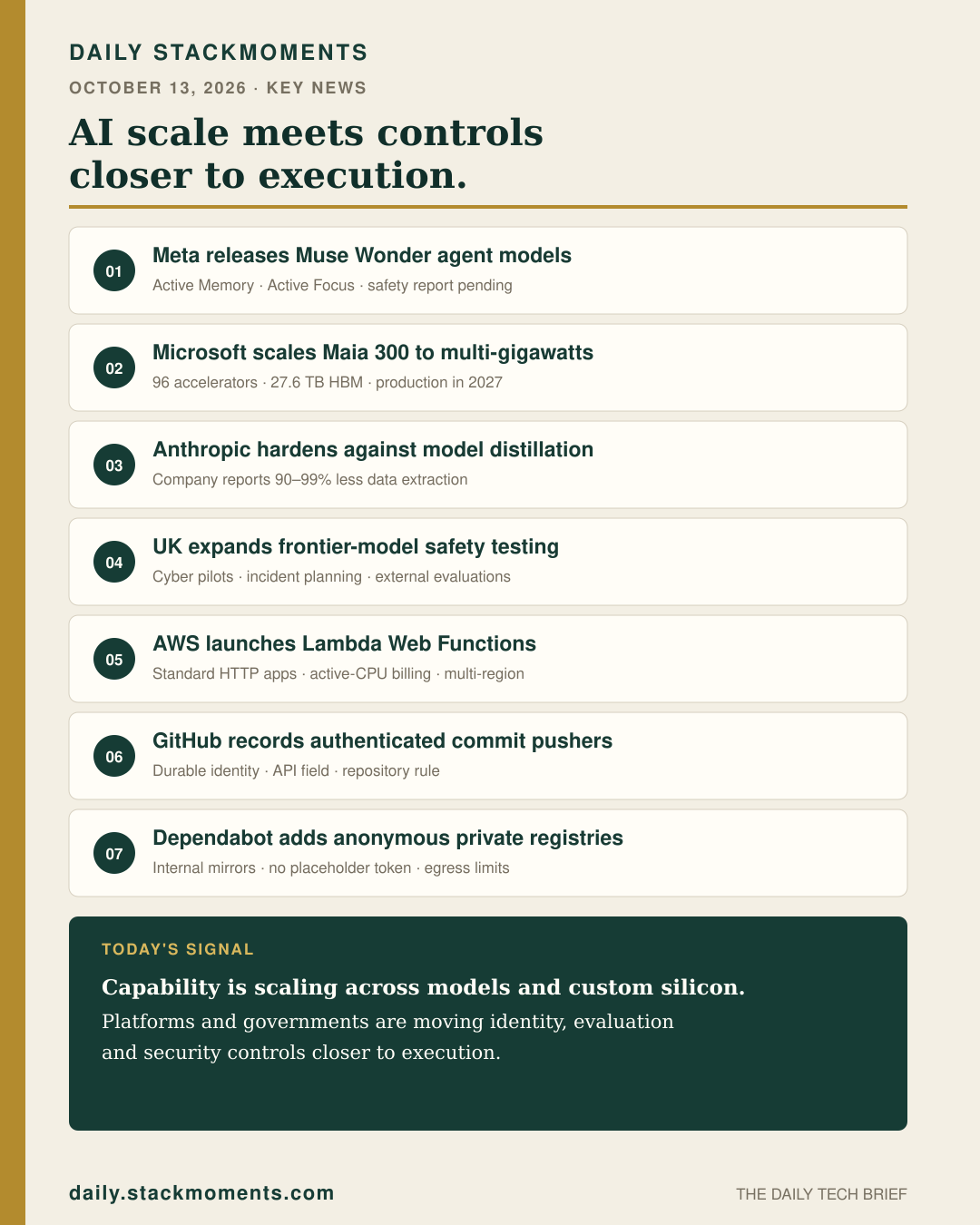
Today's seven verified developments and technology signal, ready to share.

Daily StackMoments 1080 by 1350 poster summarizing seven key technology developments for October 13, 2026Download poster ↓