Daily brief · October 14, 2026

Agent autonomy meets enforceable control and recovery.

Self-replication research, banking scrutiny and platform controls turn agent safety into concrete engineering boundaries.

10 minute read7 developmentsPrimary sources first
01
Security6 min read

Anthropic tests how smaller AI models could self-replicate

Anthropic reported controlled experiments in which models of 30 billion parameters or fewer completed many individual replication tasks. A stronger model propagated an 8B payload across a simplified, firewalled Android test network, while a 9B model set up inference on eight of nine hardware types. Anthropic says the results suggest a future IoT threat; its own test deliberately simplified initial access and does not demonstrate a reliable real-world autonomous worm.

Why it mattersTreat this as a threat model, not a present capability claim. Security teams should inventory edge compute, constrain model-artifact movement and egress, monitor unusual peer-to-peer inference traffic, and design shutdown and quarantine paths that do not depend on one central host.
Read the updated agent-security guide

Source: Anthropic Research ↗ · Published October 12, 2026

#AI security#autonomous replication#IoT#agent containment
02
Security5 min read

Banking supervisors probe agent controls and independent recovery

Reuters reported that U.S. banking regulators are asking large banks how they govern foreign AI models, agent authority, human approval and emergency shutdown. European and UK supervisors are also pressing institutions to prove they can restore critical services from clean data and independent infrastructure after a destructive cyberattack. The questions are supervisory inquiries, not a newly published formal rule.

Why it mattersRegulated engineering teams need evidence that agents cannot silently exceed delegated authority—and that recovery does not share the same control plane, credentials or corrupted data as production. Decision traces, approval gates, third-party dependency maps and bare-metal recovery tests are becoming one resilience program.

Source: Reuters ↗ · Published October 13, 2026

#banking#agent governance#cyber recovery#operational resilience
03
AI Coding4 min read

Copilot policy refresh can fail closed at startup

GitHub added a forceRemoteSettingsRefresh policy for Copilot CLI, VS Code and the Copilot app. When enabled, the client must confirm current organization or enterprise policy at startup instead of relying on cached settings; if it cannot, Copilot fails closed. GitHub is also introducing minimum client-version enforcement, beginning with the local-sandboxing policy.

Why it mattersA cached policy can leave a managed coding agent operating after its permissions have changed. Fail-closed refresh and version floors let platform teams make governance changes effective at the client boundary, but require reliable policy availability and a tested outage experience.

Source: GitHub Changelog ↗ · Published October 13, 2026

#GitHub Copilot#enterprise policy#fail closed#client governance
04
Developer Platforms4 min read

GitHub narrows permissions for repository automation

GitHub introduced repository_creation and installation_repositories permissions so GitHub Apps and fine-grained personal access tokens can create repositories and add or remove an app installation's repository access without broad organization administration. Repository administrators can also install pre-approved apps without an organization owner's intervention.

Why it mattersRepository automation no longer needs a classic token or expansive administration scope for common lifecycle operations. Platform teams should split provisioning, installation management and destructive actions into distinct credentials, then review whether older integrations can shed broad permissions.

Source: GitHub Changelog ↗ · Published October 13, 2026

#GitHub Apps#least privilege#fine-grained PAT#repository automation
05
Cloud & Infrastructure4 min read

Scaleway plans a commercial AMD AI supercomputer in Sweden

Scaleway said it will build what it describes as Europe's first AMD-based commercial AI supercomputer outside France, using Instinct MI355X accelerators and the open ROCm software stack. Reuters reported the Swedish system will combine Bull assembly, Giga Computing servers, HPE networking and VAST storage, with deployment planned around lower-carbon regional power.

Why it mattersA commercial AMD cluster gives European teams another route to large-scale training and inference beyond the dominant CUDA stack. Buyers should validate ROCm workload compatibility, networking and storage performance, energy claims and migration cost before treating hardware diversity as application portability.

Source: Reuters ↗ · Published October 13, 2026

#Scaleway#AMD Instinct#ROCm#sovereign AI infrastructure
06
Security3 min read

GitHub blocks Anthropic keys at push by default

GitHub secret scanning added patterns for Anthropic service and user API keys, Salesforce consumer secrets and access tokens, and Cloudsmith service keys. Anthropic keys are now blocked by push protection by default, while detected public-repository credentials can be reported to participating providers for validation and revocation.

Why it mattersCredential prevention is strongest before a secret reaches repository history. Teams using Anthropic APIs should confirm push protection coverage, preserve an exception workflow for false positives, and still rotate any key that appears in logs, artifacts or prior commits.

Source: GitHub Changelog ↗ · Published October 13, 2026

#secret scanning#Anthropic API#push protection#credential security
07
AI Coding3 min read

Gemini 4 Argon reaches general availability in GitHub Copilot

GitHub made Gemini 4 Argon generally available across Copilot plans and surfaces including supported IDEs, the CLI, coding agent and Copilot app. Organization administrators can govern access through the model policy; the model is enabled unless a global, default or explicit policy disables it. GitHub's quality and performance statements are based on its own early testing.

Why it mattersThe model's October 1 launch is now an operational platform choice rather than a preview. Engineering leaders should evaluate it on their own repositories, set an explicit enterprise policy, track cost and latency by task, and avoid assuming GitHub's benchmark claims transfer to production workloads.

Source: GitHub Changelog ↗ · Published October 13, 2026

#Gemini 4 Argon#GitHub Copilot#model policy#AI coding

Shareable visual

Poster of the Day

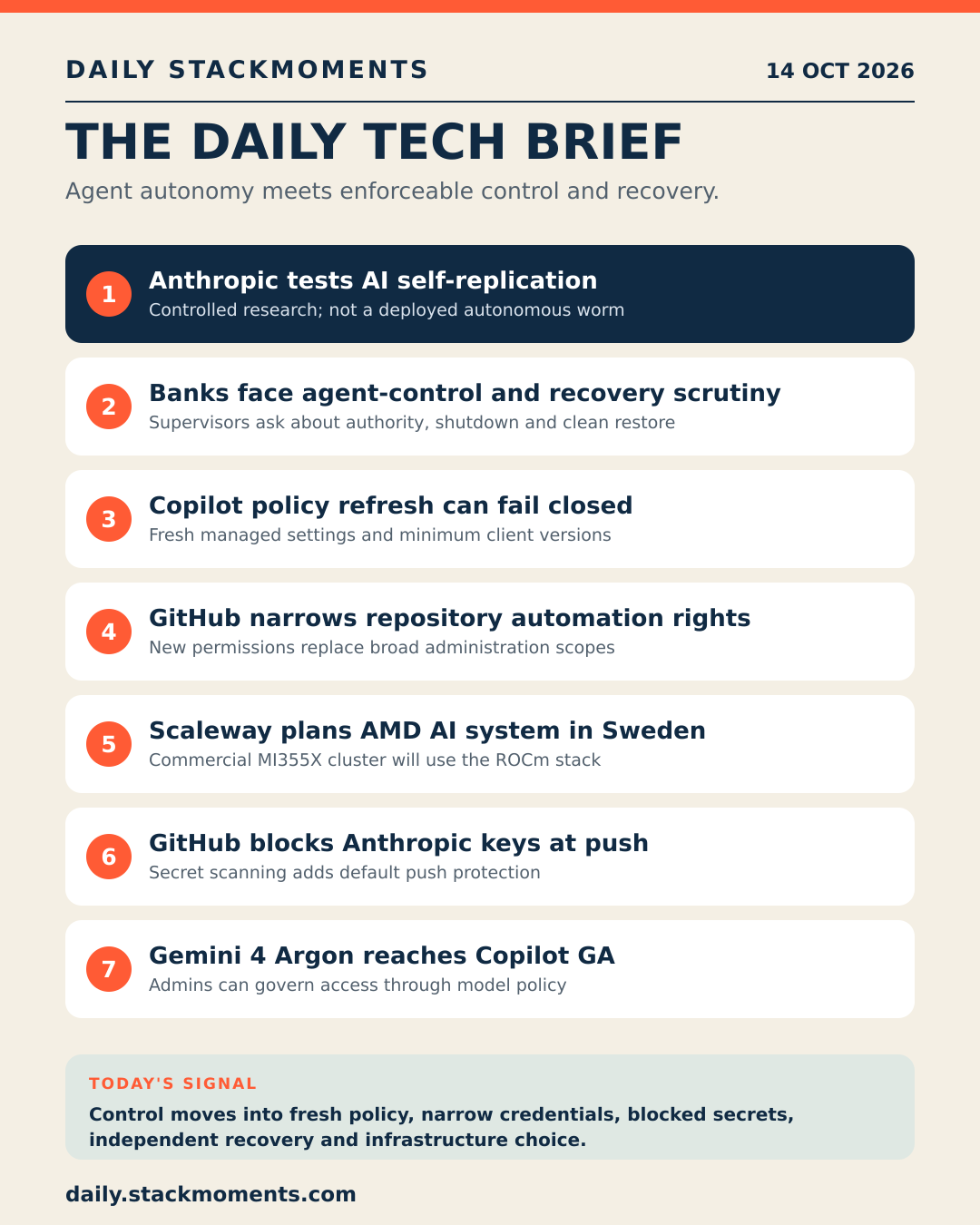
Today's seven verified developments and technology signal, ready to share.

Daily StackMoments 1080 by 1350 poster summarizing seven key technology developments for October 14, 2026Download poster ↓