01
Security4 min read
GitHub makes AI Scan generally available for pull requests
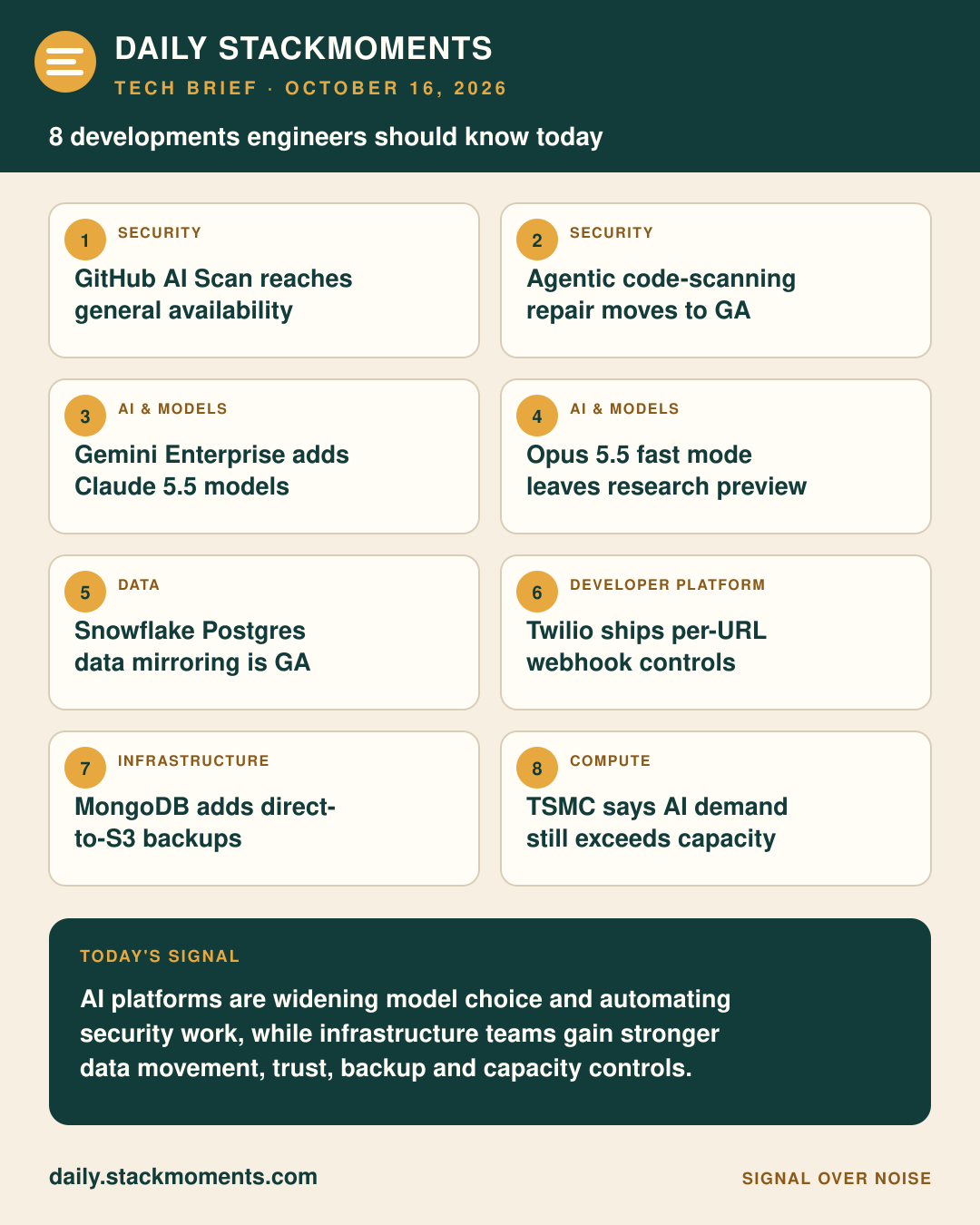
GitHub made AI Scan for pull requests generally available. It complements CodeQL across additional languages and formats including PHP, Shell, HCL, Dockerfiles, JSP and Blazor, and can attach risk explanations and suggested fixes to pull-request findings. The findings are advisory: they do not fail code-scanning checks or block merges through rulesets.
Why it mattersAI-assisted detection can widen review coverage where deterministic queries are incomplete, but an advisory result is not an enforcement control. Security teams should measure precision, review AI-labeled findings separately and retain CodeQL and branch policy as the merge gate.
Read the updated AI-security governance guide →Source: GitHub Changelog ↗ · Published October 15, 2026
#AI Scan#CodeQL#pull requests#application security
02
Security4 min read
GitHub moves agentic code-scanning repair to general availability
GitHub made agentic autofix generally available for Code Security and Advanced Security customers on Enterprise Cloud. When assigned an alert, Copilot explores related files, proposes a change, reruns CodeQL, iterates when needed and opens a draft pull request with its validation steps.
Why it mattersThe remediation loop now reaches from alert to validated pull request, but review remains the control point. Teams should track fix acceptance, regressions, Actions-minute and AI-credit use, and whether CodeQL closure corresponds to the underlying risk being removed.
Read the updated AI-security governance guide →Source: GitHub Changelog ↗ · Published October 15, 2026
#agentic autofix#GitHub Copilot#code scanning#secure coding
03
AI & Models3 min read
Gemini Enterprise adds Claude Opus and Sonnet 5.5
Google Cloud made Claude Opus 5.5 and Claude Sonnet 5.5 generally available inside the Gemini Enterprise app. Administrators must enable the third-party models before users can select them; they are offered in global, US and EU multi-regions and billed on a pay-as-you-go basis.
Why it mattersEnterprise model choice is becoming a governed platform setting rather than a separate application decision. Teams should compare models on the same tasks while verifying regional processing, data terms, administrator defaults, cost attribution and fallback behavior.
Source: Google Cloud release notes ↗ · Published October 15, 2026
#Gemini Enterprise#Claude Opus 5.5#Claude Sonnet 5.5#model governance
04
AI & Models3 min read
Claude Opus 5.5 fast mode leaves research preview
Anthropic moved fast mode for Claude Opus 5.5 out of research preview. API requests no longer need the beta header, every usage tier receives a default fast-mode rate limit, and existing requests that still send the header continue to work. Fast mode also became available for Opus 5.5 deployments in Microsoft Foundry.
Why it mattersA latency-oriented serving path is now a production API option, not an experimental flag. Application teams should remeasure tail latency, throughput, rate-limit behavior and cost under representative concurrency before changing defaults.
Source: Claude Platform release notes ↗ · Published October 15, 2026
#Claude Opus 5.5#fast mode#API latency#Microsoft Foundry
05
Cloud & Infrastructure4 min read
Snowflake Postgres data mirroring reaches general availability
Snowflake made Postgres data mirroring generally available on AWS and Azure. The service continuously replicates inserts, updates, deletes and schema changes from a Snowflake Postgres instance into a Snowflake database with minimal lag, without separate ETL jobs or third-party connectors.
Why it mattersOperational-to-analytical data movement can become a managed platform primitive, reducing pipeline code and synchronization delay. Teams still need to test schema-change handling, replay and failure recovery, target cost, observability and application expectations around replication lag.
Source: Snowflake release notes ↗ · Published October 15, 2026
#Snowflake Postgres#data mirroring#CDC#data platforms
06
Developer Platforms3 min read
Twilio makes per-URL webhook controls generally available
Twilio made its Webhook Configuration API generally available. The API exposes Webhook Settings and Webhook Rules so customers can configure how outbound webhooks are authenticated and delivered for each destination URL.
Why it mattersWebhook trust should be explicit at the destination boundary instead of buried in application-specific code. Platform teams can standardize authentication and delivery policy, but should test key rotation, retries, replay handling and migration for existing endpoints.
Source: Twilio product changelog ↗ · Published October 15, 2026
#Twilio#webhooks#authentication#delivery policy
07
Cloud & Infrastructure3 min read
MongoDB Ops Manager adds direct-to-S3 backups
MongoDB made direct-to-S3 backup generally available in Ops Manager. Database nodes can compress snapshot data and upload it directly to S3, removing an intermediate backup path from self-managed MongoDB deployments.
Why it mattersA shorter backup data path can reduce infrastructure and bottlenecks, but it also makes object-store policy part of the recovery boundary. Operators should validate encryption, bucket isolation, immutability, retention, restore throughput and credentials that remain usable during a control-plane incident.
Source: MongoDB product updates ↗ · Published October 15, 2026
#MongoDB Ops Manager#S3#database backup#recovery
08
Cloud & Infrastructure4 min read
TSMC reports record profit as AI demand outpaces capacity
TSMC reported a sixth consecutive record quarterly profit, with July-to-September net income of T$763.1 billion, up 69% year over year. The company said AI demand remains extremely robust and exceeds available capacity, kept 2026 capital spending at $60–64 billion, and expects its second Arizona fab to begin mass production in the third quarter of 2027.
Why it mattersAccelerator roadmaps depend on foundry and advanced-packaging capacity, not only chip design. Infrastructure planners should keep supply lead times, geography and packaging constraints in forecasts even as financing concerns create volatility around AI investment.
Source: Reuters ↗ · Published October 15, 2026
#TSMC#AI chips#foundry capacity#capital spending