Daily brief · October 17, 2026

Policy becomes executable from package choice to production infrastructure.

Dependency licenses, agent evidence, model serving and urgent infrastructure patches define the weekend signal.

9 minute read7 developmentsPrimary sources first
01
Security5 min read

GitHub makes open-source license policy enforceable at merge time

GitHub made open-source license compliance generally available for Enterprise Cloud repositories with GitHub Code Security. An enterprise policy can be attached through a ruleset that requires compliant results before merge; pull requests annotate noncompliant dependency changes, while designated license managers can handle exceptions. New APIs expose policy management and package-compliance checks to automation and coding agents.

Why it mattersLicense review can now move from a periodic legal inventory into the same pre-merge control plane as code scanning. Teams should define approved and prohibited license classes, assign exception ownership, log policy changes and make agents query policy before proposing a package.
Read the implementation guide

Source: GitHub Changelog ↗ · Published October 16, 2026

#license compliance#dependency policy#rulesets#software supply chain
02
AI & Models4 min read

Gemini Enterprise adds MCP citations and data-center workflow connectors

Google Cloud made citation mappings generally available for custom MCP data stores, allowing answers that use a custom MCP server to display source chips. It also added Workflow Builder connections for self-managed Confluence Data Center and Jira Data Center so workflows can search content and automate actions across those systems.

Why it mattersEnterprise agents need both reach and evidence. Platform owners should require citations for custom tools, verify authorization is preserved through Jira and Confluence actions, and test whether cited records actually support the generated answer.

Source: Google Cloud release notes ↗ · Published October 16, 2026

#Gemini Enterprise#MCP#citations#Workflow Builder
03
AI & Models3 min read

Google moves Agent Search stable answers to Gemini 3.5 Flash

Google Cloud changed the stable answer-generation model in Agent Search from Gemini 2.5 Flash to Gemini 3.5 Flash. Applications that rely on the stable alias can therefore receive different answer behavior without changing their configured model name.

Why it mattersA stable alias is an operational convenience, not a frozen model. Search and RAG owners should rerun grounding, refusal, latency and cost evaluations whenever the provider advances the alias, and pin a version where reproducibility matters more than automatic upgrades.

Source: Google Cloud Agent Search release notes ↗ · Published October 16, 2026

#Agent Search#Gemini 3.5 Flash#RAG#model lifecycle
04
AI & Models5 min read

Reflection releases Beam weights as Google publishes optimized serving recipes

Reflection made its 501-billion-parameter sparse mixture-of-experts Beam model available with Apache 2.0 weights, model artifacts and an API. Google Cloud published day-zero deployment recipes using llm-d or NVIDIA Dynamo and reported customer benchmarks of up to five-times higher throughput and eight-times lower latency on its accelerator instances; those performance figures are vendor-reported, not independent tests.

Why it mattersThe material change from the earlier preview is deployability. Teams can now inspect and operate the weights, but should benchmark their own coding and agent workloads, validate the model card and safety constraints, and compare total serving cost rather than adopting headline throughput numbers.

Source: Google Cloud / Reflection ↗ · Published October 16, 2026

#Reflection Beam#open weights#llm-d#NVIDIA Dynamo
05
AI & Models5 min read

Claude finds lower-cost designs for eight quantum-circuit tasks

Anthropic and collaborators reported that Claude Mythos 5 improved the best published designs across eight quantum-circuit primitives using a closed loop of code generation, automated correctness checks and resource scoring. The paper reports a reversible modular-inversion family with one design using 12% more qubits but 17-times fewer gates, and a Reed–Solomon decoder with twelve-times fewer gates than the cited prior construction.

Why it mattersThis is a concrete pattern for AI-assisted engineering: constrain the problem in code, attach a deterministic evaluator and optimize a measurable cost. The results are research, not proof that useful fault-tolerant quantum computers are imminent, but they show where verifiable agent loops can produce durable technical gains.

Source: Anthropic / arXiv ↗ · Published October 16, 2026

#quantum circuits#Claude Mythos 5#automated evaluation#scientific computing
06
Security4 min read

AWS warns self-managed KVM hosts to patch virtio-net memory corruption

AWS classified CVE-2026-99999 as important for unpatched Linux kernels 4.4 through 6.18 used by self-managed KVM hypervisors with virtio-net or TAP networking. A privileged guest actor could send crafted packets that corrupt host-kernel memory, potentially disclosing host memory or causing denial of service. AWS-managed EC2, Lambda and Fargate services are not affected.

Why it mattersThe guest-to-host boundary is a core isolation assumption. Operators of Firecracker or other self-managed KVM stacks should apply vendor kernel updates and reboot; AWS lists no workaround, so network filtering is not a substitute for patching.

Source: AWS Security Bulletin ↗ · Published October 15, 2026

#CVE-2026-99999#KVM#virtio-net#kernel security
07
Security4 min read

Amazon Neptune patches unsafe Gremlin graph-import processing

AWS disclosed CVE-2026-110812 in the Apache TinkerPop functionality used by Amazon Neptune. Under certain conditions, an authenticated principal with Neptune data-plane query permissions could submit input that causes unintended activity inside the query-engine environment. AWS fixed the issue in Neptune 1.4.7.1, 1.4.8.1 and 1.5.0.0.

Why it mattersDatabase query permission is not equivalent to permission to influence the engine environment. Neptune operators should upgrade, verify maintenance-window timing and restrict query access to trusted principals until patched rather than treating authentication alone as sufficient containment.

Source: AWS Security Bulletin ↗ · Published October 15, 2026

#CVE-2026-110812#Amazon Neptune#Gremlin#database security

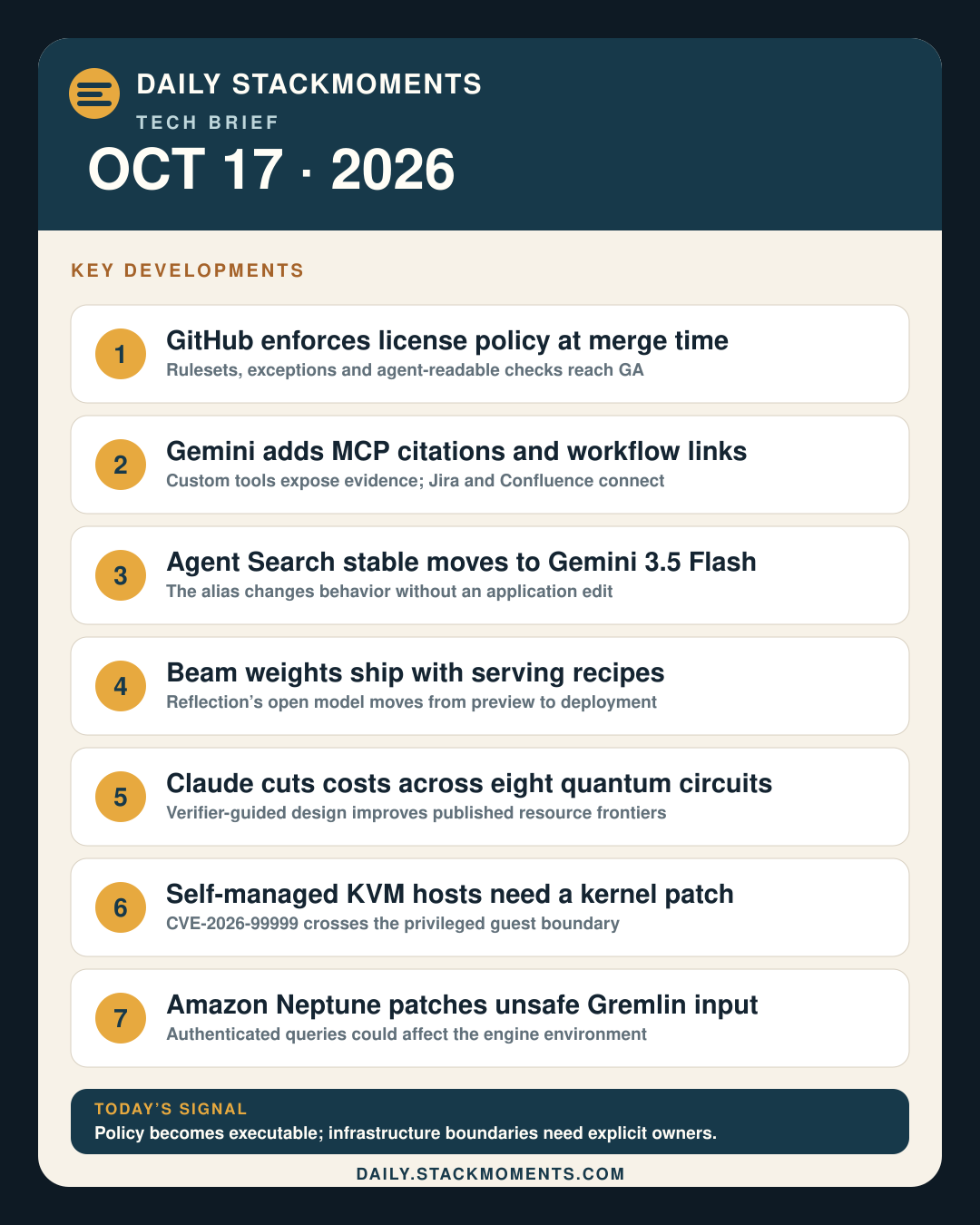
Shareable visual

Poster of the Day

Today's seven verified developments and technology signal, ready to share.

Daily StackMoments 1080 by 1350 poster summarizing seven key technology developments for October 17, 2026Download poster ↓