Daily brief · October 21, 2026

Boundaries move into the delivery path.

Regional resilience, package intake, container ingress, repository policy and disconnected AI stacks define the day.

14 minute read7 developmentsPrimary sources first
01
Cloud & Infrastructure5 min read

A power event disrupts 38 Google Cloud services in London

Google Cloud recorded a seven-hour, 52-minute incident in europe-west2 after a power event took down the europe-west2-b zone. The impact list spanned 38 products, including Compute Engine, GKE, Cloud Run, Cloud SQL, Spanner, BigQuery, Storage, Pub/Sub and Apigee; regional customers also saw elevated errors and intermittent network failures before recovery.

Why it mattersA multi-service architecture can still share one regional failure boundary. Teams using europe-west2 should review zonal placement, test cross-region recovery for stateful services and verify that identity, networking, queues and data restore paths remain usable when an entire zone and adjacent regional control paths degrade together.

Source: Google Cloud Service Health ↗ · Published October 20, 2026

#Google Cloud#europe-west2#regional resilience#disaster recovery
02
Security5 min read

GitHub previews an npm package firewall for runners and coding agents

GitHub introduced a package firewall that proxies metadata and downloads between endpoints such as Actions runners or coding agents and upstream registries. Enterprise administrators can apply cooldown periods, malware and vulnerability checks from the GitHub Advisory Database, and supply-chain checks such as attestation downgrades. The public preview is free for Enterprise Cloud customers and currently supports npm only.

Why it mattersPackage installation is an execution boundary even when application code never starts. Teams should route CI and agent environments through the firewall, keep lockfiles and provenance checks, define an exception workflow and preserve an emergency bypass that is narrow, logged and time-limited.
Read the package-firewall implementation guide

Source: GitHub Changelog ↗ · Published October 20, 2026

#package firewall#npm#malware#software supply chain
03
Cloud & Infrastructure5 min read

Amazon ECS Gateway centralizes ingress for container services

AWS launched ECS Gateway as an account-level resource that lets platform teams define shared subnets, security groups, TLS certificates, listeners and WAF policy. Application teams opt in through a gateway connector; ECS then provisions DNS, listener rules, target groups, certificates and service security groups. One Application Load Balancer can host-route traffic for as many as 25 services.

Why it mattersIngress becomes a platform contract instead of repeated per-service plumbing. Platform teams gain a central policy point and incremental migration path, but should treat the ECS infrastructure role, immutable gateway settings, shared load-balancer capacity and blast radius as explicit architecture decisions.

Source: AWS News Blog ↗ · Published October 20, 2026

#Amazon ECS#ingress#Application Load Balancer#platform engineering
04
Security4 min read

AWS fixes privilege escalation in a serverless CI/CD sample

AWS disclosed CVE-2026-112407 in CICD-toolchain-for-serverless-applications versions 1.0.7 through 1.0.10. A remote authenticated user with push access to the application repository could use application templates deployed by the pipeline to access or modify resources outside the application stack in the same account. Version 1.0.11 fixes the IAM policy; AWS says no workaround is available.

Why it mattersRepository write access became cloud-account privilege because the pipeline trusted deployment templates too broadly. Operators should upgrade or patch forks, rotate and review the pipeline role, inspect CloudFormation and CloudTrail activity, and constrain deployment roles to the stack resources they actually own.

Source: AWS Security Bulletin 2026-141 ↗ · Published October 20, 2026

#CVE-2026-112407#IAM#CI/CD#serverless
05
Cloud & Infrastructure5 min read

Microsoft expands disconnected development and AI on Azure Local

Microsoft said GitHub Enterprise Local and Foundry Local will become generally available at Ignite for connected and disconnected Azure Local environments. The stack adds locally hosted Copilot inference, agentic retrieval, DocumentDB and Blob Storage previews, confidential virtual machines, external HSM key control, and a Sovereign Control Panel preview for posture, dependency and portability analysis.

Why it mattersSovereignty is becoming an application-lifecycle property rather than a data-location checkbox. Architects should classify which workloads need local operation, map every remaining control-plane dependency, test connected-to-disconnected transitions and define how models, patches, identities and audit evidence move across the boundary.

Source: Official Microsoft Blog ↗ · Published October 20, 2026

#Azure Local#sovereign cloud#GitHub Enterprise#Foundry Local
06
AI & Models4 min read

Gemini brings managed multimodal RAG inside an air-gapped perimeter

Google Cloud previewed enterprise search with Gemini on Google Distributed Cloud air-gapped, accelerated by NVIDIA Blackwell Ultra. The managed RAG experience runs inside the customer's physical security perimeter without public-internet or Google Cloud global-infrastructure connectivity, and can ground cited answers across documents, audio, video, images and spreadsheets.

Why it mattersDisconnected AI no longer has to mean a bespoke retrieval stack, but managed packaging does not remove governance work. Teams should evaluate model and index updates, evidence export, offline patching, key custody, source-level authorization and how answers are audited when the environment cannot call a central cloud service.

Source: Google Cloud Blog ↗ · Published October 20, 2026

#Gemini#Google Distributed Cloud#air-gapped AI#RAG
07
Software Engineering4 min read

GitHub adds bulk migration from branch protections to rulesets

GitHub can now convert all classic branch-protection rules in a repository to rulesets in one reviewable operation. Administrators can preview the generated rules, see existing coverage, choose Active, Evaluate or Disabled enforcement, and keep the original branch protections until the new policy has been validated.

Why it mattersCentralized policy is easier to govern than duplicated branch settings, but migration can change enforcement semantics or bypass behavior. Teams should start in Evaluate mode, diff the generated scope and exceptions, preserve the old rules during validation and test human, app and automation paths before activating the new rulesets.

Source: GitHub Changelog ↗ · Published October 20, 2026

#GitHub rulesets#branch protection#platform governance#policy migration

Shareable visual

Poster of the Day

Today's seven verified developments and technology signal, ready to share.

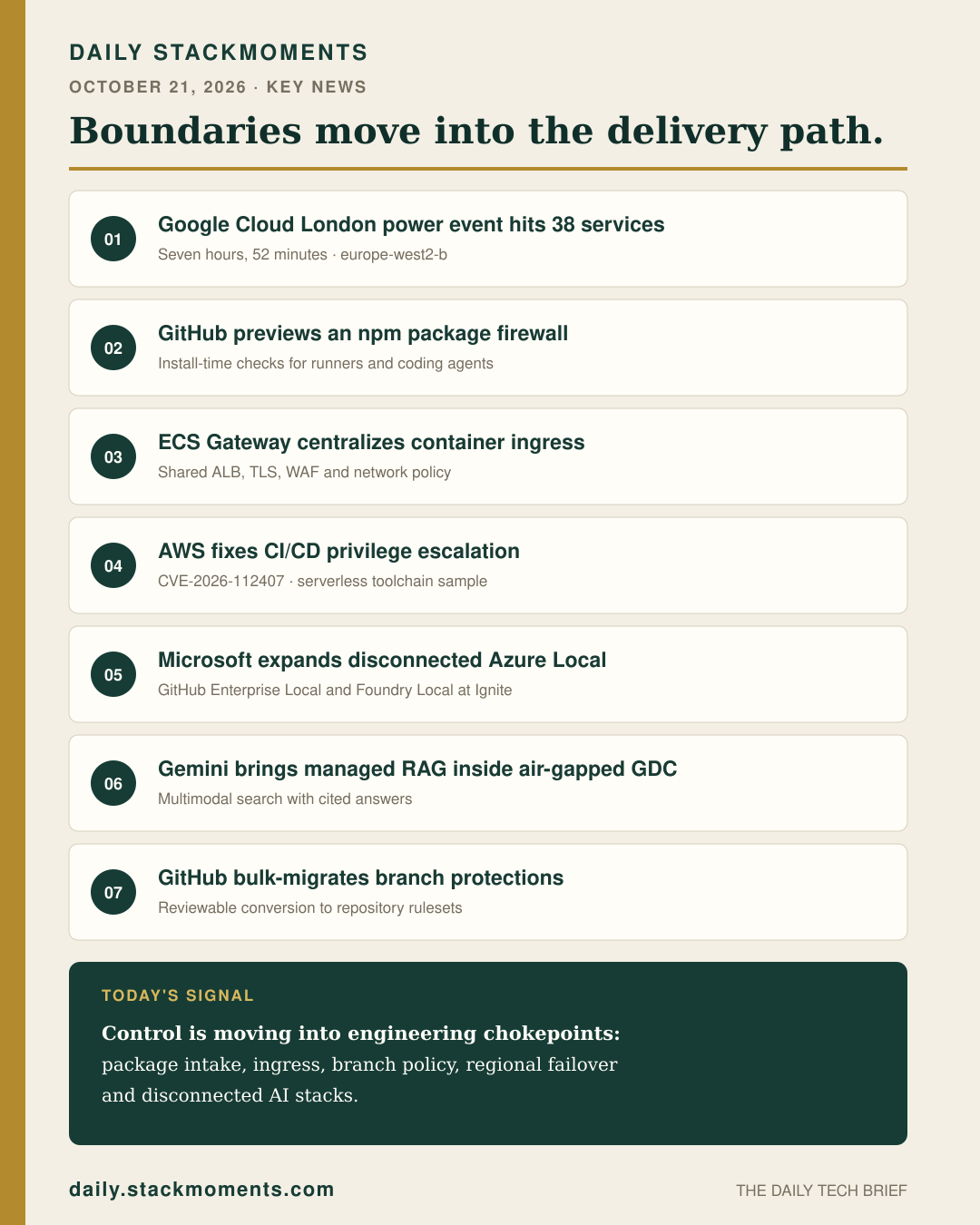
Daily StackMoments 1080 by 1350 poster summarizing seven key technology developments for October 21, 2026Download poster ↓