Daily brief · October 22, 2026

AI platforms widen while execution boundaries harden.

Critical PHP patches, multi-cloud model access, confidential GPUs, Rubin-scale infrastructure, multimodal SQL and expiring developer credentials define the day.

13 minute read6 developmentsPrimary sources first
01
Security5 min read

PHP patches two critical runtime vulnerabilities

PHP released 8.5.12, 8.4.27, 8.3.36 and 8.2.35 to address CVE-2026-109618 and CVE-2026-109619, flaws affecting PHP 5.4 through 8.5.11 that can enable unauthenticated remote code execution or memory disclosure. Google Cloud advised customers to rebuild and redeploy affected container images; PHP 8.1 and older are end-of-life and did not receive fixes.

Why it mattersRuntime flaws can sit beneath every application path, including code that appears unreachable at the framework layer. Teams should inventory PHP versions, rebuild images from patched bases, redeploy rather than only restart, verify managed-platform remediation and retire unsupported branches instead of attempting to carry local patches indefinitely.

Source: PHP and Google Cloud Security ↗ · Published October 21, 2026

#PHP#CVE-2026-109618#CVE-2026-109619#remote code execution
02
AI & Models4 min read

OpenAI models are coming to Google Cloud Model Garden

OpenAI and Google Cloud announced that GPT-6 Astra, GPT-6.1 Sol and GPT-6 Luna will be offered through Google Cloud Model Garden and Marketplace, with private preview and broader availability planned over the coming weeks. Google Cloud said customers will use its identity, networking, auditing and billing controls, while Codex clients will be able to connect through the Gemini platform.

Why it mattersModel choice is becoming a cloud-governed procurement and operations decision rather than a separate API contract. Platform teams should evaluate preview scope, data handling, regional availability, quota, observability and exit paths before standardizing production workloads on the new route.

Source: OpenAI and Google Cloud ↗ · Published October 21, 2026

#OpenAI#Google Cloud#Model Garden#Codex
03
Cloud & Infrastructure5 min read

Confidential Blackwell G4 GPUs reach general availability

Google Cloud made Confidential G4 instances generally available across 36 zones for Compute Engine virtual machines and GKE nodes. The service pairs NVIDIA RTX PRO 6000 Blackwell GPUs with hardware-backed remote attestation, encrypted memory and non-exportable keys; Google says its internal testing measured less than 3.5% throughput degradation on representative workloads.

Why it mattersGPU confidentiality can move model weights and sensitive inference into a verifiable hardware boundary, but attestation is useful only when deployment policy checks it. Teams should validate the measured boot chain, key-release conditions, guest images, regional capacity and workload-specific performance rather than relying on the confidential label alone.

Source: Google Cloud Blog ↗ · Published October 21, 2026

#Confidential Computing#NVIDIA Blackwell#GKE#remote attestation
04
Cloud & Infrastructure5 min read

Google Cloud outlines Vera Rubin-scale AI infrastructure

Google Cloud said A5X bare-metal systems based on NVIDIA Vera Rubin NVL72 will become generally available next month. Its roadmap also adds local regions in EMEA, Managed Lustre with GPUDirect Storage and Virgo networking designed to support as many as 80,000 Rubin GPUs within one site and 960,000 across multiple sites; those scale figures are platform design targets, not customer deployment counts.

Why it mattersFrontier training is now constrained by the system around the accelerator as much as by the chip. Infrastructure leaders should evaluate network topology, storage paths, regional sovereignty, scheduler integration and failure domains together, while treating announced capacity and availability dates as vendor roadmap commitments until delivered.

Source: Google Cloud Blog ↗ · Published October 21, 2026

#Vera Rubin#A5X#AI infrastructure#sovereign cloud
05
Software Engineering4 min read

BigQuery ObjectRef makes multimodal analytics generally available

Google Cloud made ObjectRef and related multimodal analysis capabilities generally available across BigQuery editions and on-demand pricing. The predefined structure points to a versioned object in Cloud Storage so SQL and Python workflows can reference documents, images, audio and video under BigQuery governance, including arrays of objects sent to Gemini from SQL.

Why it mattersUnstructured data can now participate in governed analytical workflows without copying every object into a separate application pipeline. Data teams should still design object-version retention, row- and object-level authorization, model-call cost controls, lineage and reproducible prompts before treating multimodal queries like ordinary relational SQL.

Source: Google Cloud Blog ↗ · Published October 21, 2026

#BigQuery#ObjectRef#multimodal analytics#data governance
06
Developer Platforms4 min read

GitHub CLI previews expiring OAuth credentials

GitHub CLI 2.103.0 added an opt-in `gh auth login --expiring` flow that issues short-lived access tokens backed by rotating refresh tokens. GitHub recommends configuring Git credential storage with `gh auth setup-git` and warns that scripts caching the output of `gh auth token` may break when credentials rotate.

Why it mattersDeveloper credentials should expire without turning routine command-line work into a manual renewal loop. Teams can reduce the blast radius of stolen tokens, but should first find scripts and tools that cache token values, update them to request credentials when needed and keep refresh-token storage inside the operating system credential manager.

Source: GitHub Changelog ↗ · Published October 21, 2026

#GitHub CLI#OAuth#short-lived credentials#developer security

Shareable visual

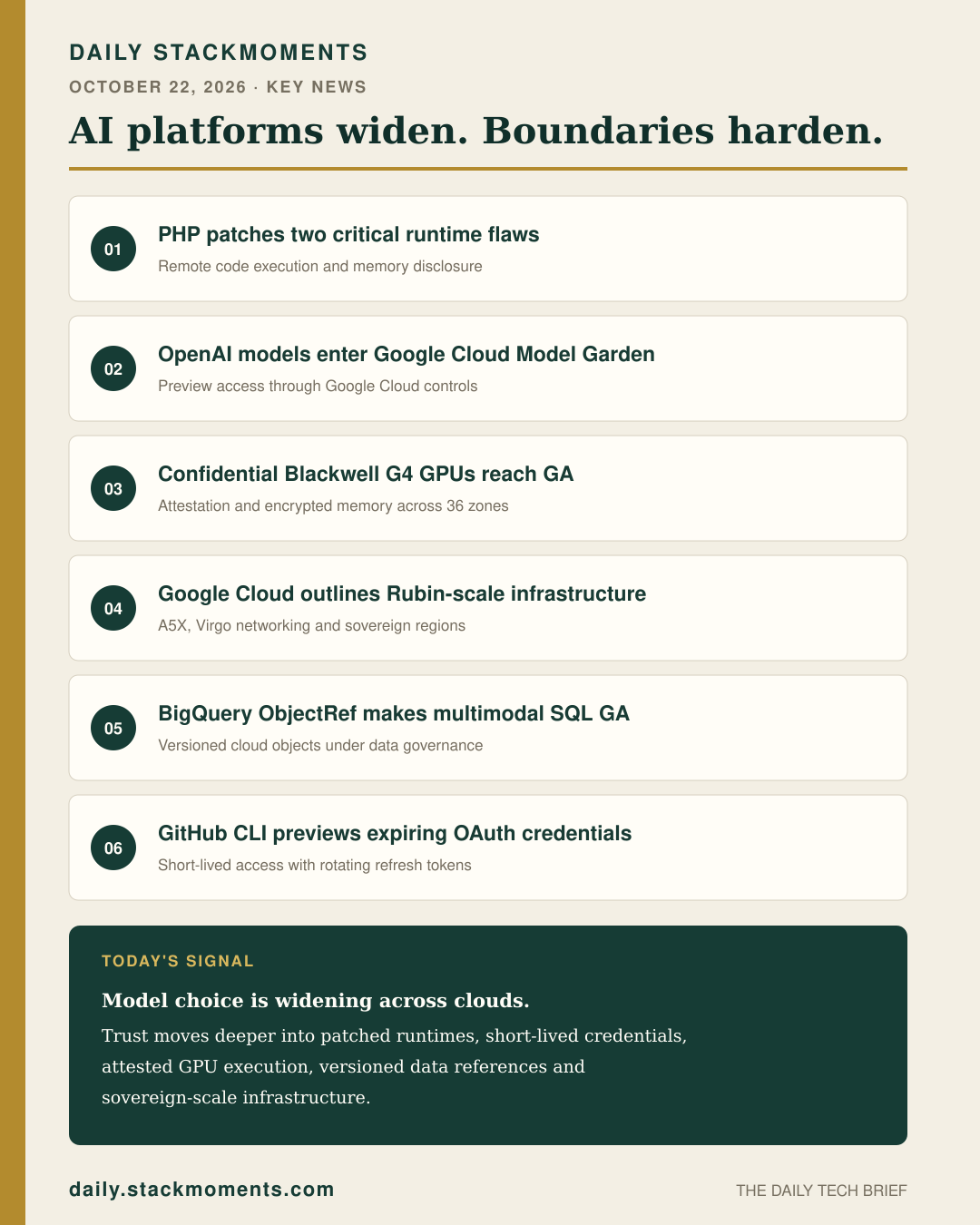
Poster of the Day

Today's six verified developments and technology signal, ready to share.

Daily StackMoments 1080 by 1350 poster summarizing six key technology developments for October 22, 2026Download poster ↓