Daily brief · October 24, 2026

Operational control becomes part of the AI platform.

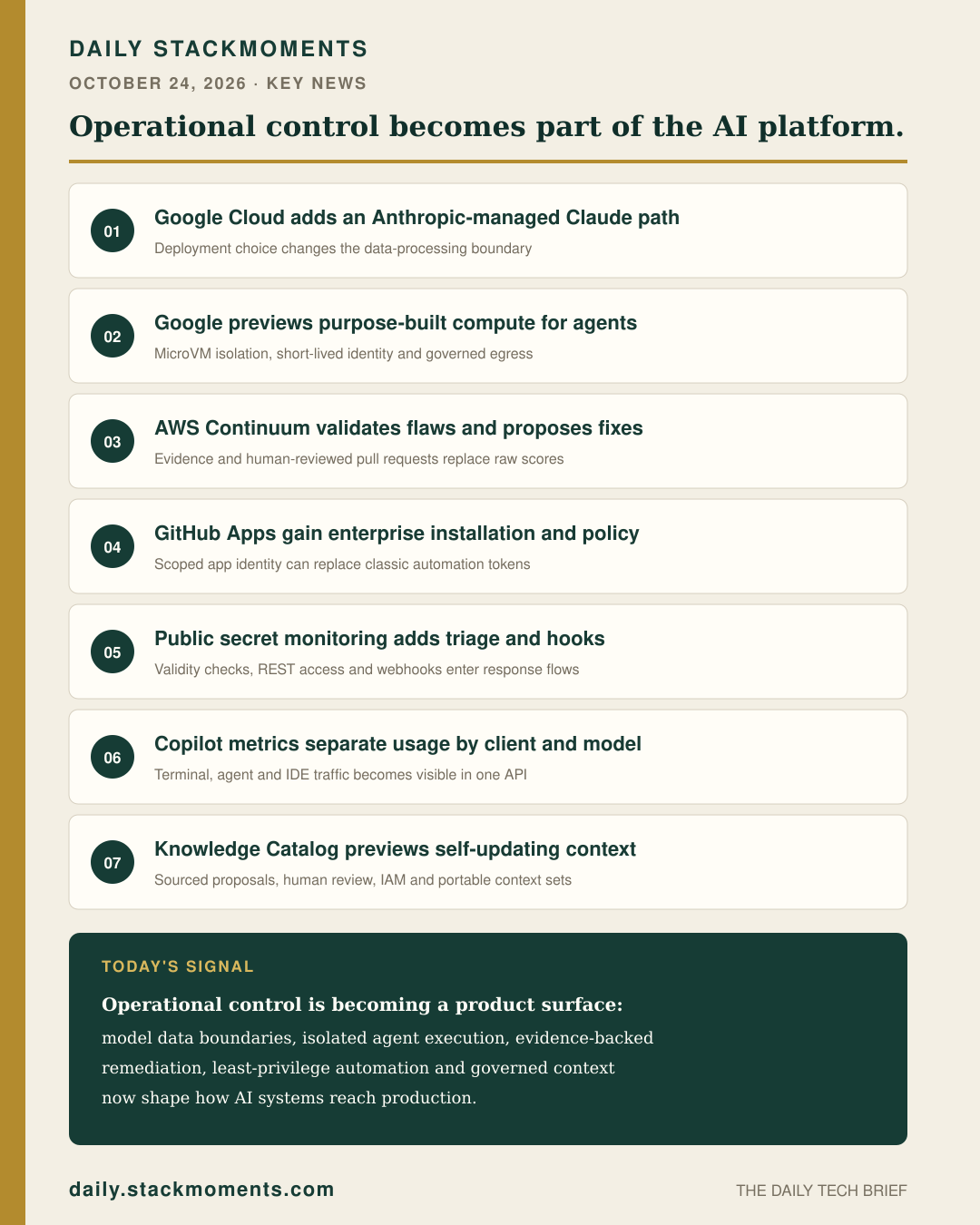
Model-processing boundaries, isolated agent compute, evidence-backed remediation, scoped automation and governed context define the weekend signal.

18 minute read7 developmentsPrimary sources first
01
AI & Models5 min read

Google Cloud adds an Anthropic-managed path for Claude

Google Cloud made an Anthropic-managed deployment option for Claude generally available alongside its Google-managed route. Both use Google Cloud IAM, Audit Logging, billing and eligible commitments, but the Anthropic-managed option provides immediate access to Claude platform features while Anthropic is the data processor; the Google-managed option keeps Google as processor and adds controls including VPC Service Controls, CMEK and regional data residency.

Why it mattersThe endpoint may look similar while the contractual and technical trust boundary changes. Platform teams should choose the route per workload, document which company processes prompts and outputs, test feature parity and region support, and keep model access policy separate from procurement convenience.

Source: Google Cloud Blog ↗ · Published October 23, 2026

#Claude#Google Cloud#data processing#AI governance
02
Cloud & Infrastructure6 min read

Google previews purpose-built compute and governance for agents

Google Cloud introduced Agent Compute Engine, a forthcoming preview service that assigns agents hardware-isolated microVMs with short-lived identity, persistent Hyperdisk workspaces and credential injection outside the guest. It also released the open-source Agent Substrate runtime for Kubernetes and outlined broader Agent Gateway, Registry, identity and OpenTelemetry-based governance across Google Cloud, hybrid environments and managed endpoints.

Why it mattersAgent sandboxes are becoming a distinct infrastructure primitive rather than ordinary containers with extra policy. Architecture reviews should separate execution isolation, agent identity, credential delivery, egress policy, persistence and observability—and treat performance figures and future preview dates as vendor claims until independently tested.

Source: Google Cloud Blog ↗ · Published October 22, 2026

#Agent Compute Engine#microVM#Agent Gateway#GKE
03
Security5 min read

AWS Continuum turns validated vulnerabilities into reviewed fixes

AWS made Continuum for code vulnerabilities generally available in US East (N. Virginia) and US West (Oregon). The service combines repository and AWS-environment context, assigns evidence levels, can reproduce some exploits in an isolated sandbox, maps attack paths and proposes code, dependency or configuration fixes as pull requests. Every remediation currently requires human approval.

Why it mattersThe useful unit is a proven, reachable path with a reviewable patch—not another scanner score. Security teams should verify collector permissions, evidence reproducibility, sandbox containment, test and rollback gates, data residency and ownership before allowing generated fixes near production repositories.
Read the updated cyber-AI governance guide

Source: AWS News Blog ↗ · Published October 22, 2026

#AWS Continuum#vulnerability validation#attack paths#remediation
04
Developer Platforms4 min read

GitHub Apps gain enterprise-wide installation and policy access

GitHub made enterprise installations for GitHub Apps generally available and expanded permissions for repository policies, rulesets, bypass requests, two-factor requirements, verified domains, IP allowlists, access restrictions and administration. GitHub positions the coverage as a path away from classic personal access tokens for enterprise automation; the updates are planned for GHES 3.24.

Why it mattersAutomation can use scoped app identity instead of a person-bound token, but the new permissions are highly privileged. Administrators should split apps by duty, grant only required read or write scopes, constrain network access, protect private keys and audit installation changes and bypass activity.

Source: GitHub Changelog ↗ · Published October 23, 2026

#GitHub Apps#enterprise automation#least privilege#rulesets
05
Security4 min read

GitHub public monitoring adds triage, validity checks and hooks

GitHub expanded its public-monitoring preview with dismiss and reopen workflows, alert timelines, filters and continuous validity checks for supported secret types. Enterprise administrators can query attributed findings through a REST endpoint and receive new-leak events through an enterprise webhook; closing an alert does not revoke the credential or remove it from the public repository.

Why it mattersYesterday's regional detection path now has the controls needed to enter an incident pipeline. Teams should route webhooks idempotently, preserve alert history, set ownership and revocation targets, and measure time to credential invalidation rather than treating alert closure as remediation.

Source: GitHub Changelog ↗ · Published October 23, 2026

#secret scanning#webhooks#incident response#GitHub Enterprise
06
AI Coding4 min read

Copilot metrics now separate usage by client and model

GitHub added a totals_by_client array to one-day and 28-day Copilot usage reports, covering tools including OpenCode, Claude Code, Codex, Zed, Copilot CLI, cloud agents and IDEs. The API reports request, session and token totals plus model and selection mode; GitHub cautions that request counts are model calls rather than prompts and client identity is best-effort.

Why it mattersAI coding now spans terminals, agents and editors, so governance based only on IDE telemetry misses real consumption. Engineering leaders can compare cost and adoption by client, but should avoid ranking productivity from request counts and should treat client labels as unverified operational metadata.

Source: GitHub Changelog ↗ · Published October 23, 2026

#GitHub Copilot#OpenCode#Codex#usage metrics
07
Software Engineering5 min read

Knowledge Catalog previews governed self-updating agent context

Google Cloud previewed self-learning context enrichment and a redesigned Knowledge Studio. The system analyzes agent and user interactions, proposes sourced definitions, joins, queries and instructions with confidence scores, and can send low-confidence or sensitive changes to human review. Context sets use IAM, preserve provenance and can import or export the Open Knowledge Format.

Why it mattersShared agent context is becoming versioned operational data rather than prompt text. Data teams should disable automatic publication until evaluation sets, conflict handling, PII redaction, access boundaries and rollback are proven—and independently validate Google's performance claims on their own workloads.

Source: Google Cloud Blog ↗ · Published October 22, 2026

#Knowledge Catalog#context engineering#Open Knowledge Format#AI agents

Shareable visual

Poster of the Day

Today's seven verified developments and technology signal, ready to share.

Daily StackMoments 1080 by 1350 poster summarizing seven key technology developments for October 24, 2026Download poster ↓