Daily brief · October 27, 2026

Capability scales—and control loops follow.

A lower-cost agent model, guarded IAM automation, self-healing GPU infrastructure, exploited PHP flaws, agent-validated paging and reviewable AI research define the Tuesday signal.

18 minute read6 developmentsPrimary sources first
01
AI & Models5 min read

OpenAI launches GPT-6.1 Terra for high-volume agent work

OpenAI released GPT-6.1 Terra in ChatGPT Work, Codex and the API as gpt-6.1-terra. The company positions it as a faster, lower-cost model for visual reasoning, computer use and well-scoped coding work, with standard API prices of $1 per million input tokens and $5 per million output tokens. OpenAI reports lower error rates and stronger terminal-task results than GPT-5.6 Terra; those benchmark results remain vendor-reported.

Why it mattersThe combination of computer use, coding capability and lower unit cost makes broader automation economically plausible. Teams should rerun task-level evaluations, route only suitable workloads, measure end-to-end cost and latency, and keep approval boundaries around actions with financial, security or production impact.

Source: OpenAI ↗ · Published October 26, 2026

#GPT-6.1 Terra#computer use#coding agents#model economics
02
Security5 min read

Google Cloud gives agents guarded IAM workflows

Google Cloud introduced IAM Helper Agent Skills and MCP tools for coding assistants, deployment pipelines and custom agents. The skills use Google Cloud IAM services for troubleshooting, simulation and privileged-access workflows; read-only discovery can run automatically, while policy changes pause for human confirmation according to configurable risk tiers. The skills support Gemini CLI, Gemini Cloud Assist, ADK, Claude Code and Cursor.

Why it mattersPermission reasoning should not live solely in an LLM prompt. Platform teams should keep diagnosis and simulation read-only, require explicit approval for mutations, issue short-lived grants, log the policy evidence and verify that agent credentials cannot silently broaden their own authority.
Read the updated agent-governance guide

Source: Google Cloud Blog ↗ · Published October 26, 2026

#Google Cloud IAM#Agent Skills#MCP#least privilege
03
Cloud & Infrastructure5 min read

NVIDIA extends autonomous recovery to Kubernetes AI jobs

NVIDIA made Mission Control 2.5 available with its autonomous recovery engine extended from Slurm to Kubernetes workloads managed by NVIDIA Run:ai. A three-layer loop separates scheduling, workload-aware job recovery and hardware recovery: jobs can restart or reschedule on healthy capacity while suspect nodes are quarantined and diagnosed in parallel. The release also adds beta network-anomaly detection and Kubernetes hardening updates.

Why it mattersAccelerator failures no longer need to block training until hardware triage finishes. AI platform teams should validate checkpoint semantics, retry limits, node quarantine and audit trails, and keep a manual off-ramp for misclassified faults before relying on self-healing behavior at cluster scale.

Source: NVIDIA Technical Blog ↗ · Published October 26, 2026

#NVIDIA Mission Control#Kubernetes#Run:ai#AI infrastructure
04
Security4 min read

CISA moves two critical PHP flaws into the KEV catalog

CISA updated its PHP alert and added CVE-2026-109618 and CVE-2026-109619 to the Known Exploited Vulnerabilities catalog, confirming evidence of exploitation in the wild. This materially raises the urgency of the PHP vulnerabilities first disclosed last week and applies to organizations running affected PHP versions or downstream products that embed the vulnerable runtime.

Why it mattersThe risk has moved from severe-but-theoretical to observed exploitation. Asset owners should identify internet-facing PHP, upgrade to fixed releases, rebuild containers and self-contained images, inspect web and process telemetry for exploitation, rotate exposed secrets and prioritize unsupported downstream appliances that bundle PHP.

Source: CISA ↗ · Published October 26, 2026

#PHP#CISA KEV#active exploitation#patching
05
Software Engineering4 min read

Vercel Agent can validate alerts before paging responders

Vercel added an optional Critical Only path for monitor webhooks. Before an alert reaches a paging system, Vercel Agent checks logs and metrics to assess customer impact; only alerts it classifies as critical are forwarded to that destination. Teams can supply monitor-specific context, and the control is available with Observability Plus on Pro and Enterprise plans.

Why it mattersAn AI classifier now sits directly in the incident-notification path. SRE teams should begin in shadow mode, compare suppressed alerts with human outcomes, define a fail-open path when investigation is unavailable, preserve the evidence behind each classification and keep independent paging for hard safety signals.

Source: Vercel Changelog ↗ · Published October 26, 2026

#Vercel Agent#observability#incident response#SRE
06
AI & Models6 min read

OpenAI publishes AI-generated proofs for outside review

OpenAI released AI-generated natural-language and Lean artifacts for claimed results in harmonic analysis and computational complexity, including a claimed refutation of the Exponential Time Hypothesis, and described a third result in mathematical physics. External academic groups are being organized to examine and explain the work. OpenAI explicitly describes the manuscripts as raw research data; the claims are not yet scientific consensus.

Why it mattersFormalization makes claims inspectable but does not remove the need to verify theorem statements, assumptions, dependencies and the correspondence between code and the intended scientific result. If independently validated, the complexity result could alter assumptions used across algorithms, databases and computational science; until then, engineering conclusions should remain provisional.

Source: OpenAI ↗ · Published October 26, 2026

#Lean#complexity theory#AI for science#verification

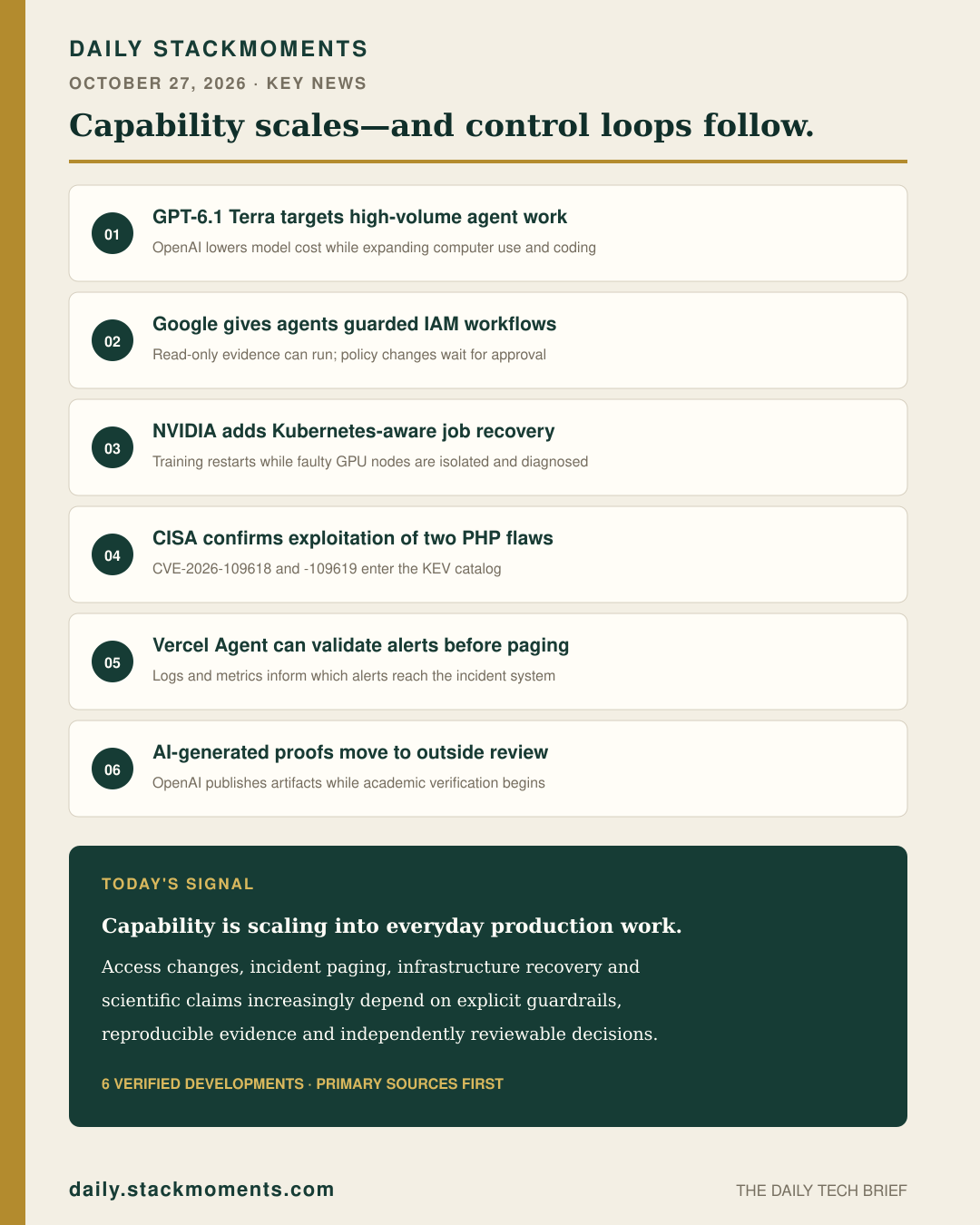
Shareable visual

Poster of the Day

Today's six verified developments and technology signal, ready to share.

Daily StackMoments 1080 by 1350 poster summarizing six key technology developments for October 27, 2026Download poster ↓