Daily brief · October 28, 2026

Agent power meets enforceable boundaries.

Model-built exploit chains, point-of-access privacy policy, governed agent identity, memory-enforced GPU sharing, enterprise workflows, multicloud TPUs and preclinical AI research define the Wednesday signal.

22 minute read7 developmentsPrimary sources first
01
Security6 min read

Anthropic details model-built exploit chains across major platforms

Anthropic said an unreleased internal research model discovered and chained vulnerabilities across Chrome, Safari, Android, Windows and Linux. Google assigned 62 Chrome CVEs and patched them by Chrome 156; Anthropic also described a patched Linux multipath-TCP flaw that enabled remote root command execution. The work followed coordinated disclosure, and the reported results remain Anthropic's account of its research system.

Why it mattersFrontier models can now combine weak signals into working multi-stage exploits, changing both offensive tempo and defensive economics. Security teams should scan authorized code at pull-request time, require reproducible proofs, separate discovery from exploit execution, standardize human verification and coordinate privately with maintainers before disclosure.
Read the updated cyber-AI governance guide

Source: Anthropic Frontier Red Team ↗ · Published October 27, 2026

#AI security#vulnerability research#coordinated disclosure#exploit chains
02
Software Engineering5 min read

Meta moves agent privacy checks to the data-access boundary

Meta described PrivacyLib, a common client-side enforcement library that runs billions of checks per second across its data systems. For supported internal-agent paths, session context travels with tool calls until they reach a PrivacyLib-integrated system, where modules can observe access or block disallowed operations. Meta is extending the same pattern through AgentLib to govern tool calls between agents.

Why it mattersPrompt instructions cannot reliably govern dynamic, nested data access. Platform teams should propagate agent and user context end to end, enforce purpose and destination policy where data is read or written, compile common checks for the hot path, and roll out each policy module with simulation, metrics and an independent rollback path.

Source: Meta Engineering ↗ · Published October 27, 2026

#PrivacyLib#agent data access#policy enforcement#data lineage
03
AI & Models5 min read

IBM links agent identity, short-lived credentials and containment

IBM announced generally available Agent Identity and Vault 2.2 capabilities that give agents governed identities and short-lived, least-privilege credentials, with real-time revocation when an agent attempts unauthorized work. Watsonx Orchestrate adds evaluation controls, while cross-platform discovery and containment for agents, models and MCP servers are in technical preview across Amazon Bedrock, Microsoft Foundry and Google Gemini.

Why it mattersAn inventory record is not an authorization system. Enterprise agent platforms need an accountable owner, task-scoped credentials, runtime policy, isolated execution, a kill switch and logs that connect identity to every tool call. Preview capabilities should be validated independently before they become a governance dependency.

Source: IBM Newsroom ↗ · Published October 27, 2026

#agent identity#HashiCorp Vault#watsonx Orchestrate#least privilege
04
Cloud & Infrastructure5 min read

NVIDIA brings memory-enforced GPU fractions to Kubernetes

CUDA 13.4 adds transparent per-workload GPU-memory boundaries with exact limits or guaranteed minimums and burstable maximums. NVIDIA also released an open-source GPU Fractioning Operator that configures and measures fractions on Kubernetes nodes. KAI Scheduler 0.18.0 is the first integrated scheduler, supporting explicit time-slicing or SM-sharing modes through Pod annotations.

Why it mattersMemory enforcement makes fractional GPUs more practical for notebooks, inference and small tuning jobs without allocating a whole accelerator. Operators should distinguish memory isolation from error isolation, avoid mixing trust levels in SM-sharing mode, test oversubscription and failure behavior, and meter actual usage before changing chargeback or capacity plans.

Source: NVIDIA Technical Blog ↗ · Published October 27, 2026

#CUDA 13.4#Kubernetes#GPU sharing#KAI Scheduler
05
AI & Models5 min read

OpenAI and Oracle connect ChatGPT to enterprise applications

OpenAI and Oracle announced plans for Oracle AI Workspace to connect ChatGPT with Oracle applications and data for approved workflows. Oracle also introduced AI Security Mesh for managed vulnerability discovery with OpenAI cyber models and App Composer for building and deploying applications with Codex and approved Oracle data. US Oracle customers can now procure OpenAI API, Codex and ChatGPT Work through Oracle Marketplace.

Why it mattersThe conversational surface is becoming an entry point into finance, procurement, security and application delivery. Architects should treat every connector as privileged integration, preserve source-system permissions, require explicit approval for consequential actions, and record the model, tool, data source and business identity behind each transaction.

Source: OpenAI ↗ · Published October 27, 2026

#ChatGPT Work#Oracle AI Workspace#Codex#enterprise agents
06
Cloud & Infrastructure4 min read

Google TPUs will expand to Oracle Cloud in 2027

Oracle and Google announced that OCI will become the first hyperscale cloud outside Google to offer Google TPUs. OCI plans to add eighth-generation TPU 8t for training and TPU 8i for inference beginning in calendar 2027, alongside its existing accelerator portfolio. Availability and performance claims are forward-looking until the service launches and customers can benchmark it.

Why it mattersA second hyperscaler offering Google accelerators could widen procurement and placement options for large training and inference fleets. AI infrastructure teams should wait for regional availability, networking, software compatibility, quotas and end-to-end pricing, then benchmark representative workloads rather than compare chip-level claims alone.

Source: Oracle News ↗ · Published October 27, 2026

#Google TPU#Oracle Cloud#AI accelerators#multicloud
07
AI & Models5 min read

Anthropic reports early Claude work across drug-development programs

Anthropic described research partnerships with six drug-development organizations and its own early programs for rare childhood muscular dystrophies. The company published case studies and technical materials spanning modality engineering, target discovery and operational work. Anthropic says most of the research remains preclinical and has not yet reached human testing.

Why it mattersThe work tests a foundation model across the distributed bottlenecks of scientific and regulated workflows rather than only molecule generation. Engineering teams supporting similar systems need traceable evidence, domain-expert review, versioned data and prompts, reproducible analyses and clear separation between research assistance and clinical claims.

Source: Anthropic Science ↗ · Published October 27, 2026

#AI for science#drug development#preclinical research#Claude

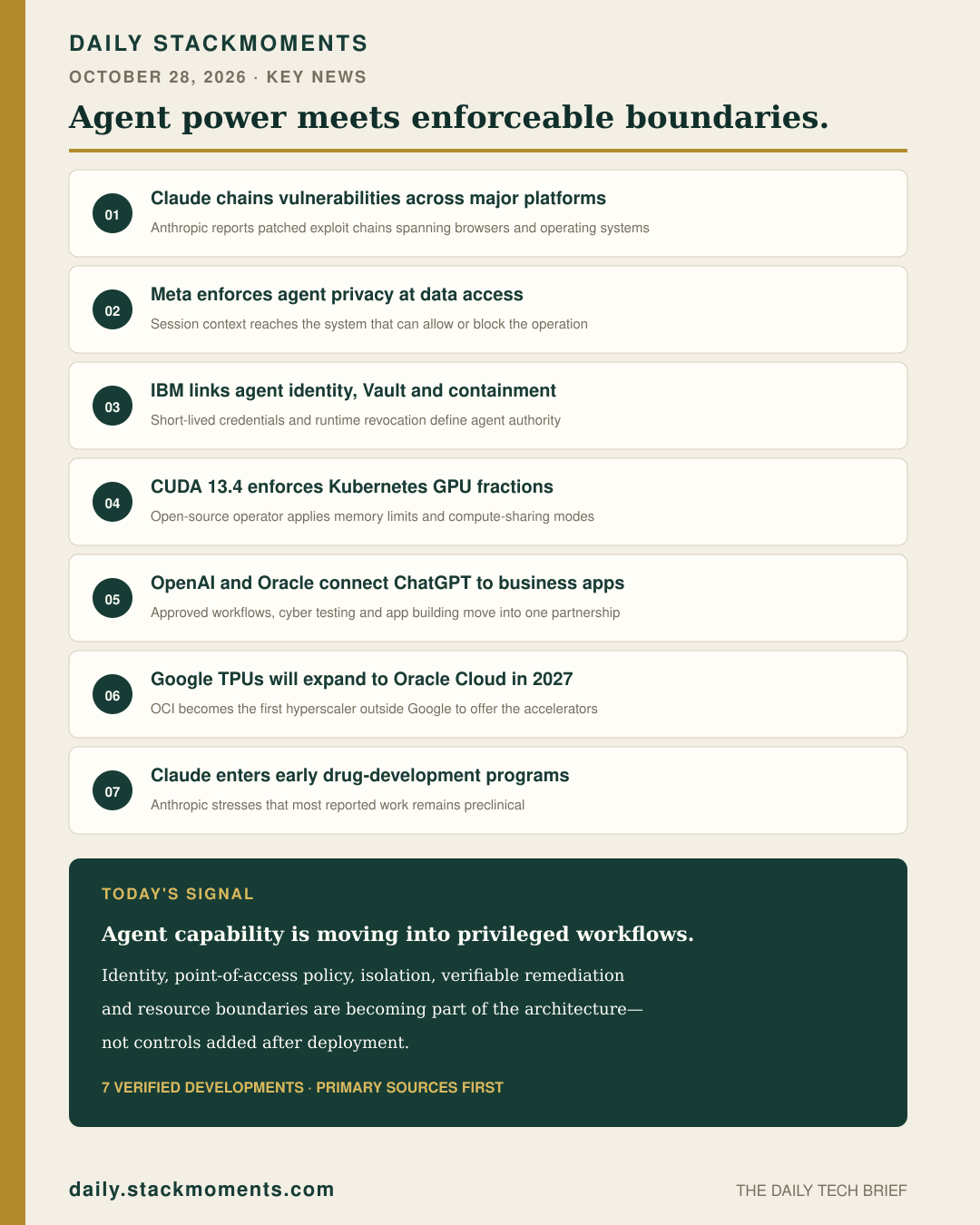
Shareable visual

Poster of the Day

Today's seven verified developments and technology signal, ready to share.

Daily StackMoments 1080 by 1350 poster summarizing seven key technology developments for October 28, 2026Download poster ↓