Daily brief · October 29, 2026

The harness becomes the control plane.

Managed multi-model routing, guarded agent workflows, repository-scale AI scanning, reproducible CI dependencies, Android agent tooling, two urgent runtime fixes and early 6G semantics define the Thursday signal.

29 minute read8 developmentsPrimary sources first
01
AI Coding6 min read

Microsoft and GitHub turn the agent harness into a managed control plane

Microsoft introduced the Copilot harness in Foundry Agent Service as a public preview, providing a managed agent loop, sandbox, reusable skills, tools and source-controlled definitions. GitHub separately made Copilot Fusion generally available with single-model, cascade and critique paths that route among models allowed by enterprise policy. Performance and cost comparisons in the announcements are vendor-reported.

Why it mattersModel selection is becoming one policy within a larger execution system. Platform teams should evaluate the harness separately from the model, pin tool and model policy, measure every routing path, capture model and tool provenance, and make long-running side effects idempotent before relying on automatic recovery.
Read the agent-harness architecture guide

Source: Microsoft Foundry and GitHub ↗ · Published October 28, 2026

#agent harness#Copilot Fusion#Microsoft Foundry#model routing
02
Software Engineering5 min read

GitHub Agentic Workflows reach general availability

GitHub made its open-source Agentic Workflows project generally available. Natural-language Markdown compiles to standard Actions YAML, reusing runner groups and policy constraints, with Copilot or a bring-your-own coding agent. The release adds model routing, budget forecasting, ARC and Docker-in-Docker support, plus micro-VM and enclave isolation; GitHub's productivity figures remain customer and company claims.

Why it mattersReasoning-based automation now sits inside the same CI control plane as deterministic jobs. Teams should review generated YAML, keep tokens and permissions read-only by default, isolate untrusted repository content, cap spend and runtime, and require human approval before workflows merge code, publish packages or touch production.

Source: GitHub Changelog ↗ · Published October 28, 2026

#GitHub Actions#agentic workflows#CI/CD#sandboxing
03
Security4 min read

GitHub expands AI Scan from pull requests to whole repositories

GitHub launched AI Scan for repositories in public preview. An agentic scanner explores the latest default-branch commit within a fixed time budget, skips findings already reported by CodeQL and places new alerts in the existing code-scanning backlog. Scans use Code Security AI credits, and fixed alerts require a new scan before they close.

Why it mattersRepository-scale analysis can cover legacy code and languages outside rule-based scanners, but it is neither continuous nor complete. Security teams should pair it with CodeQL and dependency controls, budget scans by risk, validate findings, rescan after remediation and track false negatives through independent testing.

Source: GitHub Changelog ↗ · Published October 28, 2026

#AI Scan#code scanning#application security#GitHub
04
Software Engineering4 min read

GitHub Actions workflow dependency lockfiles reach GA

GitHub made workflow dependency lockfiles generally available. The gh-actions-lock extension records exact commits for actions, transitive dependencies and reusable workflows in .github/workflows/actions.lock while workflow files keep readable references. Policies can require lockfiles, Dependabot can update them, and CI can detect stale state.

Why it mattersReadable tags no longer need to mean mutable execution. Repositories should generate and review the lockfile, require it for sensitive workflows, validate updates in the same pull request and retain artifact attestations; pinning improves reproducibility but does not establish that the pinned dependency is safe.

Source: GitHub Changelog ↗ · Published October 28, 2026

#GitHub Actions#lockfiles#software supply chain#Dependabot
05
AI Coding5 min read

Android Studio Rabbit 2 opens the IDE to more than 40 coding agents

Google released Android Studio Rabbit 2 to the stable channel with Bring Your Own Agent support. More than 40 ACP-compatible agents—including Claude Agent, Codex, Junie and Antigravity—can use IDE context and tools such as the emulator, build system, Logcat and Android skills. Rabbit 2 also adds agent-assisted LeakCanary fixes and an Android-skills manager.

Why it mattersAgent choice is moving from a separate terminal into a tool-rich IDE boundary. Mobile teams should standardize allowed agents and authentication, scope shell and device access, review skill packages, protect signing material and production telemetry, and compare agents on reproducible Android tasks rather than generic benchmarks.

Source: Android Developers ↗ · Published October 28, 2026

#Android Studio#ACP#coding agents#developer tools
06
Security4 min read

Strands Agents Tools flaw let prompts disable environment-secret masking

AWS disclosed CVE-2026-115415 in strands-agents-tools versions 0.1.0 through 0.8.5. Because the environment tool exposed its masking switch to the model, crafted content could induce a call that returned environment variables—including credentials and API keys—in cleartext without operator consent. Version 0.8.6 removes model control and deprecates the tool.

Why it mattersA security parameter controlled through an LLM schema is attacker-influenced input. Upgrade to 0.8.6 or remove the tool, rotate credentials present in affected agent environments, avoid long-lived secrets in process variables, restrict egress and keep secret-handling policy outside the model's authority.

Source: AWS Security Bulletin ↗ · Published October 28, 2026

#CVE-2026-115415#Strands Agents#prompt injection#secrets
07
Security5 min read

Native Brotli decoder flaw forces runtime and container rebuilds

AWS published service-specific guidance for CVE-2026-111497, a native Brotli buffer overflow that can permit code execution or memory disclosure when an application decodes crafted input. The issue extends beyond Node.js. Managed-service and runtime rollouts differ; customer-managed environments need patched Node.js releases or fixed Brotli libraries, plus image rebuilds and redeployment.

Why it mattersUpdating a manifest is insufficient when a vulnerable native library is already baked into a runtime, layer or container. Inventory every Brotli decoder, rebuild from patched bases, redeploy pinned images, verify runtime versions and migrate off Node.js 18 and 20, which no longer receive these security updates.

Source: AWS Security Bulletin ↗ · Published October 28, 2026

#CVE-2026-111497#Brotli#Node.js#container security
08
Cloud & Infrastructure4 min read

ETSI starts a pre-standardization group for semantic communications in 6G

ETSI established ISG SEM to coordinate semantic communications work for AI-native networks. The group will define use cases, metrics, evaluation methods, architectures and interfaces for transmitting task-relevant meaning rather than every original bit, including privacy, security and AI/ML integration. Its output is intended to inform future 3GPP and IMT-2030 work, not serve as a finished standard.

Why it mattersMeaning-aware networking could change bandwidth, latency and compute trade-offs at the edge, but interoperability and measurable semantic fidelity are unresolved. Network architects should follow the metrics and reference interfaces, keep conventional fallbacks and treat current implementations as experiments until standards and cross-vendor trials mature.

Source: ETSI ↗ · Published October 28, 2026

#6G#semantic communications#ETSI#AI-native networks

Shareable visual

Poster of the Day

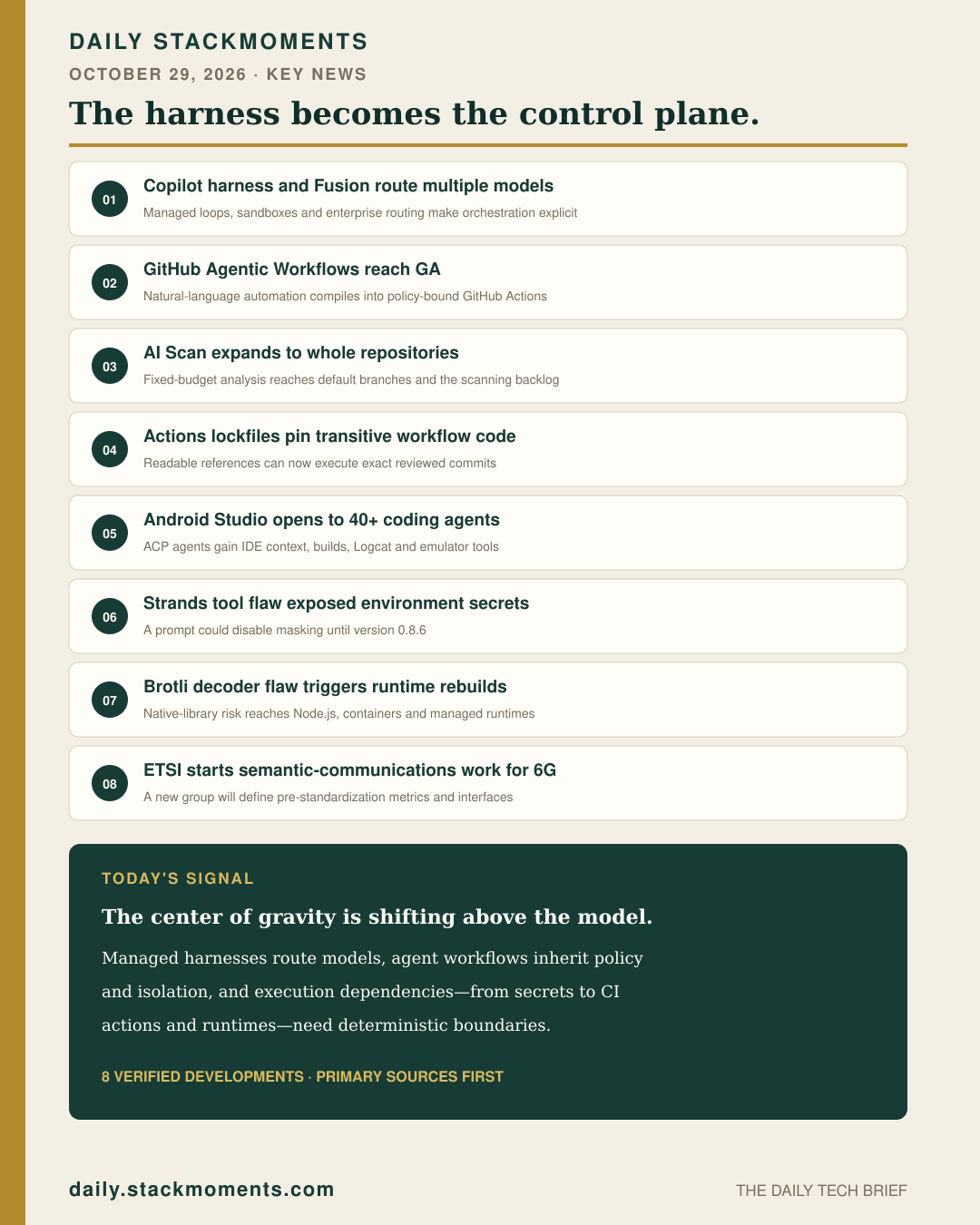
All eight verified developments and today's technology signal, ready to share.

Daily StackMoments 1080 by 1350 poster summarizing eight key technology developments for October 29, 2026Download poster ↓