Daily brief · October 30, 2026

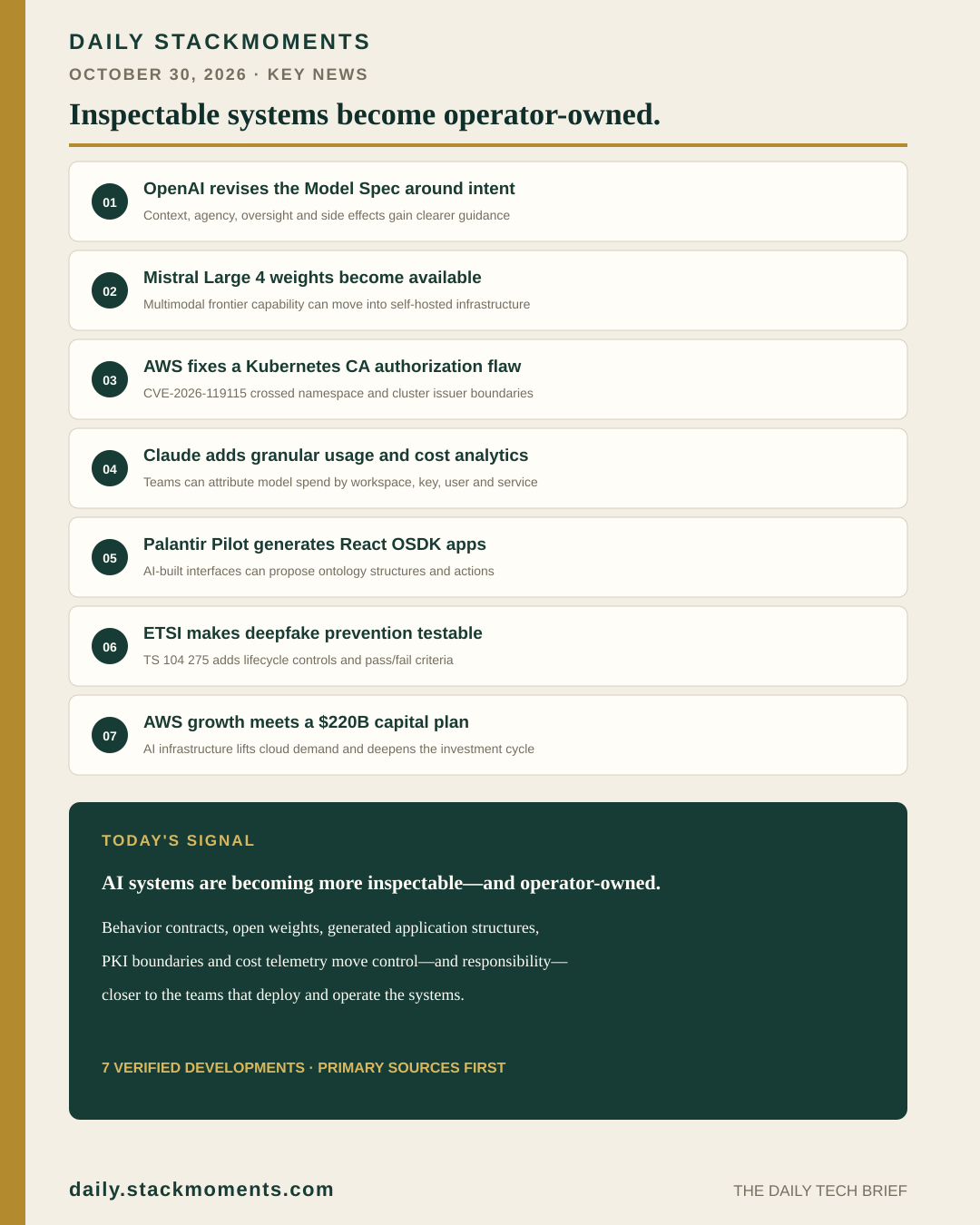
Inspectable systems become operator-owned.

A revised model-behavior contract, open frontier weights, a Kubernetes PKI fix, granular AI cost telemetry, generated enterprise apps, deepfake controls and AI infrastructure economics define the Friday signal.

31 minute read7 developmentsPrimary sources first
01
AI & Models5 min read

OpenAI reorganizes its Model Spec around intent, agency and care

OpenAI updated its public Model Spec around five values: faithfulness to human intent, harm minimization, honesty and transparency, human agency, and care. The revision adds guidance on context, memory, oversight and side effects, adjusts behavioral defaults and retires most detailed style guidance. OpenAI says the document describes target behavior and that current models do not yet fully reflect it.

Why it mattersA behavior specification is an input to product assurance, not proof of runtime behavior. Teams using GPT should map developer instructions and approval boundaries to the revised chain of command, rerun behavioral evaluations, expose memory assumptions, and test consequential side effects rather than infer compliance from the document alone.

Source: OpenAI ↗ · Published October 29, 2026

#Model Spec#AI governance#human agency#evaluation
02
AI & Models5 min read

Mistral releases Large 4 weights for self-hosted deployment

Mistral Large 4 weights became publicly available in official FP8 and NVFP4 variants. The multimodal mixture-of-experts model has roughly one trillion total parameters, about 50 billion active parameters and a one-million-token context window. It uses the Mistral Ecosystem Open-Weight License, whose terms limit some model-as-a-service uses; capability claims remain vendor-reported.

Why it mattersOpen weights increase deployment and sovereignty options while transferring control obligations to the operator. Teams should verify license fit, isolate inference, secure weight distribution, test cyber-capability controls, benchmark representative workloads and budget the memory, networking and observability needed for production serving.

Source: Hugging Face and Mistral ↗ · Published October 29, 2026

#Mistral Large 4#open weights#self-hosting#model licensing
03
Security5 min read

AWS fixes cross-scope certificate issuance in its Kubernetes CA connector

AWS disclosed CVE-2026-119115 in Private CA Connector for Kubernetes. Before version 1.10.1, a user authorized only for a namespace-scoped issuer could under certain conditions obtain certificates—including subordinate CA certificates—from an unauthorized cluster-scoped issuer. The fixed release strictly validates issuerRef.kind, which can also stop renewals for previously lenient configurations.

Why it mattersThis is both a privilege-boundary fix and a migration hazard. Platform teams should inventory CertificateRequest, Certificate and Ingress resources, correct issuer kinds before upgrading, test renewal paths, scope approval and RBAC rules by issuer name and kind, and investigate unexpected subordinate-CA issuance.

Source: AWS Security Bulletin ↗ · Published October 29, 2026

#CVE-2026-119115#Kubernetes#PKI#cert-manager
04
Cloud & Infrastructure4 min read

Anthropic launches a granular Usage and Cost Analytics API

Anthropic launched a beta Usage and Cost Analytics API for Claude Console and Claude Enterprise organizations. Its organization-level endpoints can filter and group token usage and cost by model, workspace, API key and the user or service account behind each request. Older usage, cost and enterprise analytics endpoints are now legacy but remain supported.

Why it mattersModel spending can now feed automated chargeback, anomaly detection and capacity planning without scraping dashboards. Platform teams should migrate integrations deliberately, restrict analytics credentials, minimize user-level exports, pin the beta header and reconcile internal allocation rules against billed totals.

Source: Anthropic Platform Docs ↗ · Published October 29, 2026

#Claude API#FinOps#usage analytics#cost allocation
05
AI Coding4 min read

Palantir Pilot reaches GA for generated React OSDK applications

Palantir made Pilot generally available as an AI-powered builder for React OSDK applications and custom Workshop widgets. Natural-language prompts can generate frontends, propose Ontology object types, relationships and actions, show a live preview and guide deployment. Palantir's release flow still requires continuous-integration checks to pass.

Why it mattersGenerated UI code now reaches the enterprise data model and action layer. Teams should review proposed ontology changes and permissions, keep production actions behind explicit approval, inspect generated code, use representative but non-sensitive preview data and enforce tests, ownership and rollback before release.

Source: Palantir Foundry ↗ · Published October 29, 2026

#Palantir Pilot#React#OSDK#enterprise applications
06
Security4 min read

ETSI publishes lifecycle controls for harmful-deepfake prevention

ETSI released TS 104 275, a Technical Specification for reducing harmful deepfake production across the generative-AI lifecycle. It combines pre-deployment risk assessment, human oversight, misuse safeguards, monitoring and evidence retention with test scenarios and pass/fail criteria. The specification builds on ETSI's baseline cybersecurity requirements for AI systems.

Why it mattersDeepfake controls are moving from post-hoc detection toward testable engineering requirements. Model providers should map threat scenarios to release gates, document filter and labeling behavior, retain evidence that controls work, monitor bypasses and define an incident loop that can update safeguards after deployment.

Source: ETSI ↗ · Published October 29, 2026

#ETSI TS 104 275#deepfakes#AI safety#standards
07
Cloud & Infrastructure4 min read

AWS growth accelerates as Amazon's AI investment drives cash outflow

Amazon reported third-quarter AWS sales of $46.0 billion, up 39% year over year, with AWS operating income of $17.8 billion. Companywide trailing-twelve-month free cash flow shifted to a $42.4 billion outflow, driven primarily by a $94.8 billion increase in property-and-equipment purchases that Amazon attributed mainly to AI investment. Its 2026 capital-expenditure estimate remains about $220 billion.

Why it mattersAI infrastructure demand is expanding while the capital burden becomes visible. Engineering leaders should treat capacity promises and price incentives as part of a long investment cycle, model reservation and egress commitments carefully, and benchmark whether managed AI services improve unit economics enough to justify tighter platform dependence.

Source: Amazon Investor Relations ↗ · Published October 29, 2026

#AWS#AI infrastructure#capital expenditure#cloud economics

Shareable visual

Poster of the Day

All seven verified developments and today's technology signal, ready to share.

Daily StackMoments 1080 by 1350 poster summarizing seven key technology developments for October 30, 2026Download poster ↓