Daily brief · October 31, 2026

Policy becomes machine-readable; trust remains operational.

A shared AI-training preference signal, two enclave flaws, exposed Kinesis credentials, a FreeRTOS privilege-boundary fix and an exploited VPN chain define the weekend signal.

25 minute read5 developmentsPrimary sources first
01
AI & Models6 min read

OpenAI and Google back a shared robots.txt signal for AI training

OpenAI and Google announced plans to honor a shared robots.txt policy token for generative-AI training preferences. The October 30 Internet-Draft proposes User-Agent: __usage_ai-training with ordinary Allow and Disallow path rules, separate from crawler access. The draft is not an IETF standard: OpenAI plans implementation in coming months, while Google targets 2027 and will retain Google-Extended controls.

Why it mattersPublishers may gain one cross-provider control instead of maintaining a crawler list, but support is prospective and the signal expresses preference rather than enforcing access. Website teams should keep provider-specific rules, version and test path policy, separate crawling from training permissions, and wait for documented provider behavior before treating the draft token as operationally complete.
Read the AI-training preference implementation guide

Source: OpenAI, Google and IETF Internet-Draft ↗ · Published October 30, 2026

#robots.txt#AI training#IETF AIPREF#publisher controls
02
Security5 min read

AWS fixes enclave code execution and forged KMS-response paths

AWS disclosed two flaws in the Nitro Enclaves SDK for C through version 0.4.5. CVE-2026-119116 lets a crafted parent-instance vsock message corrupt memory and execute code inside enclave images containing kmstool-enclave. CVE-2026-119148 lets a crafted region value redirect the SDK toward an impersonated KMS endpoint and inject forged responses. Version 0.4.6 fixes both; AWS lists no workaround.

Why it mattersAn enclave is only as trustworthy as its host-facing parser and attested service path. Teams must upgrade the SDK, rebuild and redeploy enclave images, inventory forks derived from kmstool-enclave, validate region inputs before trust decisions, and re-run attestation and key-release tests against the rebuilt artifact.

Source: AWS Security Bulletin ↗ · Published October 30, 2026

#CVE-2026-119116#CVE-2026-119148#Nitro Enclaves#KMS
03
Security5 min read

Kinesis Producer Library exposed credentials in logs and process arguments

AWS disclosed CVE-2026-119117 in the Java Kinesis Producer Library. Affected releases can write resolved AWS credentials to DEBUG logs and pass them to a native child process as command-line arguments visible to local users. Version 1.0.8 removes both paths. AWS says secret scanners may miss the logged values because they are hex-encoded.

Why it mattersCredential response must cover historical evidence, not only the dependency upgrade. Teams should move to 1.0.8, rotate long-lived keys, revoke relevant role sessions, remove or redact affected logs, restrict local process visibility and prefer short-lived, stream-scoped IAM roles.

Source: AWS Security Bulletin ↗ · Published October 30, 2026

#CVE-2026-119117#Amazon Kinesis#AWS credentials#logging
04
Security4 min read

FreeRTOS queue-set flaw crosses the MPU privilege boundary

AWS disclosed CVE-2026-119086 in FreeRTOS-Kernel versions 7.4.0 through 11.3.2. On MPU-enabled builds with queue sets enabled, an unprivileged task can trigger an out-of-bounds write while the kernel runs in privileged context. Version 11.3.3 fixes the type-validation gap; builds without queue sets are not affected.

Why it mattersEmbedded patching requires a firmware lifecycle, not a package-only update. Device teams should confirm MPU and queue-set configuration, upgrade or backport the fix into forks, rebuild and reflash firmware, run privilege-boundary regression tests, and track field-device coverage rather than assuming source remediation reaches deployed hardware.

Source: AWS Security Bulletin ↗ · Published October 30, 2026

#CVE-2026-119086#FreeRTOS#firmware security#MPU
05
Security5 min read

CISA adds two more Ivanti Connect Secure chain components to KEV

CISA added CVE-2026-111357 and CVE-2026-118527 in Ivanti Connect Secure to its Known Exploited Vulnerabilities catalog on October 30. The flaws can participate in a chain with CVE-2026-104935. Ivanti's fixed releases include 25.1.1.3, 25.1.3.1 and 22.8R2.6; Canada's Cyber Centre also updated its advisory to call for the vendor updates.

Why it mattersInternet-edge access appliances need both remediation and compromise assessment. Operators should patch to a release covering the complete chain, run Ivanti's integrity checks, review authentication, configuration and packet-capture evidence, rotate exposed credentials, and rebuild an appliance if forensic findings undermine trust.

Source: CISA KEV and Canadian Centre for Cyber Security ↗ · Published October 30, 2026

#CVE-2026-111357#CVE-2026-118527#Ivanti Connect Secure#CISA KEV

Shareable visual

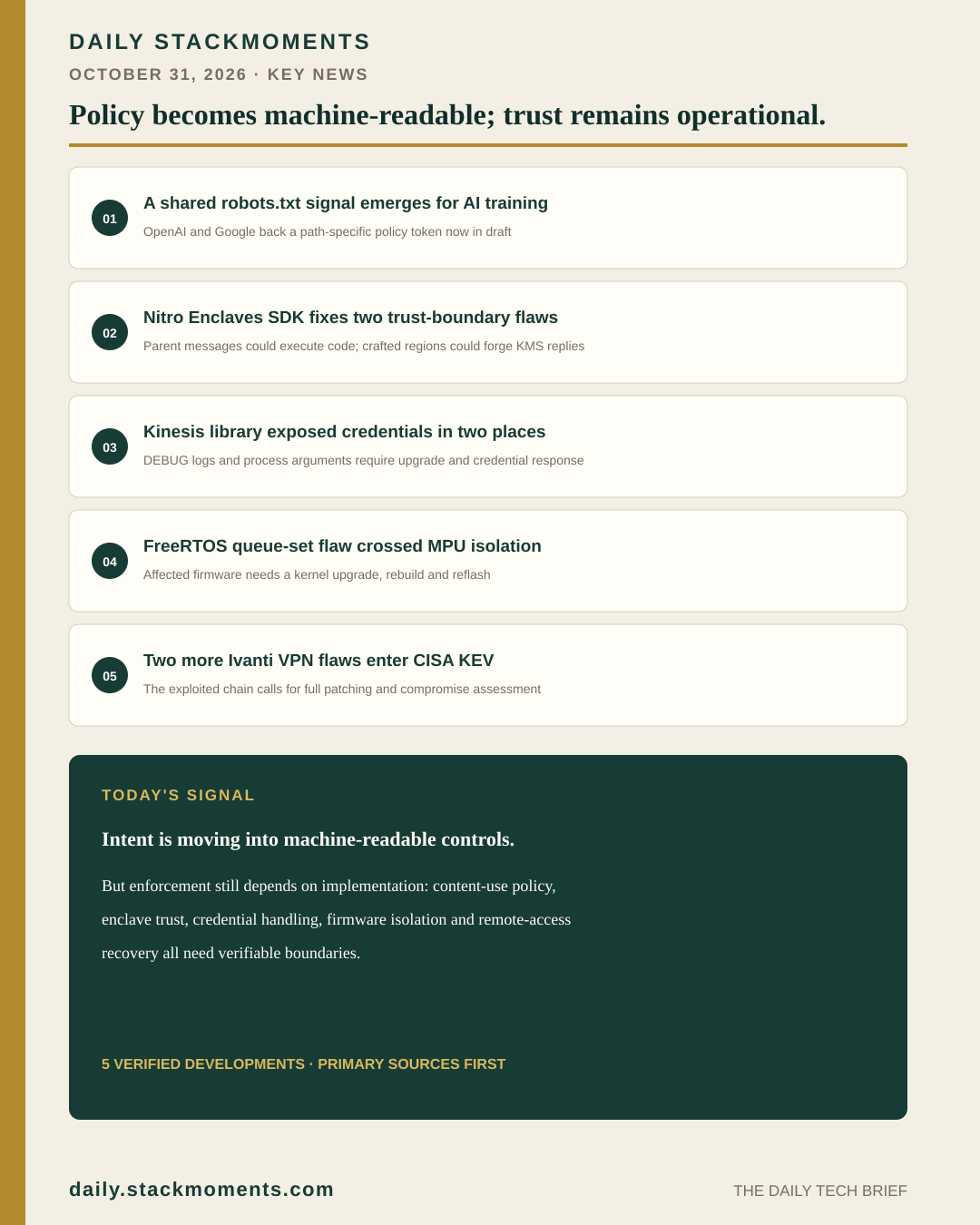
Poster of the Day

All five verified developments and today's technology signal, ready to share.

Daily StackMoments 1080 by 1350 poster summarizing five key technology developments for October 31, 2026Download poster ↓