Daily brief · September 12, 2026

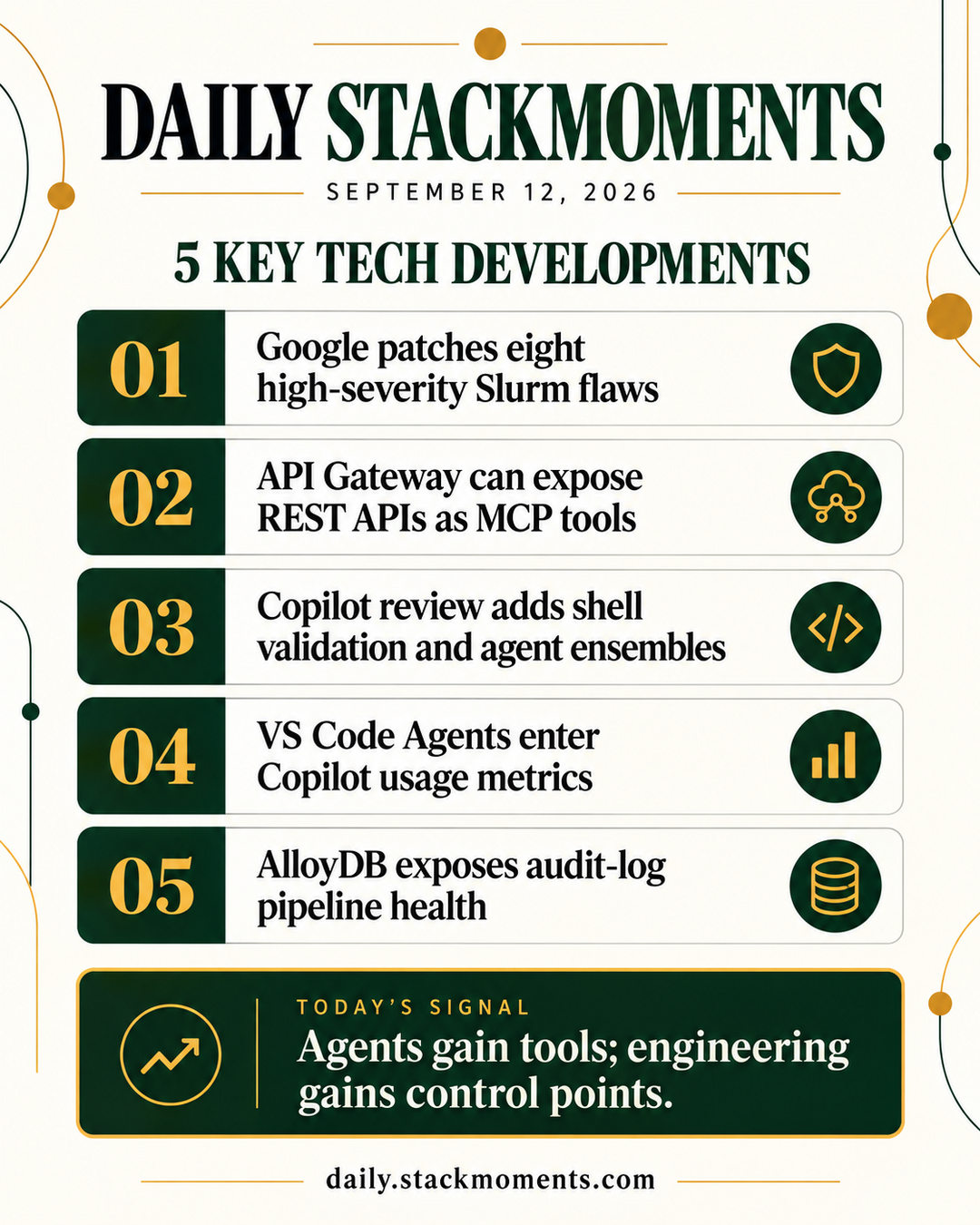
Agents gain tools; engineering gains control points.

Five verified developments connect HPC patching, agent-facing APIs, executable code review, adoption metrics and audit telemetry.

15 minute read5 developmentsPrimary sources
01
Security3 min read

Google requires Cluster Toolkit rebuilds for eight high-severity Slurm flaws

Google published GCP-2026-062 for eight high-severity Slurm vulnerabilities affecting Cluster Toolkit blueprints, including slurmstepd, RPC handling and the accounting database. The fix is Cluster Toolkit v1.103.0 or later with Slurm 25.11.8; existing deployments must recreate VMs or clusters because redeploying onto running nodes does not update them.

Why it mattersThis is not a routine in-place patch. HPC operators must update the blueprint and replace running compute, while planning workload drainage and checking for version mismatches across controllers, nodes and accounting services.

Source: Google Cloud security bulletin ↗ · Published September 11, 2026

#Slurm#Cluster Toolkit#HPC#CVE
02
AI & Models3 min read

Google API Gateway can expose existing REST APIs as MCP tools

Google Cloud added a public preview that lets API Gateway act as a remote MCP server. Teams can annotate an OpenAPI 3.x specification with Google extensions to expose existing REST operations to AI agents without changing the backend service.

Why it mattersMCP enablement is moving into the API-management layer, where authentication, quotas and policy already live. That can reduce custom adapter work, but every exposed operation should be reviewed as an agent capability with explicit scopes, input constraints and approval requirements.

Source: Google Cloud release notes ↗ · Published September 11, 2026

#API Gateway#MCP#AI agents#OpenAPI
03
AI Coding3 min read

Copilot code review adds shell validation and agent ensembles

GitHub expanded Copilot code review with build, test and targeted-script execution behind its agent firewall. Lite reviews now combine findings from an ensemble of agents, while addressed comments can auto-resolve and applied suggestions receive context-aware commit messages.

Why it mattersAI review is shifting from static inspection toward executable validation and multiple independent passes. Teams should still treat generated findings as review input, monitor false positives and make sure repository scripts cannot turn a review run into an unsafe execution path.

Source: GitHub Changelog ↗ · Published September 11, 2026

#GitHub Copilot#code review#multi-agent#software testing
04
AI Coding3 min read

GitHub adds VS Code Agents to Copilot usage metrics

GitHub's generally available Copilot metrics now report daily active users, session counts and user messages for the dedicated VS Code Agents window at enterprise, organization and user levels. These fields remain separate from editor Agent Mode and require the Copilot metrics policy.

Why it mattersEngineering leaders can distinguish agent adoption from conventional completion usage and compare engagement across teams. The metrics measure activity rather than productivity or quality, so they should be paired with delivery, review and reliability outcomes.

Source: GitHub Changelog ↗ · Published September 11, 2026

#VS Code Agents#Copilot metrics#developer productivity#enterprise governance
05
Cloud & Infrastructure3 min read

AlloyDB exposes audit-log pipeline health in Cloud Monitoring

AlloyDB for PostgreSQL now publishes monitoring for the status, throughput and backlog of its audit-logging pipeline across instances and nodes.

Why it mattersAn enabled audit policy is not proof that records are arriving on time. Pipeline health and backlog visibility let security and platform teams alert on telemetry loss before an investigation reveals a silent audit gap.

Source: Google Cloud release notes ↗ · Published September 11, 2026

#AlloyDB#PostgreSQL#audit logging#Cloud Monitoring

Shareable visual

Poster of the Day

All five key developments from today's verified edition, ready to share.

Daily StackMoments poster summarizing five key technology developments for September 12, 2026Download poster ↓