Daily brief · September 16, 2026

Agent infrastructure becomes a platform of its own.

Five verified developments connect isolated execution, persistent workspaces, enforceable security policy and graph-scale operational intelligence.

15 minute read5 developmentsPrimary sources
01
Cloud & Infrastructure4 min read

Google brings high-density Agent Substrate to GKE

Google announced Agent Substrate on GKE, an open-source execution runtime for large fleets of long-lived agents. It offers Cloud Hypervisor microVM or gVisor isolation, controlled network egress, credential injection outside the agent environment, suspend-and-resume scheduling and active-only compute allocation.

Why it mattersGeneral-purpose containers are a poor fit for thousands of mostly idle agents that execute untrusted code. A dedicated runtime can reduce idle cost while making kernel isolation, network policy and credential boundaries part of the platform rather than each agent harness.

Source: Google Cloud ↗ · Published September 15, 2026

#Agent Substrate#GKE#agent sandbox#microVM
02
Cloud & Infrastructure3 min read

Filestore adds elastic persistent workspaces for agent fleets

Google introduced Filestore agent volumes for dynamically provisioning isolated, persistent file workspaces to GKE agent sandboxes. Volumes attach in milliseconds, scale with session demand and support POSIX file locking plus ReadWriteMany access for multi-agent collaboration.

Why it mattersStateful agents need workspaces that survive suspension without pre-allocating a disk for every idle session. Automated volume lifecycles can remove custom state-shuttling code while preserving tenant isolation and resumable execution.

Source: Google Cloud ↗ · Published September 15, 2026

#Filestore#agent workspaces#persistent storage#GKE
03
Security2 min read

GitHub makes enterprise security configurations non-overridable

GitHub enterprise administrators can now enforce Advanced Security configurations against both organization and repository administrators. The policy offers separate enforcement levels so centrally defined settings cannot be weakened lower in the hierarchy.

Why it mattersSecurity controls lose value when delegated administrators can silently relax them. Enterprise-wide enforcement turns code-scanning and related configuration into a durable governance baseline across large repository fleets.

Source: GitHub Changelog ↗ · Published September 15, 2026

#GitHub Advanced Security#enterprise policy#code scanning#governance
04
Security2 min read

GitHub disables SHA-1 for HTTPS across its cloud services

GitHub completed its planned retirement of SHA-1 in HTTPS for github.com and partner CDNs, including Enterprise Cloud and Enterprise Cloud with Data Residency. GitHub Enterprise Server is not affected by this change.

Why it mattersLegacy operating systems, TLS proxies and embedded clients that still depend on SHA-1 can now fail when connecting to GitHub. Engineering teams should treat any breakage as a dependency-modernization signal rather than weakening transport security.

Source: GitHub Changelog ↗ · Published September 15, 2026

#SHA-1#HTTPS#GitHub#TLS compatibility
05
AI & Models3 min read

Google outlines distributed GraphFlow for autonomous networks

Google described a telecommunications architecture that combines distributed GraphFlow graph-neural-network training and inference with AI agents. The design targets large relational and temporal datasets for root-cause analysis, capacity planning, traffic forecasting, simulations and anomaly detection.

Why it mattersOperational agents cannot reason directly over billions of raw network measurements. Graph models can compress topology and time-dependent signals into structured evidence, giving higher-level agents a safer basis for explaining and proposing network actions.

Source: Google Cloud ↗ · Published September 15, 2026

#GraphFlow#GNN#telecommunications#autonomous networks

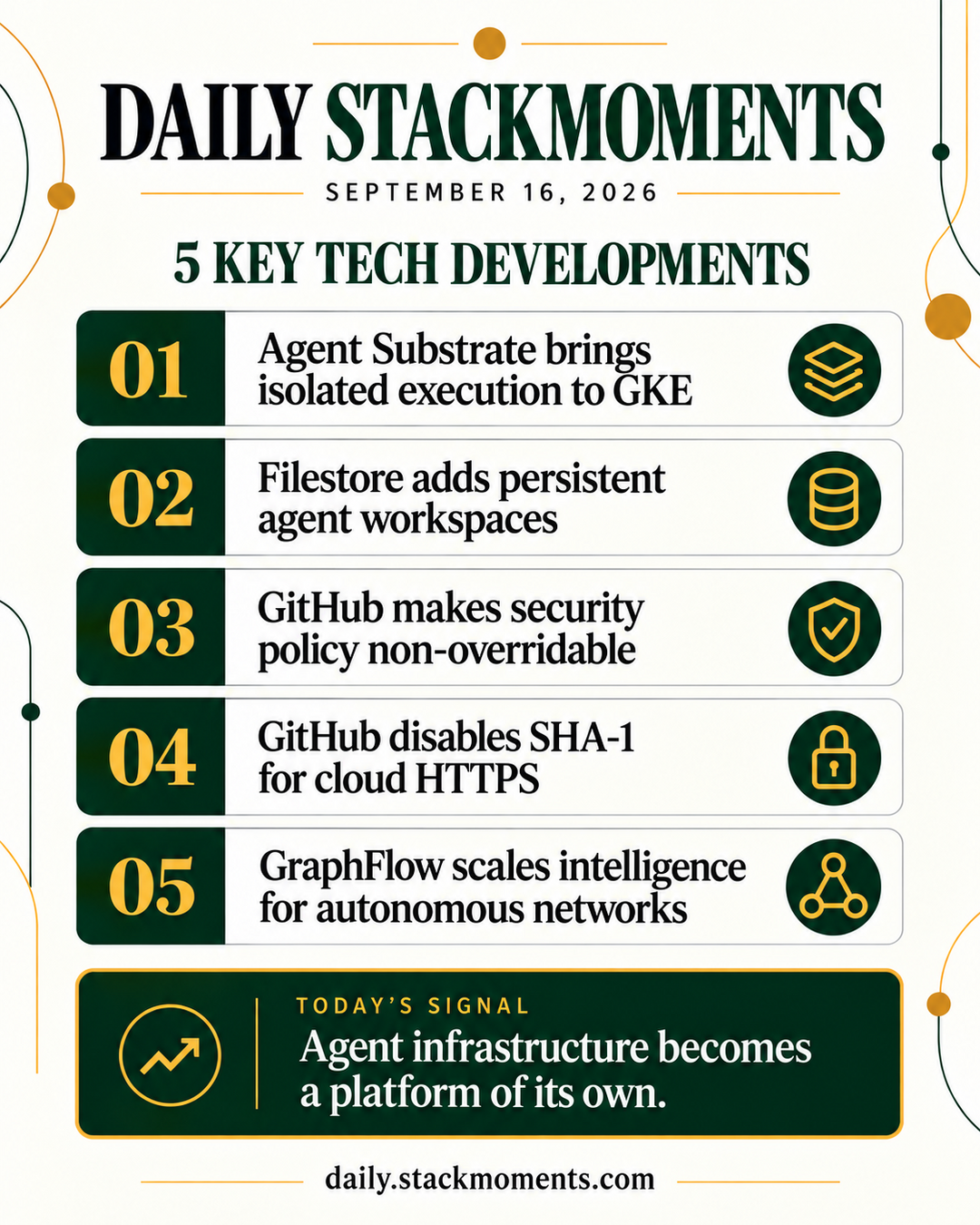
Shareable visual

Poster of the Day

All five key developments from today's verified edition, ready to share.

Daily StackMoments 1080 by 1350 poster summarizing five key technology developments for September 16, 2026Download poster ↓