Daily brief · September 20, 2026

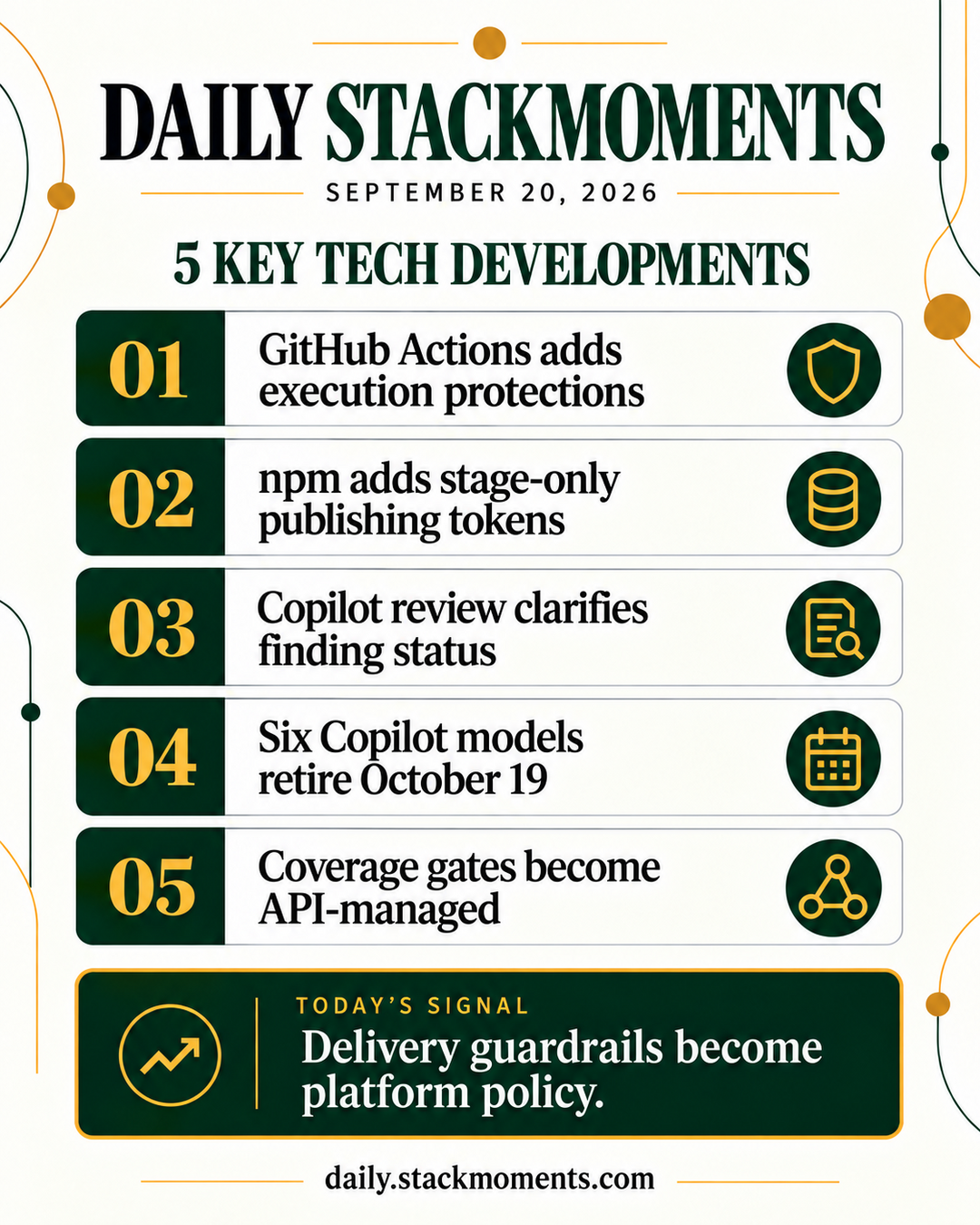
Delivery guardrails become platform policy.

Five verified developments tighten workflow execution, package publishing, AI review, model lifecycles and code-quality gates.

13 minute read5 developmentsPrimary sources
01
Security3 min read

GitHub Actions execution protections reach general availability

GitHub made workflow execution protections generally available with actor and event allowlists, per-workflow targeting, audit insights and REST management. Public repositories without an applicable policy will also receive a staged default restriction on pull_request_target, with enforcement planned for November 2.

Why it mattersWorkflows triggered from forks can expose secrets or poison privileged pipelines. Central, testable policies let platform teams restrict who and what can start sensitive automation without duplicating fragile checks inside every workflow.

Source: GitHub Changelog ↗ · Published September 17, 2026

#GitHub Actions#CI/CD security#pull_request_target#policy as code
02
Security3 min read

npm adds stage-only tokens for safer release automation

npm granular access tokens can now receive a Read and write (stage only) permission. Automation can submit a version with npm stage publish, but a maintainer must approve the release with two-factor authentication; direct npm publish attempts are rejected.

Why it mattersTeams that cannot yet adopt OIDC Trusted Publishing gain a narrower migration path than a token that can publish immediately. Staging inserts malware scanning and human approval between a compromised workflow and the public registry.

Source: GitHub Changelog ↗ · Published September 18, 2026

#npm#supply chain#staged publishing#2FA
03
AI Coding3 min read

Copilot code review makes findings and resolution state clearer

GitHub made a refreshed Copilot review experience generally available. The overview now separates open, resolved and previously missed findings, records resolution reasons, preserves review progress across commits and proposes commit messages for eligible suggestion batches.

Why it mattersAI review is more useful when developers can distinguish current risk from stale feedback and see how findings changed. Clear state and provenance reduce review noise, but teams should still validate suggestions as untrusted analysis.

Source: GitHub Changelog ↗ · Published September 18, 2026

#GitHub Copilot#code review#developer workflow#AI coding
04
AI Coding2 min read

GitHub sets an October 19 deadline for six Copilot models

GitHub will remove Gemini 3.7 Flash, GPT-5.5, GPT-5.4, GPT-5.4 mini, GPT-5 mini and Grok 4.5 from Copilot experiences on October 19, 2026, and listed newer suggested alternatives for each model family.

Why it mattersPinned model names are production dependencies. Teams should inventory policies, agents and evaluation baselines now, test the proposed replacements and avoid discovering behavioral or cost changes on retirement day.

Source: GitHub Changelog ↗ · Published September 18, 2026

#GitHub Copilot#model lifecycle#deprecation#migration
05
Software Engineering2 min read

GitHub exposes code-coverage gates through its REST API

GitHub's generally available REST API can now create, read and update the Restrict code coverage repository ruleset condition. Teams can enforce minimum line coverage or cap an allowable coverage drop across repositories through infrastructure-as-code workflows.

Why it mattersQuality gates become scalable only when they can be versioned and applied consistently. API management lets platform teams standardize coverage policy across repository fleets while still reviewing thresholds against each codebase's risk profile.

Source: GitHub Changelog ↗ · Published September 18, 2026

#code coverage#repository rulesets#REST API#platform engineering

Shareable visual

Poster of the Day

All five key developments from today's verified edition, ready to share.

Daily StackMoments 1080 by 1350 poster summarizing five key technology developments for September 20, 2026Download poster ↓