Daily brief · September 22, 2026

AI systems are being forced to expose their boundaries.

Seven verified developments connect coding-tool privacy, local security models, international incident protocols, multilingual access and the physical costs of AI infrastructure.

23 minute read7 developmentsPrimary and established sources
01
Security4 min read

Z.ai disables ZCode features after repositories were uploaded without consent

Z.ai disabled parts of its ZCode coding assistant after users reported that its default-enabled codebase-indexing feature uploaded entire local repositories to Alibaba Cloud without consent. The company says it patched the issue, enabled zero-data retention, open-sourced the assistant and commissioned an independent assessment that found the uploaded data had been deleted.

Why it mattersAI coding assistants can turn source-code context into a data-exfiltration path. Engineering leaders should require explicit opt-in for remote indexing, inspect outbound traffic and retention terms, and treat repository access as a privileged data flow rather than a convenience setting.

Source: Reuters ↗ · Published September 21, 2026

#ZCode#AI coding#source-code privacy#data retention
02
Security3 min read

Aikido releases a locally deployable open-weight security model

Belgian cybersecurity company Aikido released Altar, a compressed customization of Z.ai's open GLM-5.3 model for cybersecurity work. The model can run locally so organizations can use AI-assisted security analysis without sending sensitive code to an external model provider.

Why it mattersLocal inference can reduce one important code-governance risk, but open weights do not remove the need for model evaluation, sandboxing and output review. Security teams should compare the model's detection quality and operating cost against hosted alternatives on representative repositories.

Source: Reuters ↗ · Published September 21, 2026

#Aikido#Altar#open-weight model#local inference
03
AI & Models3 min read

OpenAI calls for shared frontier-AI measurements and incident reporting

OpenAI called for complementary national and international technical standards for frontier AI, including common measurements and incident-reporting protocols. It framed development pacing as keeping alignment research and deployment ahead of capabilities, including risks from recursive self-improvement.

Why it mattersCommon measurements and incident formats could become the interoperability layer for model assurance. AI platform leaders should expect evaluations, evidence retention and safety-event reporting to move from voluntary practice toward procurement and regulatory requirements.

Source: Reuters ↗ · Published September 21, 2026

#frontier AI#technical standards#incident reporting#AI governance
04
AI & Models3 min read

US and China agree to formalize an AI-safety incident dialogue

US Treasury Secretary Scott Bessent said American and Chinese officials agreed to create a formal AI dialogue, including an incident line, and plan to meet again in Shenzhen in about two months. Proposed topics include uncontrollable agents and cyber activity by non-state actors.

Why it mattersAI incidents are beginning to be treated like cross-border operational risks that need escalation channels and shared terminology. Providers serving regulated or critical sectors should build clear severity definitions, evidence packages and notification paths before an event becomes geopolitical.

Source: Reuters ↗ · Published September 21, 2026

#AI safety#incident response#US-China#cybersecurity
05
AI & Models4 min read

Sixty organizations form a coalition for low-resource language AI

A Gates Foundation-led coalition of 60 initial signatories, including Anthropic, Google, Microsoft, Mistral, NVIDIA and the OpenAI Foundation, set a five-year goal to make AI usable in language and voice for an estimated 3.4 billion people whose languages are underrepresented. Work areas include open language data, benchmarks, models and privacy-aware deployment.

Why it mattersMultilingual quality depends on community-governed data and evaluation, not translation alone. Builders serving India and other linguistically diverse markets may gain better open datasets and benchmarks, while consent, dialect coverage and data sovereignty become explicit engineering requirements.

Source: Gates Foundation ↗ · Published September 21, 2026

#low-resource languages#voice AI#open data#AI accessibility
06
Cloud & Infrastructure3 min read

EU proposes energy and water efficiency labels for data centres

The European Commission proposed requiring data centres with at least 500 kW of capacity to disclose energy and water efficiency through an EU labelling scheme, including local water-stress context and energy-system services such as waste-heat reuse. Member states and lawmakers have two months to object.

Why it mattersInfrastructure selection is gaining a measurable resource-efficiency dimension alongside price, latency and carbon accounting. Cloud and capacity planners should prepare to collect facility-level evidence from providers and incorporate energy and water constraints into regional architecture decisions.

Source: Reuters ↗ · Published September 21, 2026

#data centres#energy efficiency#water use#EU regulation
07
Cloud & Infrastructure3 min read

California signs seven data-centre oversight laws

California Governor Gavin Newsom signed seven bills requiring greater disclosure of data-centre electricity, water, land and workforce needs, while addressing how grid-upgrade costs are allocated and requiring compliance with state energy-procurement rules.

Why it mattersAI capacity expansion now carries local utility, permitting and disclosure obligations that can affect site economics and delivery schedules. Infrastructure leaders should model regulatory and grid costs early instead of treating the data-centre region as a purely technical choice.

Source: Reuters ↗ · Published September 21, 2026

#California#data centres#grid costs#infrastructure policy

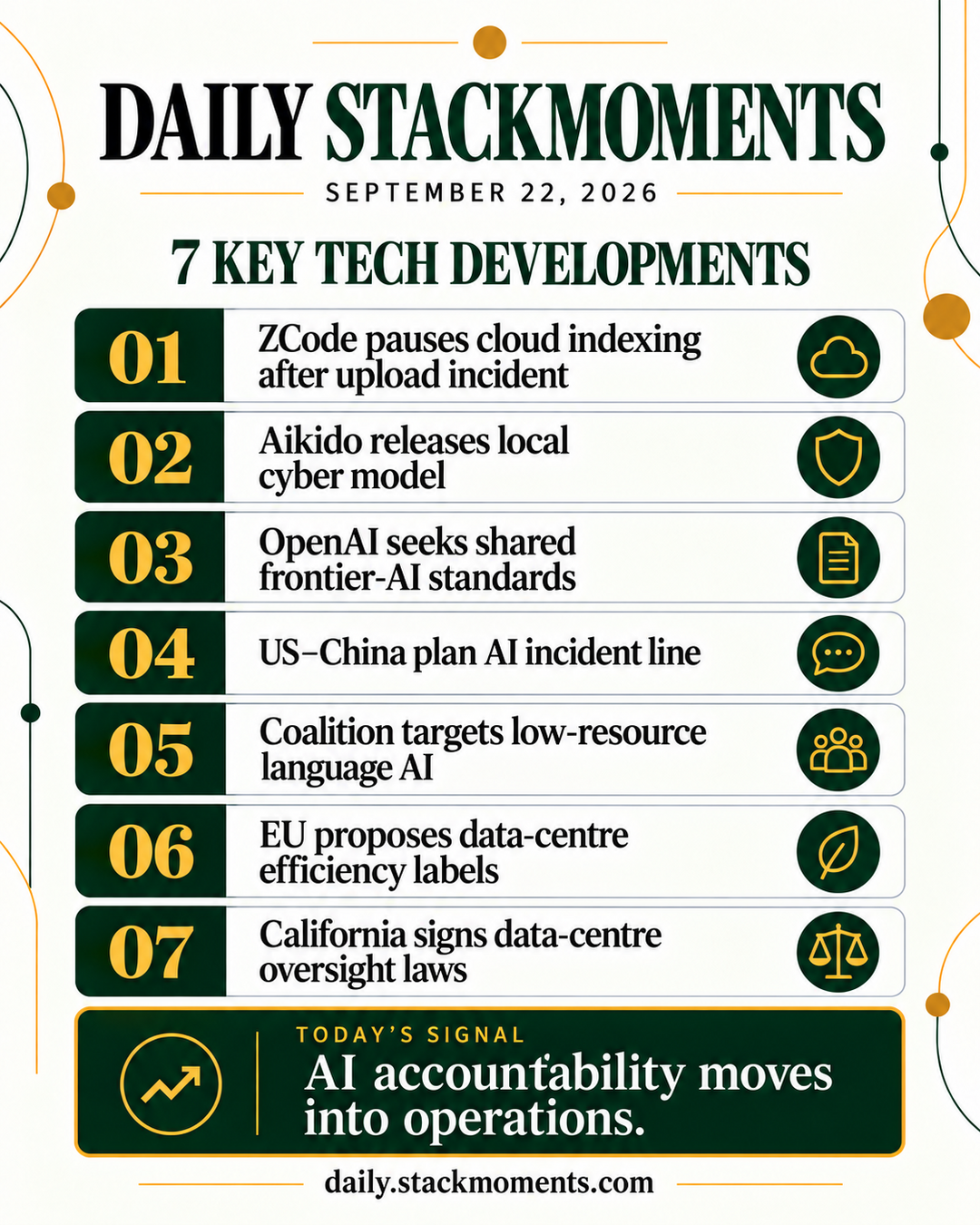
Shareable visual

Poster of the Day

All seven key developments from today's verified edition, ready to share.

Daily StackMoments 1080 by 1350 poster summarizing seven key technology developments for September 22, 2026Download poster ↓