Daily brief · September 26, 2026

AI tools learn—and governance catches up.

Six verified developments connect agent markets, step-up authentication, repository memory, policy validation, delivery metrics and static analysis.

18 minute read6 developmentsOfficial sources
01
AI & Models4 min read

Anthropic tests how agents negotiate in a miniature market

Anthropic's Project Swap sent Claude-powered agents into a book-trading market after brief conversations with their human participants. Agent rankings matched participants on 61% of book pairs; repeated simulations found model capability affected negotiation outcomes more than instruction changes, while missing preference information remained the largest constraint.

Why it mattersTransaction agents need faithful preference capture as much as negotiating skill. Teams building procurement or commerce agents should treat preference elicitation, spending limits, explainability and reversible commitments as core system requirements.

Source: Anthropic ↗ · Published September 24, 2026

#economic agents#agent negotiation#preference alignment#market design
02
Security3 min read

GitHub adds proof of presence for high-impact enterprise actions

GitHub introduced a public preview that lets Entra ID-backed Enterprise Managed User organizations require fresh re-authentication or an MFA challenge before actions such as creating tokens, editing webhooks, changing security settings or viewing recovery codes.

Why it mattersA valid session is not sufficient evidence for a sensitive change when cookies, tokens or agents can be hijacked. Step-up authentication inserts a human-verification boundary directly into privileged developer-platform operations.

Source: GitHub Changelog ↗ · Published September 24, 2026

#GitHub Enterprise#MFA#session security#Entra ID
03
Security3 min read

GitHub agentic autofix learns repository security patterns through Copilot Memory

For customers who enable Copilot Memory, agentic autofix can now read existing repository memories before resolving code-scanning alerts and store successful fix patterns for later use by autofix, code review and the Copilot coding agent. Both capabilities remain in public preview.

Why it mattersPersistent context can make remediation more consistent, but remembered fix patterns also become security-relevant state. Teams should review retention, repository scope, stale-pattern handling and human approval before relying on learned fixes.

Source: GitHub Changelog ↗ · Published September 25, 2026

#agentic autofix#Copilot Memory#code scanning#secure coding
04
AI Coding2 min read

GitHub validates enterprise Copilot policy files in product

GitHub added an in-product validator for enterprise-managed Copilot settings. It detects malformed JSON, unsupported configuration and invalid team mappings, and identifies the affected file and JSON path before administrators rely on unenforced policy.

Why it mattersPolicy-as-code fails silently when configuration is syntactically valid enough to commit but semantically unusable. Visible validation gives platform teams a direct check that AI controls are actually enforceable.

Source: GitHub Changelog ↗ · Published September 25, 2026

#GitHub Copilot#policy as code#enterprise governance#configuration validation
05
Software Engineering3 min read

Copilot metrics API exposes pull-request review-stage latency

GitHub's repository-level Copilot usage reports now provide median and 90th-percentile times from ready-for-review to first review, first to final review and final review to merge. The initial release measures human-reviewed pull requests and accumulates data only from the release date forward.

Why it mattersA single cycle-time number hides whether work waits for attention, iteration or merge. Stage-level latency lets engineering leaders target the actual constraint and judge AI review adoption without confusing bot activity with human review flow.

Source: GitHub Changelog ↗ · Published September 25, 2026

#Copilot metrics#pull requests#developer productivity#DORA
06
Security3 min read

CodeQL 2.27.1 expands language models and security queries

CodeQL 2.27.1 adds C/C++ and C# queries, Kotlin 2.4.20 support, expanded Go 1.27 and Rust data-flow models, better Fastify route attribution and more accurate handling of globally applied ASP.NET Core anti-forgery protection.

Why it mattersStatic-analysis coverage depends on accurate framework and language models. Teams using Kotlin 2.4.20, modern Go, Rust, Fastify or ASP.NET Core should expect changed findings and review new alerts or reduced false positives during rollout.

Source: GitHub Changelog ↗ · Published September 25, 2026

#CodeQL#SAST#Kotlin#data flow

Shareable visual

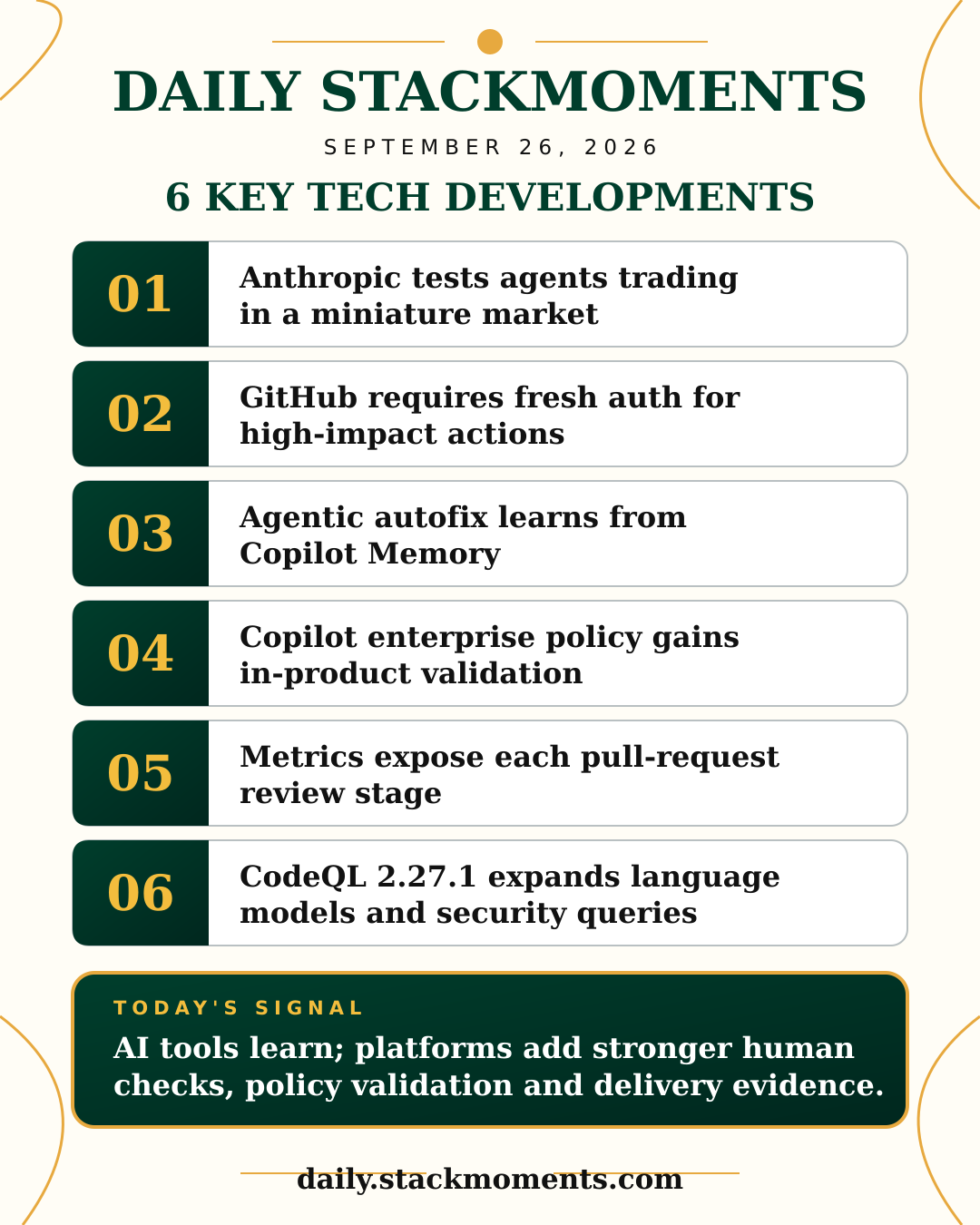
Poster of the Day

All six key developments from today's verified edition, ready to share.

Daily StackMoments 1080 by 1350 poster summarizing six key technology developments for September 26, 2026Download poster ↓