Daily brief · September 27, 2026

Science reaches nine loops as cloud infrastructure scales up.

Four verified developments connect AI-assisted scientific discovery, agent-ready credential controls, 48 TB virtual machines and denser Kubernetes nodes.

13 minute read4 developmentsOfficial sources
01
AI & Models4 min read

Claude computes a previously unknown nine-loop physics amplitude

Anthropic reported that Claude computed the nine-loop MHV six-particle amplitude in planar N=4 super Yang–Mills theory. Independent physicist Lance Dixon validated the result using known structural constraints, and Anthropic published the expression and supporting material for scrutiny.

Why it mattersThe result shows an AI system contributing to expert-level mathematical physics beyond summarizing existing literature. Research teams should treat it as evidence for tighter model–expert workflows, with independent validation and reproducible artifacts remaining essential.

Source: Anthropic ↗ · Published September 25, 2026

#Claude#scientific computing#mathematical physics#AI research
02
AI Coding3 min read

Google Cloud previews an MCP server for API-key administration

Google Cloud made the API Keys remote Model Context Protocol server available in preview. AI applications can use it to create, inspect, restrict and manage API-key lifecycles within Google Cloud projects.

Why it mattersAgent access is moving from application APIs into security-sensitive control planes. Platform teams should combine narrow identity scopes, approval gates, audit logs and key restrictions before allowing an agent to change credentials.

Source: Google Cloud release notes ↗ · Published September 25, 2026

#MCP#API keys#agent tooling#credential governance
03
Cloud & Infrastructure3 min read

Compute Engine X5 raises single-VM memory to 48 TB

Google Cloud made its X5 memory-optimized machine series generally available with configurations up to 48 TB of memory—50% above the 32 TB ceiling of X4. Google positions the series for the largest SAP HANA and RISE with SAP deployments.

Why it mattersA larger scale-up ceiling can keep very large in-memory databases on one node, reducing partitioning complexity. Architects still need to compare resilience, licensing, recovery time and scale-out alternatives before concentrating a critical workload in one instance.

Source: Google Compute Engine release notes ↗ · Published September 25, 2026

#Compute Engine#X5#SAP HANA#memory optimized
04
Cloud & Infrastructure3 min read

GKE Standard doubles the pod ceiling per node

Google Kubernetes Engine Standard clusters now support as many as 512 Pods per node, up from 256. Nodes configured above 256 Pods receive a /22 Pod CIDR block with 1,024 IP addresses.

Why it mattersHigher pod density can improve utilization for small workloads, but it also enlarges failure domains and raises networking, kubelet and noisy-neighbor pressure. Teams should load-test density changes and revisit disruption budgets, IP planning and node recovery assumptions.

Source: Google Kubernetes Engine release notes ↗ · Published September 25, 2026

#GKE#Kubernetes#pod density#cluster networking

Shareable visual

Poster of the Day

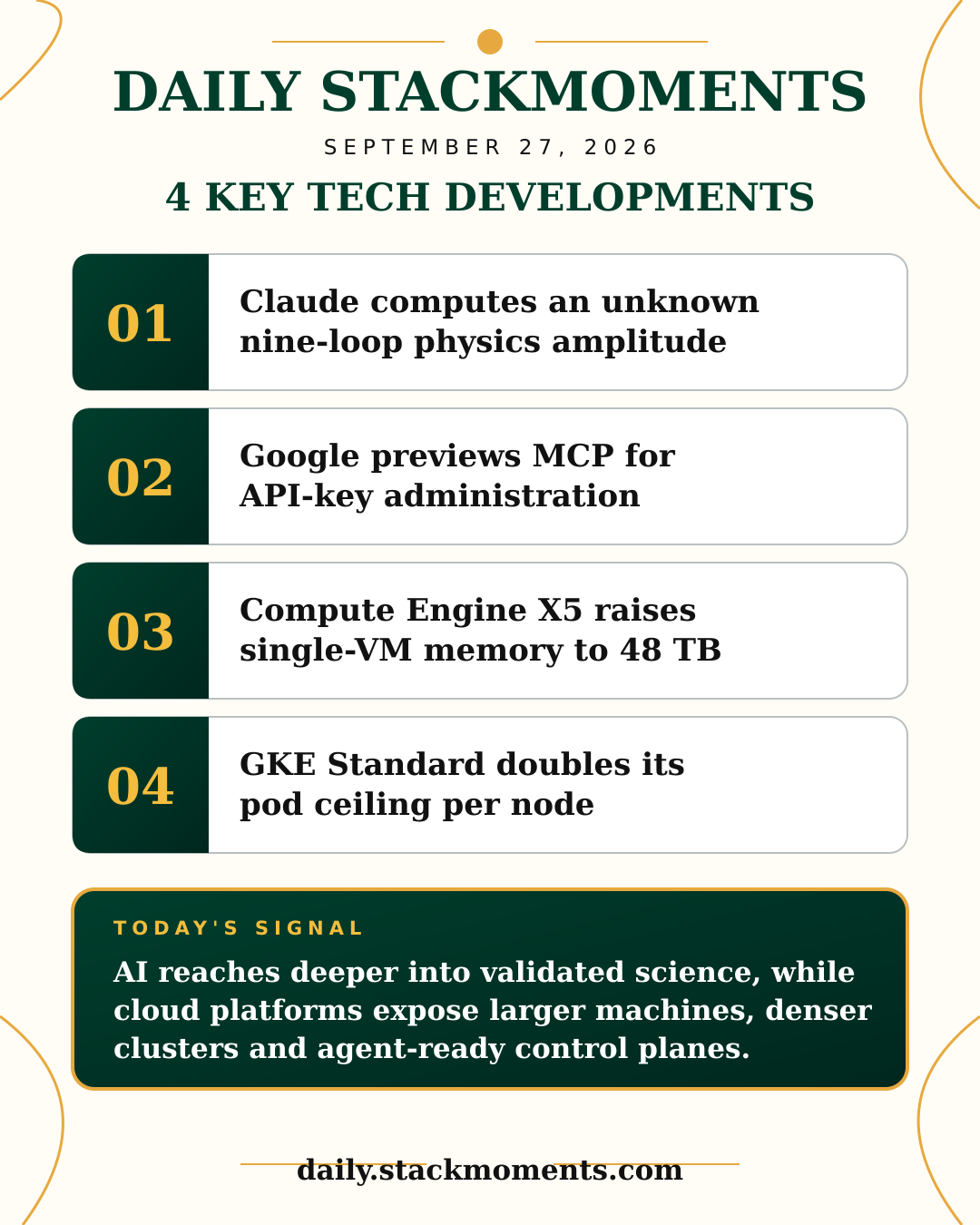
All four key developments from today's verified edition, ready to share.

Daily StackMoments 1080 by 1350 poster summarizing four key technology developments for September 27, 2026Download poster ↓